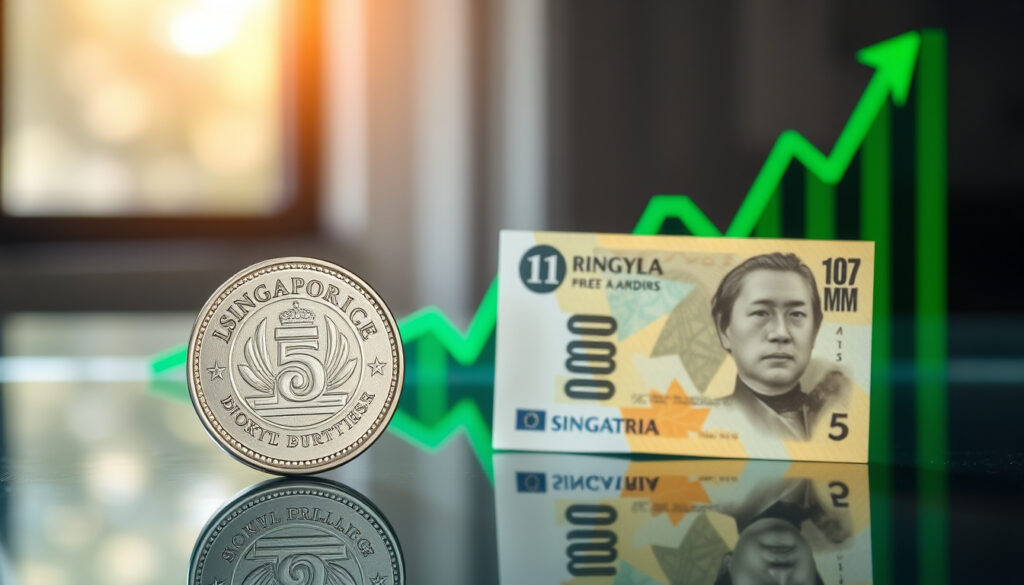
SGD to MYR Rate Today: Live Rate & Why Ringgit Is Strengthening
If you’re a Malaysian working in Singapore or planning a trip across the Causeway, the SGD to MYR rate is probably on your mind more than usual these days as the ringgit flexes its muscles against the Singapore dollar, hitting levels not seen since 2021. This article covers the current exchange rate, why the ringgit is strengthening, and what it means for cross-border workers and travelers.
Current SGD to MYR rate (mid-market): 1 SGD = 3.2035 MYR (as of 17:42 UTC, XE) ·
Recent high (2026): 1 SGD = 3.1775 MYR (CIMB, 19 Jun 2026) ·
All-time high SGD/MYR: 3.30+ MYR per SGD (historical peak) ·
Ringgit strength vs SGD since 2021: Strongest level since 2021 ·
Typical transfer rate (Wise): 1 SGD = 3.2046 MYR (mid-market)
Quick snapshot
- Mid-market rate: 1 SGD = 3.2035 MYR (XE)
- MYR at strongest vs SGD since 2021 (XE)
- Bank Negara Malaysia held OPR at 2.75% in March 2026 (Reuters)
- Stronger ringgit reduces take-home pay for cross-border workers (New Straits Times)
- Whether SGD will strengthen in 2026 (forecast uncertain)
- Exact cause of today’s drop (needs real-time news)
- How long the ringgit’s rally can last
- Whether a global downturn could reverse the ringgit’s strengthening trend (depends on commodity demand and Fed policy)
- 2021: SGD/MYR above 3.20; ringgit weak
- 2022-2023: Rate fluctuates 3.10–3.25
- Early 2026: MYR begins strengthening
- June 2026: Ringgit hits strongest vs SGD since 2021
Five key facts about the current exchange rate, one pattern: the ringgit is gaining ground against the Singapore dollar across multiple indicators.
| Label | Value |
|---|---|
| Current mid-market rate | 1 SGD = 3.2035 MYR (XE, 17:42 UTC) |
| CIMB indicative rate | 1 SGD = 3.1775 MYR (19 Jun 2026) |
| Wise mid-market rate | 1 SGD = 3.2046 MYR |
| Revolut rate | 1 SGD = 3.19 MYR |
| Ringgit strength vs SGD | Strongest since 2021 |
The implication: the gap between mid-market and bank rates represents real costs for regular remitters.
How much is $1 SGD in Ringgit today?
Live mid-market rate from XE and Wise
As of the latest market data, 1 Singapore dollar buys around 3.2035 Malaysian ringgit at the mid-market rate, according to XE. Money transfer platform Wise shows an almost identical mid-market rate of 3.2046 MYR. These rates are the wholesale exchange rates that banks and financial institutions use among themselves; the rate you get on a consumer transfer will typically include a markup. For other currency conversions, see our SGD to PHP rate guide.
Rate from CIMB (indicative)
CIMB, one of Malaysia’s largest banks, published an indicative rate of 1 SGD = 3.1775 MYR on 19 June 2026. That’s about 0.8% below the mid-market rate, reflecting the spread most banks charge. For cross-border workers sending money home, that difference adds up — especially with weekly transfers of S$700–S$1,000.
The implication: a small percentage difference can become hundreds of ringgit lost over a year.
Why is SGD to MYR dropping today?
Today’s drop isn’t a single event — it’s part of a broader trend. The ringgit has been strengthening against the Singapore dollar throughout 2026, and the forces behind it are structural, not just daily noise.
Bank Negara policy impact
Bank Negara Malaysia has kept its policy rate unchanged at 2.75% since early 2026. The central bank’s March 2026 decision was widely expected — all 30 economists surveyed by Reuters predicted no change. Meanwhile, DBS noted that the decision marked the first policy meeting of 2026. A stable policy rate signals confidence in Malaysia’s economic trajectory, which supports the ringgit. The U.S. Treasury also acknowledged Bank Negara’s commitment to transparent exchange rate policies, including quarterly reporting of foreign exchange intervention data.
Regional currency movements
The ringgit’s strength is also driven by higher palm oil prices and a recovery in tourism, both key exports for Malaysia. On the other side, Singapore’s export data has shown signs of slowing, putting mild pressure on the Singapore dollar. The combination — a stronger MYR and a softer SGD — has pushed the SGD/MYR pair lower in recent months.
For the 500,000+ Malaysians earning in SGD and spending in MYR, every 0.01 cent move in the rate affects real income. At the current rate, a S$7,000 monthly salary converts to about RM22,424 — roughly RM700 less than it would have been when the rate was above 3.30.
The pattern: structural factors, not daily noise, are driving the shift.
Why is MYR getting stronger against SGD?
Malaysia’s economic fundamentals
The ringgit is at its strongest level versus the Singapore dollar since 2021. According to MIDF, the ringgit appreciated further in February 2026 and breached the RM3.90 mark against the U.S. dollar. The research house attributes the trend partly to narrowing interest-rate differentials between Malaysia and major economies. With global rate hikes slowing, the yield advantage of keeping money in ringgit-denominated assets has improved.
Comparison with regional peers
Ringgit Plus reported that headline inflation in Malaysia rose to 1.7% in March 2026, while the ringgit fell 3.8% against the U.S. dollar during the same month. That divergence — stronger against the SGD but weaker against the USD — highlights how currency movements are never uniform. “The ringgit is expected to remain on a strengthening trend throughout 2026,” MIDF stated in its currency bulletin.
The catch: a stronger ringgit helps importers but pressures cross-border earners.
What is a good SGD to MYR rate?
Mid-market vs bank rates
A “good” rate is one close to the mid-market — above 3.20 MYR per SGD. Bank rates often lag by 0.5% to 1.5% due to spreads and fees. For example, CIMB’s indicative rate of 3.1775 is about 0.8% below mid-market. For a transfer of S$10,000, that difference amounts to roughly RM260 lost to the spread. Platforms like Wise offer rates nearer to mid-market — 3.2046 MYR as of today — making them a preferred choice for regular remittances.
Historical context
Looking back, the SGD/MYR rate has traded between roughly 3.00 and 3.30 over the past five years. Rates below 3.10 are generally considered unfavorable for those converting SGD to MYR. The all-time high above 3.30, recorded during the pandemic volatility of 2020-2021, offers a stark reminder of how much the rate can swing.
The implication: a good rate depends on timing and the markup applied.
What was the highest SGD to MYR rate ever?
All-time high record
The highest SGD to MYR rate ever recorded is above 3.30 MYR per SGD, a peak reached during the COVID-19 pandemic in 2020-2021. At that time, the ringgit weakened sharply as global uncertainty hit emerging-market currencies. The current level around 3.20 is still within historical norms, but far from the lows near 3.00 seen in 2024.
Recent peaks
The most recent peak above 3.30 occurred in early 2021, before the ringgit began a gradual recovery. Since then, the SGD/MYR rate has moved in a broad range, with the current level representing the strongest ringgit showing in over five years. MIDF’s forecast suggests the trend could continue, but macroeconomic shocks — a global recession or sudden Fed hawkishness — could reverse it.
Bank Negara Malaysia’s monetary policy decisions through the rest of 2026 will be critical. If the central bank holds rates steady while other central banks cut, the ringgit could strengthen further. If a global downturn hits commodity demand, palm oil and energy exports may suffer, weakening the ringgit again.
The pattern: historical swings show that trends can reverse quickly.
Timeline: SGD/MYR exchange rate (2021-2026)
- 2021: SGD/MYR rate above 3.20; ringgit weak post-pandemic
- 2022-2023: Rate fluctuates between 3.10 and 3.25 as global rate hikes begin
- Early 2026: MYR begins strengthening against SGD, driven by policy rate stability and commodity exports
- June 2026: Ringgit hits strongest level versus SGD since 2021, with mid-market rate at 3.2035
The timeline shows the ringgit’s recovery trajectory from pandemic lows.
What we know and what remains unclear
Confirmed facts
- Current mid-market rate is 1 SGD = 3.2035 MYR (XE)
- MYR is at strongest level since 2021
- CIMB indicative rate is 3.1775 as of 19 Jun 2026
- BNM kept OPR at 2.75% through March and April 2026 (Trading Economics)
- Stronger ringgit reduces take-home pay for cross-border workers (New Straits Times)
What’s unclear
- Whether SGD will strengthen in 2026 — forecast uncertain
- Exact cause of today’s daily drop (needs real-time news)
- How long the ringgit’s rally can last (dependent on global commodity prices and Fed policy)
- Whether a global downturn could reverse the strengthening trend (depends on demand and policy shifts)
Expert perspectives
“The strong ringgit, which has been on a steady rise since the start of the year, has already started to bite into the take-home pay of Malaysians who work in Singapore.”
“The MPC decided to maintain the Overnight Policy Rate at 2.75%.”
— Bank Negara Malaysia monetary policy statement, March 2026
Bank Negara’s steady hand is one pillar of the ringgit’s strength. But the real-world impact falls on hundreds of thousands of workers who see their SGD earnings buy less in ringgit each month. The trade-off is clear: a stronger MYR helps Malaysia’s importers and consumers, but it hits the exact group that bridges both economies.
The pattern over the past several months is unambiguous: the ringgit is gaining ground, and cross-border workers are feeling the pinch. MIDF expects the trend to continue through 2026, supported by narrowing interest-rate differentials and stable domestic policy. For the estimated 500,000 Malaysians commuting or living in Singapore, the decision is increasingly stark — either adjust to a stronger ringgit by cutting back on ringgit-zone spending, or explore alternatives like converting a portion of savings into SGD-denominated assets to hedge against further MYR appreciation. For another exchange rate comparison, see our 2000 Yen to SGD guide.
facebook.com, thestar.com.my, tradingeconomics.com, facebook.com
För en mer detaljerad genomgång av dagens bästa omvandlingsmetoder kan du läsa vår SGD to MYR rate guide.
Frequently asked questions
What is the best way to convert SGD to MYR?
Online transfer services like Wise and Revolut offer rates close to mid-market with transparent fees. Banks like CIMB and Maybank are convenient but typically charge wider spreads. Always compare the total cost (rate + fees) before transferring.
How often does the SGD to MYR rate change?
The mid-market rate updates continuously during market hours (Monday to Friday, Asian forex sessions). For live tracking, use XE or Wise’s rate page. Weekend rates often fix at Friday’s close.
Is it better to exchange money in Singapore or Malaysia?
If you’re carrying cash, money changers in Malaysia (e.g., at JB Sentral) often offer better rates than Singapore. For digital transfers, a platform with mid-market pricing beats both. Check the rate including any transfer fees.
What factors affect the SGD to MYR exchange rate?
Key factors: Bank Negara Malaysia interest rate decisions, Singapore GDP data, palm oil and energy export prices, U.S. dollar strength, and global risk sentiment. Bank Negara’s foreign exchange policy also plays a role (HSBC Malaysia outlines the framework).
Can I lock in a rate for a future transfer?
Some banks and services offer forward contracts for large amounts, but they’re usually for corporate clients. For personal transfers, Wise and Revolut allow you to set rate alerts, but you can’t fix a future rate without extra cost.
Are there fees when converting SGD to MYR online?
Yes. Platforms like Wise charge a percentage fee (about 0.4%–0.6%) on the mid-market rate. Banks may charge a flat transfer fee plus a margin on the rate. Always read the fee breakdown before confirming a transfer.
More related posts
 POSB Credit Card Hotline: Toll-Free 24/7 Number
 Polo Ralph Lauren Boys Clothing Size Guide
 Kai-Ji Adam Lo: Lapu Lapu Festival Suspect & Brother’s Murder
 Korea Weather in December: Temps, Snow & What to Wear
 Mid-Autumn Festival: Traditions, Mooncakes, Wishes & Gifts
 Sheng Siong Staff Lunch Photo – Viral Story and Key Facts
 Bali Flight from Singapore: Time, Distance & Best Prices (2025)
 Singapore Visit Pass 30 Days Extension: Official Guide
