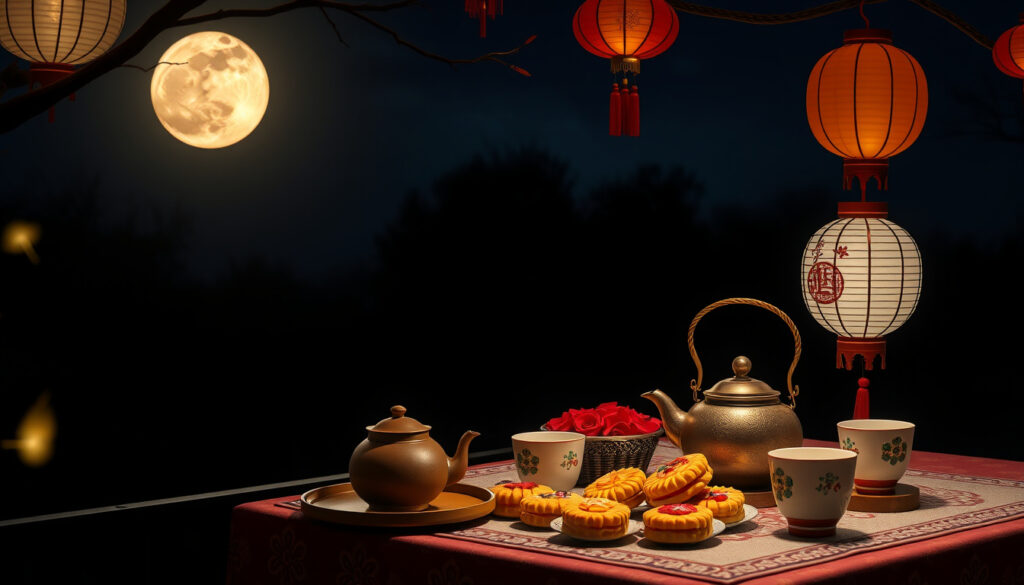
Mid-Autumn Festival: Traditions, Mooncakes, Wishes & Gifts
Few full moons carry as much cultural weight as the one behind the Mid-Autumn Festival, and anyone who has accepted a dinner invitation from a Chinese, Vietnamese, or Singaporean friend knows the question: what am I supposed to bring, say, and eat? The festival is an evening of family reunion, moon gazing, lanterns, and mooncakes across China, Vietnam, Japan, Korea, and beyond — with regional customs that differ more than a quick search suggests. The practical answers — what to eat, what to say, what to give — are below, tied to named sources.
Date: 15th day of the 8th lunar month (September–October) ·
Also known as: Moon Festival, Mooncake Festival, Lantern Festival (in some regions) ·
Main food: Mooncakes (lotus seed paste, red bean, salted egg yolk) ·
Core tradition: Family reunion, moon gazing, lantern parades ·
Celebrated in: China, Vietnam (Tết Trung Thu), Japan (Tsukimi), Korea (Chuseok), Taiwan, Singapore, Malaysia
Quick snapshot
- An evening celebration centered on family reunion, lanterns, mooncakes, and moon appreciation (IDCPC (Chinese government culture portal))
- The festival date is the full moon of the eighth lunar month (IDCPC (Chinese government culture portal))
- The mooncake’s circular shape signifies domestic harmony and the fullness of the moon (IDCPC (Chinese government culture portal))
- Exact origins of mooncake gifting as a business practice
- Whether Christian participation is appropriate — varies by denomination and personal conviction
- Regional food customs are documented unevenly, with many details coming from community guides
- In 2025, the festival fell on 6 October (MICHELIN Guide Singapore (restaurant guide))
- The date shifts each year because it follows the lunar calendar (MICHELIN Guide Singapore (restaurant guide))
- Lantern carnivals and dragon dances near the festival date (MICHELIN Guide Singapore (restaurant guide))
- Hong Kong’s Victoria Park Lantern Carnival and Tai Hang Fire Dragon Dance are seasonal fixtures (Cathay Pacific (Hong Kong travel guide))
- Expect dinner invitations and mooncake gift boxes in the weeks before the full moon (Cathay Pacific (Hong Kong travel guide))
One pattern runs through most of the details: roundness — a round moon, a round mooncake, a round table of family members. The calendar follows the moon, and every other symbol follows the circle.
| Label | Detail |
|---|---|
| Date | 15th day of the eighth lunar month; in 2025, 6 October (MICHELIN Guide Singapore (restaurant guide)) |
| Origin | Over 3,000 years old, rooted in moon worship and harvest celebrations; moon-offering is described as an ancient custom (Beijing Municipal Government (official city culture guide)) |
| Most popular legend | Chang’e flying to the moon after drinking the elixir of immortality (folk legend) |
| Signature food | Mooncakes, traditionally filled with lotus-seed or bean paste and salted egg yolk |
| Meaning of the mooncake | Its circular shape signifies domestic harmony and the fullness of the moon |
| Typical mooncake price | USD $5–$50 per box for traditional sets; premium boxes can pass $200 (market estimate) |
| Global reach | China, Taiwan, Vietnam, Korea, Japan, Singapore, Malaysia, and diaspora communities worldwide |
What Does the Mid-Autumn Festival Celebrate?
The short answer is a triple one: the autumn harvest, the fullest moon of the lunar year, and the family members who gather under it. Everything else — the mooncakes, the lanterns, the gifts — is decoration around those three ideas.
Origins and the Legend of Chang’e
- The festival grew out of ancient moon worship and harvest celebrations in China.
- The most retold story is the legend of Chang’e, the moon goddess.
- The customs eventually settled into an evening of reunion and moon appreciation.
Beijing’s official city culture guide records that offering sacrifices to the moon is an ancient Mid-Autumn custom, which is why so much of the festival still points upward. The popular origin story explains that focal point: the archer Hou Yi received an elixir of immortality, his wife Chang’e drank it to keep it from a thief, and she floated to the moon, where she remains. Few people treat the legend as literal history; almost everyone treats it as the festival’s emotional anchor.
What this means for guests: you do not need to know the whole myth to join the evening. The legend exists to explain why a pastry is round and why everyone steps outside to look up.
Symbolism of the Full Moon
- Completeness: a full moon signals a full family, with no one missing.
- Harmony: round shapes — the moon, the mooncake, the table — carry the same wish.
- Gratitude: the eighth lunar month lands in harvest season, so the moon doubles as a thanks-giving moment.
Singapore’s heritage listing draws the line directly from the moon to the pastry: the mooncake’s circular shape signifies domestic harmony and the fullness of the moon (Roots.gov.sg (Singapore’s heritage agency)). That is why the dessert is round, why it is cut and shared, and why it travels so well as a gift.
Is the Mid-Autumn Festival a Harvest Festival?
- Yes, historically — the lunar date sits at the end of the autumn harvest.
- Yes, in practice — the reunion dinner doubles as a harvest meal.
- Partly — modern city celebrations emphasize family and moon, not farming.
Beijing’s official guide to the festival’s customs lists classic offerings that read like a farmer’s table: watermelons, mooncakes, edamame stems, cockscomb, radishes, and lotus roots (Beijing Municipal Government (official city culture guide)). Those offerings make the harvest roots visible even in a city apartment.
What Is Another Name for the Mid-Autumn Festival?
- Moon Festival and Mooncake Festival — the two most common English names.
- Lantern Festival — used in parts of Southeast Asia, including Singapore and Malaysia.
- Tết Trung Thu — the Vietnamese name, centered on children’s lanterns.
- Tsukimi — Japan’s moon-viewing tradition.
- Chuseok — Korea’s autumn harvest holiday on the same lunar timing.
The names matter because they show what each culture keeps: Chinese communities keep the moon and the pastry, Vietnamese communities keep the lanterns and children, Japanese communities keep the moon-viewing, and Korean communities keep the harvest feast.
The pattern: each culture keeps the piece of the festival it cares about most — and the moon holds all the versions together.
What Do People Usually Do During the Mid-Autumn Festival?
Reunion dinner first, then the moon — that is the standard evening in most households.
Family Reunions and Moon Gazing
- Gather for a big dinner with immediate and extended family.
- Eat mooncake and seasonal fruit after the meal.
- Move outside to look at the full moon together.
Beijing’s official city guide describes the classic scene: after the reunion dinner, families often sit together in the moonlight, drinking and enjoying the full moon (Beijing Municipal Government (official city culture guide)). In many homes, a small table with offerings — watermelons, mooncakes, lotus roots — is set where the moonlight falls, a custom that echoes the ancient moon-offering rites.
Lantern Displays and Parades
- Children carry paper lanterns in shapes from rabbits to rockets.
- Communities stage lantern carnivals, parades, and dragon dances.
- Some regions keep older customs, like hoisting lanterns on tall poles.
Lanterns are the festival’s second icon. Singapore’s national heritage listing describes lantern lighting and carrying as another hallmark of the festival, noting that lanterns were originally used as spiritual offerings (Roots.gov.sg (Singapore’s heritage agency)). The scale expands dramatically in cities: Hong Kong’s Tai Hang Fire Dragon Dance and the Victoria Park Lantern Carnival draw large crowds every year (Cathay Pacific (Hong Kong travel guide)). Regional guides also record Guangdong families hoisting lanterns on tall poles and rooftops so entire streets glow.
Mid-Autumn Festival Ideas for Celebrating at Home
- Set up a moon-gazing corner with a clear view of the sky.
- Do a mooncake tasting with two or three fillings and a pot of tea.
- Take a lantern walk after dark with the family.
- Call relatives you cannot see and wish them a happy reunion.
None of these require special supplies beyond what a good grocery run can provide. The evening works because it is slow: food, sky, conversation, and a walk outside.
The lantern half of the festival is what children in Singapore, Hong Kong, and Vietnam remember most — it turns a private family dinner into a neighborhood-wide light show.
The trade-off: the bigger the city, the more the festival leans on public spectacle — which is wonderful for visitors, but the quieter moon-gazing version at home is closer to the original.
What Are You Supposed to Eat on the Mid-Autumn Festival?
Mooncakes lead, but they are not the whole menu. The wider table is seasonal and regional.
Mooncakes: Traditional Fillings and Modern Variants
- Lotus seed paste — the classic Cantonese filling.
- Red bean paste — the most common everyday alternative.
- Salted egg yolk — the “moon” in the middle, often paired with lotus paste.
Singapore’s official heritage listing calls the mooncake a hallmark of the festival, traditionally filled with lotus-seed or bean paste and salted egg yolk. Bakeries in Singapore and Hong Kong compete with new interpretations every season, and prices have followed the premium trend — traditional boxes typically run from a few dollars to fifty, while luxury sets can pass two hundred (market estimate).
What Does It Mean to Give Someone a Mooncake?
- Reunion — the round cake pushes the same wish as the round moon.
- Respect — offering a gift box signals you value the relationship.
- Good fortune — the sweetness carries the wish for a sweet year.
Giving mooncakes is a gesture of family unity and good wishes, which is why the gift box matters almost as much as the pastries. The roundness is not decoration; it is the message.
Who Eats Mooncakes for Mid-Autumn?
- Chinese communities across mainland China, Taiwan, Hong Kong, and the diaspora.
- Vietnamese families at Tết Trung Thu, alongside children’s lantern parades.
- Singaporeans and Malaysians, where mooncake gifting is a major seasonal event.
Japan and Korea mark the same full moon with their own traditions — Japan’s Tsukimi centers on moon-viewing, and Korea’s Chuseok is a separate harvest holiday that shares the lunar timing.
Other Festive Foods: Pomelos, Taro, and Mooncakes
- Pomelo — a large seasonal citrus that appears across southern China and Southeast Asia.
- Taro — used in moon-offering customs in Chaoshan and other Cantonese regions.
- Grapes and watermelon — northern Chinese tables pair them with Beijing-style mooncakes.
- Rice wine and river snails — regional specialties in western and eastern China.
The regional spread is wider than most guides admit. A community customs guide records Beijing-style mooncakes with grapes and watermelon in the north, Cantonese mooncakes with pomelo and taro in the south, Yunnan ham mooncakes with rice wine in the west, and Suzhou-style mooncakes with duck and river snails in the east (CHINANETZ (community customs guide)).
The takeaway: if you only eat mooncakes, you are eating half the festival. The other half is whatever your region harvests in autumn.
How to Wish Someone a Happy Mid-Autumn Festival?
Three or four words are enough — in English or Mandarin.
Common Greetings in English and Chinese
- “Happy Mid-Autumn Festival!” — the standard English greeting.
- “Zhōngqiū jié kuàilè!” — Mandarin, literally “Mid-Autumn Festival happiness.”
- “Wishing you a bright full moon and a happy reunion.” — the fuller English wish.
The Mandarin greeting is Zhōngqiū jié kuàilè — four syllables worth learning before you walk in. The phrase works for cards, messages, and in-person greetings, and it is the most useful piece of festival language for non-speakers.
Phrases for Cards, Messages, and Social Media
- “Happy Mid-Autumn Festival to you and your family.”
- “May the full moon bring you health, prosperity, and family harmony.”
- “Wishing you sweet mooncakes and a warm reunion.”
Short works better than elaborate. The festival’s greeting culture rewards warmth over formality — a plain “Happy Mid-Autumn” with a moon emoji is perfectly good in most text threads.
If you remember one phrase, make it “Zhōngqiū jié kuàilè.” In most Chinese-speaking households, the effort is appreciated more than the grammar.
The pattern: a short, warm phrase beats a long formal one — the greeting culture rewards effort over eloquence.
What Is the Best Gift for the Mid-Autumn Festival?
Short answer: mooncakes. Slightly longer answer: it depends on how well you know the host.
Do You Give Gifts for the Mid-Autumn Festival?
- Yes — to family, friends, and business associates.
- Yes — as a thank-you for a dinner invitation.
- Not required — but arriving empty-handed feels wrong to many hosts.
Gift-giving is a normal part of the festival, especially in Singapore, Hong Kong, and China, where the practice extends to business associates as well as family.
Mooncakes: The Classic Choice
- Most traditional — the round pastry carries the festival’s core wish.
- Most expected — hosts appreciate the gesture even if they already have a stack.
- Most available — supermarkets and bakeries stock them weeks ahead.
In Hong Kong, mooncake gift boxes are a seasonal fixture in the weeks before the full moon (Cathay Pacific (Hong Kong travel guide)), and Singapore’s MICHELIN Guide now publishes an annual list of the city’s best mooncakes. If you want to look at ease, buy a box from a known bakery rather than a supermarket, and check the host’s dietary limits before choosing salted egg yolk.
Non-Food Gift Alternatives (Tea, Lanterns, Jewelry)
- Premium tea — the natural pairing for mooncakes.
- A nice lantern — thoughtful for a family with children.
- Jewelry or a meaningful small object — works for close family; too personal for casual acquaintances.
Tea is the safest non-food choice because it pairs with the dessert instead of competing with it. For anyone still unsure, the rule of thumb is: round, sweet, and shared — or a quality tea that respects the same spirit.
Mooncakes are the safest gift, but they are so common that hosts notice the guest who brought a good tea instead. The trade-off is personal: tradition wins with in-laws, thoughtfulness wins with friends.
Should Christians Celebrate the Mid-Autumn Festival?
There is no single answer, because the festival is not a single thing: it is folklore, harvest thanks, family ritual, and commercial season all at once.
Is the Mid-Autumn Festival a Religious Holiday?
- Historically, yes — it began with moon worship and harvest rites.
- Today, mostly no — most households treat it as a family and cultural celebration.
- In practice, it depends — some families keep offering rituals; others only eat dinner.
The ancient practice of offering sacrifices to the moon is recorded in Beijing’s official city guide. The modern festival, however, runs on reunion dinners, mooncake gifting, and lantern walks, not on worship. That split is why Christians come to different conclusions.
Christian Perspectives on Cultural Participation
- Many Christians join happily as a family and cultural event focused on gratitude.
- Some denominations avoid it because of the moon-worship associations.
- Others attend the dinner but skip any offering or worship elements.
The distinction that matters is intent. If the evening is about family, food, and thanking God for the harvest, most Christian frameworks can accommodate it. If it becomes an act of moon worship, the same frameworks object. That is why the honest answer is personal and communal, not universal.
The festival’s moon-offering roots make some Christian communities cautious, and no single verdict fits every church or conscience. A guest can always join the meal, skip the offerings, and let the family know where the boundary sits.
Does Japan Celebrate the Mid-Autumn Festival?
- Yes — as Tsukimi, a moon-viewing tradition on the same full moon.
- The Japanese version is quieter and centered on moon appreciation.
- The customs are not mooncake-centered.
Japan’s Tsukimi shares the lunar timing but not the scale: families and friends gather to appreciate the moon rather than exchange mooncake gift boxes. It is the clearest example of how the same full moon becomes a different holiday in each culture.
What this means: the same lunar moment means different things in Beijing, Hanoi, Tokyo, and Seoul — which is why the religious question never has a single global answer.
What’s Confirmed and What’s Unclear
Most of the festival’s core facts are solid and well documented; the gray areas are matters of history and personal conviction, not of missing data.
Confirmed facts
- The festival falls on the full moon of the eighth lunar month (MICHELIN Guide Singapore (restaurant guide)).
- Mooncakes are the festival’s hallmark food, traditionally filled with lotus-seed or bean paste and salted egg yolk (Roots.gov.sg (Singapore’s heritage agency)).
- The festival is an evening celebration centered on family reunion, lanterns, mooncakes, and moon appreciation.
- The festival is a public holiday in China, Taiwan, Vietnam, and South Korea.
What’s unclear
- Exactly when mooncake gifting became a commercial practice — the business history is not well documented.
- Whether Christians should participate, which varies by denomination and personal conviction.
- The reliability of regional food descriptions, which often come from community guides rather than official sources.
- How much religious weight the moon-offering customs still carry in modern households.
The asymmetry is the point: the facts that matter for planning a celebration are solid, while the disagreements are mostly about meaning, not logistics.
What the Sources Say
“The Mid-Autumn Festival is traditionally an evening celebration centered on family reunion, lanterns, mooncakes, and moon appreciation.”
IDCPC (Chinese government culture portal)
“In Guangdong, families may raise the festival by hoisting lanterns on tall poles and rooftops, and streets glow with light as part of the celebration.”
The Takeaway
The Mid-Autumn Festival keeps its hold because it gives everyone at the table a role — sit together, look at the moon, share something round and sweet. The religious debates around it are real, but most families settle them the way they settle every holiday question: by deciding together what the evening means. For anyone planning a first celebration, the choice is clear: bring mooncakes, let the host set the tone on religion, and let the full moon do the rest — or stand at the edge of the conversation holding a very awkward gift.
Related reading
- Christmas Log Cake Singapore 2025: Prices & Top Bakeries
- What to Eat at Jewel Changi: Best Food for All Budgets
augustman.com, keewah.com, theclub.com.hk, taiwaneseamerican.org, popbee.com
Frequently asked questions
How is the date of the Mid-Autumn Festival determined each year?
The date follows the lunar calendar: it is always the 15th day of the eighth lunar month, which is the full moon of that month. In 2025, that fell on 6 October.
Are mooncakes only eaten during the festival?
No — many bakeries sell mooncakes year-round, but they become a seasonal focus in the weeks around the festival, when gifting drives most of the demand.
What is the difference between the Mid-Autumn Festival and Chuseok?
Both are tied to the eighth lunar month’s full moon, but Chuseok is Korea’s own autumn harvest holiday with its own foods and family customs. The Mid-Autumn Festival is the Chinese and Vietnamese celebration of the same lunar moment, centered on mooncakes, lanterns, and family reunion.
Can I celebrate the Mid-Autumn Festival if I am not Chinese?
Yes. The festival is a cultural, family-centered holiday with folkloric roots, and many non-Chinese families take part through dinner invitations, mooncake gifting, lantern walks, or their own moon-gazing evening.
What colors should I wear for the Mid-Autumn Festival?
There is no strict dress code. Lunar-inspired whites, silvers, and soft golds echo the moon, while red remains the default festive color in Chinese culture. Most hosts care more about comfort and good company than color.
Do I need to give a gift if invited to a Mid-Autumn celebration?
A small gift is appreciated — a box of mooncakes, a quality tea, or seasonal fruit. For casual acquaintances, avoid gifts that feel overly personal or very expensive.
Is the Mid-Autumn Festival the same as the Lantern Festival?
No, but the names overlap. In parts of Southeast Asia, Mid-Autumn is often called the Lantern Festival because lantern displays are central; in China, the Lantern Festival proper is a separate holiday that ends the Lunar New Year period.
More related posts
 What Is Global Warming? Science, Causes & the 2030 Timeline
 Central 24-HR Clinic: Locations, Fees & 24-Hour Service
 Unexpected Turbulence on Qantas: ATSB Report and Safety Changes
 R&D Meaning: Definition, Types & Examples in Business
 Opero Hotel Southkey JB: Reviews, Prices, Buffet & Amenities
 หนังออนไลน์: Best Free Online Movie Streaming in Thailand [2026]
 Tian Tian Chicken Rice: Michelin Bib Gourmand Hawker Stall Guide
 UOB Live Gold Price: Today’s Rates, Charts & Fees in Singapore
