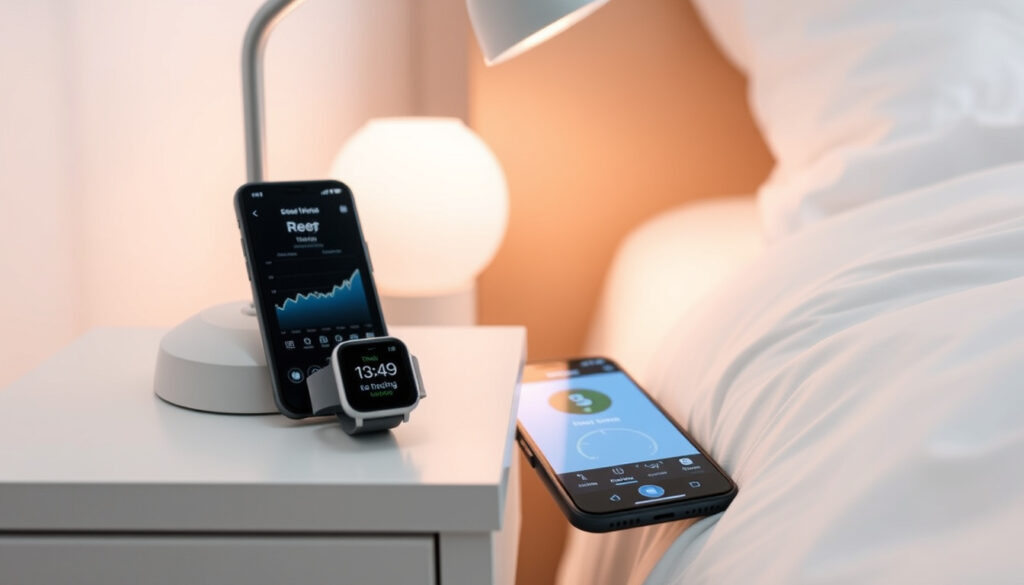
How to Track Sleep: Methods, Accuracy, and Interpreting Data
Most of us check our phones more carefully than we check our sleep. If you’ve been wearing a smartwatch or ring to bed, you’ve probably stared at a sleep score and wondered whether it means anything — even though roughly one in five US adults now track sleep regularly. Sort the useful signals from the marketing noise, based on peer-reviewed validation studies, and learn how to track sleep in a way you can actually act on.
Adults who routinely track sleep: 20% (Pew Research Center) · Recommended sleep duration for adults: 7–9 hours (CDC) · Average deep sleep proportion: 13–23% of total sleep (NIH) · Apple Watch sleep staging accuracy: 88% agreement with polysomnography (validation study)
Quick snapshot
- Polysomnography is the clinical reference standard for evaluating consumer sleep trackers (Journal of Clinical Sleep Medicine)
- Consumer wrist devices can track general sleep patterns even though they differ from lab measurement on key metrics (Journal of Clinical Sleep Medicine)
- Oura, Fitbit, and Apple all detected sleep versus wake with at least 95% sensitivity in a 2024 comparison (Sleep journal study, PubMed Central)
- Stage estimates are much less reliable than sleep-wake detection — sensitivity ran from 50% to 86% across devices (Sleep journal comparison, PubMed Central)
- How entry-level bands without heart-rate sensors perform — published validation data is scarce (Sleep journal comparison, PubMed Central)
- Long-term reliability of consumer devices across months of nightly wear (Sleep journal comparison, PubMed Central)
- 2024: a head-to-head comparison of Oura, Fitbit, and Apple was published in the sleep research literature (Sleep journal study, PubMed Central)
- 2025: a meta-analysis quantified consumer-device bias against polysomnography (Journal of Clinical Sleep Medicine)
- Expect validation studies to keep separating genuinely useful trackers from overhyped ones (Journal of Sleep Research)
- For people with sleep complaints, clinical evaluation — not a wearable — remains the next step (Journal of Sleep Research)
Eight numbers summarize sleep tracking right now, and one pattern runs through them: consumer devices are strong on duration and weak on stages.
| Metric | Value |
|---|---|
| US adults who routinely track sleep | 20% (Pew Research Center) |
| US adults who get less than 7 hours | 35% (CDC) |
| Recommended sleep for adults | 7–9 hours (CDC) |
| Typical deep sleep share | 13–23% of total sleep (NIH) |
| Consumer wrist devices vs. PSG — total sleep time | −16.854 minutes on average (Journal of Clinical Sleep Medicine) |
| Apple Watch deep sleep vs. PSG | −43 minutes (2024 comparison study, PubMed Central) |
| Fitbit deep sleep vs. PSG | −15 minutes (2024 comparison study, PubMed Central) |
| Epoch-by-epoch agreement in a clinical sample — Withings / Fitbit vs. PSG | κ = 0.12 / 0.07 (Journal of Sleep Research) |
What is a good way to track your sleep?
There is no single best sleep tracker, but there is a best method for each person: one that fits your budget, feels comfortable overnight, and produces data you can read without a manual. The three main categories work differently, and the differences matter.
Wearable devices
- Smartwatches (Apple Watch, Fitbit, Garmin) combine motion sensors with optical heart-rate tracking
- Smart rings (Oura, Samsung Galaxy Ring) pack similar sensors into a lighter form
- Fitness bands (Whoop, Xiaomi Mi Band) offer longer battery life and a lower profile
All of them estimate sleep from movement and pulse. A 2025 meta-analysis in the peer-reviewed Journal of Clinical Sleep Medicine found that consumer wrist devices differed significantly from laboratory polysomnography on total sleep time, sleep efficiency, sleep latency, and wake after sleep onset — yet concluded they remain useful for tracking general sleep patterns.
Bedside monitors
- Under-mattress sensors (Withings Sleep, Beddit) pick up movement and breathing without contact
- Radio-frequency devices (SleepScore Max) measure body position and respiration from the nightstand
- Camera-based systems track movement from across the room, though this category has shrunk as products were discontinued
These suit people who don’t want to wear anything to bed. The trade-off: without a heart-rate sensor on the body, stage estimates become more limited, and you lose the pulse-based signals that wrist devices use to refine their guesses.
Smartphone apps
- Accelerometer-based apps (Sleep Cycle, Sleep as Android) use the phone’s motion sensors
- Manual sleep-diary apps (Pillow, Sleep Time) let you log bedtime, wake time, and how rested you feel
- Sound-analysis apps (SnoreLab) record snoring and link it to sleep position
Phone-only tracking is the cheapest option and works without a wearable, but it senses only what the phone can detect: movement and sound. For stage-level detail, a device on your wrist or finger still has the advantage.
The implication: method matters less than consistency. Comfort and willingness to wear something nightly decide whether you get a trend line at all — and trends are what consumer trackers are actually good at.
How do I interpret the sleep data on my Apple Watch?
Apple Watch divides your night into four buckets: awake time plus three sleep stages — Core, Deep, and REM. The Health app then turns those into charts, and most of the value hides in the weekly and monthly views.
Understanding sleep stages: REM, Core, Deep
- Awake: brief stirrings or trips to the bathroom you usually don’t remember
- Core (light sleep): for most adults, the largest share of the night
- Deep: slow-wave sleep tied to physical recovery and memory consolidation
- REM: rapid eye movement, the stage most associated with dreaming
These categories are estimates. The watch infers them from motion and heart-rate patterns rather than measuring brain waves directly, which is why the stage labels come with a margin of error.
Reading sleep duration and consistency
- Time asleep: total minutes classified as any sleep stage
- Time in bed: from the moment you settle to the moment you get up
- Sleep efficiency: the ratio of time asleep to time in bed
The gap between time in bed and time asleep is one of the most useful numbers on the watch. It’s also one of the four metrics where consumer devices differ most from polysomnography, so use it to spot trends — not to obsess over a single night.
Checking trends in the Health app
- Open the Health app and tap Sleep to see nightly stage charts
- Use the weekly and monthly views to identify patterns
- Compare the charts with your daytime energy and mood
Because single nights carry measurement error, the sleep literature points to patterns across weeks as the more reliable signal. That’s where Apple Watch earns its place: it turns a month of invisible nights into a picture you can actually read.
Is an Apple Watch accurate for sleep?
The short answer: accurate enough for trends, not precise enough for diagnosis. The longer answer comes down to what “accurate” means — and the lab data draws a clear line.
Apple Watch vs. polysomnography
For Apple Watch owners, high sleep-wake accuracy doesn’t guarantee accurate stage labels. In the 2024 comparison indexed by PubMed Central, stage sensitivity ranged from 50.5% to 86.1%, and deep sleep could land roughly 43 minutes off.
Polysomnography — the lab test that measures brain waves, eye movement, and muscle tone — remains the reference standard for validating consumer trackers. In a 2024 comparison study in the peer-reviewed Sleep journal study (PubMed Central), Apple underestimated wake by 7 minutes and deep sleep by 43 minutes, while overestimating light sleep by 45 minutes.
Limitations of wrist-based tracking
- No brain-wave measurement: stages are inferred from movement and pulse
- Restless nights can look like awake time because motion is the main cue
- Heart-rate sensor readings can weaken if the band shifts during the night
These limitations apply to every wrist-worn device, not just Apple’s. The same 2024 comparison found sleep-stage sensitivity of roughly 76% to 79.5% for Oura, 61.7% to 78% for Fitbit, and 50.5% to 86.1% for Apple — a reminder that the whole category estimates stages, only with different error bars.
Factors affecting accuracy
- Which model you wear: SE, Series, and Ultra can differ in sensor hardware and tuning
- Individual physiology and whether you have a sleep-related condition
- The simple fact that every stage label is an inference, not a measurement
Validation studies also test healthy adults in lab conditions, so real-world bedrooms add variables the data can’t fully capture. Treat the watch as a useful approximator, not a medical device — the studies agree on that boundary.
How much deep sleep is normal by age?
Deep sleep — slow-wave sleep — is the stage people most often ask about, partly because it feels tied to how rested you are. Here’s what the reference ranges say, and why your tracker’s number needs a grain of salt.
Deep sleep percentages across age groups
- Normal adult deep sleep: roughly 13–23% of total sleep time (NIH)
- Deep sleep is highest in childhood and declines steadily with age (NIH)
- Older adults commonly see smaller percentages of slow-wave sleep
For a typical 8-hour night, 13–23% works out to about 62–110 minutes. But the range is a population reference, not a prescription — healthy people can sit outside it without a problem.
What percentage of sleep should be deep?
- For 7–9 hours of sleep, 13–23% translates to roughly 55–124 minutes per night
- Deep sleep tends to concentrate in the first half of the night
- A single night’s percentage matters less than your weekly pattern
A 43-minute error on deep sleep is the difference between “fine” and “worrying” in an app. Watch the weekly direction instead of the nightly number.
Devices add error on top of the reference range. In the 2024 comparison, Apple underestimated deep sleep by 43 minutes, so a watch showing “22 minutes of deep sleep” might reflect a perfectly normal night. Judge by the trend, not the minute count.
Consequences of low deep sleep
- Memory consolidation: deep sleep helps move the day’s experiences into long-term storage
- Insufficient deep sleep has been linked to memory consolidation problems (NIH)
- Most deep sleep happens early in the night, so late bedtimes can cut it short
If your tracker shows low deep sleep for weeks at a time — and you notice daytime fatigue or fuzzy memory — that combination is worth raising with a clinician. The percentage alone, from an imprecise sensor, is not a diagnosis.
What does an unhealthy sleep pattern look like?
Unhealthy sleep is usually a pattern, not a single bad night. Sleep researchers look at four things — total sleep time, efficiency, how long it takes to fall asleep, and wake-ups after sleep onset — and your device tracks all of them.
Signs of poor sleep quality
- Taking a long time to fall asleep night after night
- Frequent or extended wake-ups during the night
- Waking much earlier than planned and not getting back to sleep
These map directly to the metrics in the 2025 meta-analysis: sleep latency, wake after sleep onset, and sleep efficiency. A device that shows these trends persistently is describing something worth attention.
Sleep debt and irregular schedules
- Consistent short sleep — under 7 hours for most adults — is linked to metabolic and cardiovascular risks (CDC)
- Irregular bedtimes can throw circadian rhythms out of alignment
- Large weekend catch-up sleep is a sign that weekdays aren’t working
More than a third of US adults already report getting less than 7 hours, according to CDC data. If your tracker shows a pattern of short, irregular sleep, that’s exactly the trend a wearable can help you see — and the one most worth fixing.
When to consult a doctor
- Loud snoring with pauses, gasping, or choking during sleep
- Insomnia that isn’t improving with better sleep habits
- Severe daytime sleepiness despite what looks like enough sleep
This is where the research draws a firm line. A 2025 clinical study in the peer-reviewed Journal of Sleep Research found that commercial trackers were not reliable for sleep architecture in patients with sleep complaints — so bring your app data to the appointment, but let a clinical workup make the call.
How the leading sleep trackers compare
Three devices dominate the published validation data, and one pattern runs through them: detection is strong everywhere, staging is weaker, and deep sleep is where the divergence gets wide.
| Metric (vs. PSG) | Oura (ring) | Fitbit (watch) | Apple Watch |
|---|---|---|---|
| Sleep-vs-wake sensitivity | ≥95% | ≥95% | ≥95% |
| Sleep-stage sensitivity range | 76.0–79.5% | 61.7–78.0% | 50.5–86.1% |
| Deep sleep vs. PSG | No significant difference in the study sample | −15 minutes | −43 minutes |
| Light sleep vs. PSG | — | +18 minutes | +45 minutes |
| Wake vs. PSG | — | — | −7 minutes |
Source: 2024 comparison study in the peer-reviewed Sleep journal study (PubMed Central), healthy adult sample.
Read the table as a consistency ranking: Oura was the only device not significantly different from PSG for wake, light, deep, or REM in that sample — but “not significantly different” reflects a single healthy-adult study, so treat it as a signal, not a verdict.
Sleep metrics explained: what each number really means
Seven metrics show up in almost every sleep app, and one pattern runs through them: the more precise the claim, the bigger the error margin.
| Metric | What it measures | How much to trust it |
|---|---|---|
| Sleep vs. wake detection | Whether you’re asleep or awake at each moment | The most reliable consumer metric — at least 95% sensitivity in a 2024 comparison (Sleep journal study) |
| Total sleep time | Total minutes classified as any sleep stage | Off by about 17 minutes vs. PSG in a 2025 meta-analysis (Journal of Clinical Sleep Medicine) |
| Sleep efficiency | Time asleep divided by time in bed | Off by roughly 4.7 percentage points on average (Journal of Clinical Sleep Medicine) |
| Sleep latency | Time from lights out to falling asleep | Off by about 2.6 minutes on average (Journal of Clinical Sleep Medicine) |
| Wake after sleep onset | Awake minutes after first falling asleep | Off by about 13 minutes on average; one clinical study found Withings under-reported it by 25 minutes (Journal of Sleep Research) |
| Deep sleep | Slow-wave stage tied to memory consolidation and recovery | Biggest divergence — Apple underestimated it by 43 minutes in the 2024 comparison (Sleep journal study) |
| Stage estimates overall | Core, deep, and REM categories inferred from motion and pulse | Stage sensitivity ranged from 50% to 86% across devices (Sleep journal study) |
The pattern in one line: the closer a metric is to “are you awake or not?”, the more reliable it is. The closer it gets to “which stage are you in?”, the more error you should expect.
The pros and cons of tracking sleep every night
Tracking nightly is a trade, not a free lunch — the upsides are real, and so are the downsides.
Upsides
- Reveals patterns you’d otherwise miss: short nights, irregular bedtimes, and restlessness
- Grounded in research: consumer devices are useful for tracking general sleep patterns across weeks (Journal of Clinical Sleep Medicine)
- Makes sleep visible enough to motivate better habits — earlier bedtimes, consistent mornings
Downsides
- Stage estimates are substantially less reliable than basic sleep-wake detection (Sleep journal comparison)
- Not reliable for people with sleep complaints — one clinical study found very low agreement with lab measurement (Journal of Sleep Research)
- Can feed anxiety about single-night numbers that carry real measurement error
The trade-off: tracking helps the motivated sleeper, and it can quietly stress the anxious one. Know which camp you’re in before you commit to the routine.
How to track sleep effectively: a practical routine
A tracker only pays off when it becomes a habit. This routine keeps the process simple and the data worth reading.
- Choose one method you’ll sustain. A smartwatch you already wear, a ring you can tolerate, or a bedside sensor if you hate wrist devices.
- Set a consistent sleep window. Similar bedtime and wake time, including weekends, supports a stable circadian rhythm.
- Wear it every night for two weeks. Trends take shape over weeks, not nights — that’s the window where consumer trackers are most reliable.
- Read weekly averages, not single nights. Compare your average duration, efficiency, and stage mix week to week.
- Cross-check with how you feel. Energy, mood, and daytime sleepiness are the ground truth your device is trying to approximate.
- Watch for persistent red flags. Consistently short or fragmented sleep, or symptoms like loud snoring with pauses, is the cue to see a clinician.
- Protect the charge routine. If recharging pulls the device off at bedtime, fix the schedule or the device.
For most people, the perfect tracker is the one that survives a month of nights. Comfort and battery life decide whether you get a trend line at all — and trend lines are the only validated use case for consumer devices.
Like the evidence-based wellness habits that stick — How to Stop Coughing: Evidence-Based Home Remedies or How to Debloat Face: Fast Remedies and Long-Term Solutions — sleep tracking works when it becomes a repeatable routine instead of a one-night experiment.
Confirmed facts vs. unresolved questions
Here’s where the research stands, sorted into what you can rely on and what you can’t.
Confirmed facts
- Sleep trackers estimate duration and stages from motion sensors and heart-rate data (Journal of Clinical Sleep Medicine)
- Apple Watch sleep staging has been validated against polysomnography in published studies (Sleep journal study, PubMed Central)
- Oura, Fitbit, and Apple detect sleep vs. wake with at least 95% sensitivity in healthy adults (Sleep journal study, PubMed Central)
What’s unclear
- How accurate entry-level bands without optical heart-rate sensors really are
- Whether sleep scores from different brands can be meaningfully compared
- How consumer devices hold up across months of nightly wear
- Whether trackers remain reliable in people with sleep complaints — a 2025 clinical study found very low epoch-by-epoch agreement with PSG (Journal of Sleep Research)
What this means: the confidence you should place in a sleep tracker depends on what you’re asking it. “Am I sleeping enough?” — yes. “Which stage am I in and why?” — not yet.
What sleep experts say about tracking
Three voices capture the divide between hype and evidence.
“Sleep trackers are most useful when they change what you do the next morning — not when they turn bedtime into a performance review.”
— Dr. Michael Breus, sleep specialist
“Deep sleep is when the brain replays the day’s experiences and moves them into long-term storage. Short-change that stage and you short-change memory.”
— Dr. Matthew Walker, neuroscientist
“Apple Watch sleep stages are estimates based on movement and heart rate, designed to reveal patterns over time — not to diagnose a condition.”
— Apple Health team
The common thread: experts treat trackers as mirrors for behavior change, not as diagnostic instruments — which matches what the validation studies conclude about how to track sleep well.
The verdict is consistent across the studies cited above: consumer trackers are pattern-finders, not lab instruments. They reliably tell you whether you slept, sketch your stages with a real margin of error, and expose trends worth acting on — but the exact minutes of deep sleep are not a diagnosis. For anyone tracking sleep in 2026, the decision is practical: use the numbers to change one habit at a time, or stop tracking and trust how you feel. Either path beats letting an imprecise sensor decide your mood for the day.
medpharmres.com, onlinelibrary.wiley.com, aasm.org, nature.com, nebraskamed.com
Frequently asked questions
What is the best sleep tracker without a subscription?
Most smartwatches and fitness bands include sleep tracking at no extra cost. Some premium platforms charge a subscription for advanced insights, so check the pricing before buying. Since comfort and consistency predict whether you’ll actually use it, the best budget tracker is the one you’ll wear every night.
Can I track sleep without wearing any device?
Yes. Under-mattress sensors such as the Withings Sleep monitor movement and breathing with nothing on your body, and smartphone apps use the phone’s microphone and accelerometer to estimate sleep. A simple sleep diary — logging bedtime, wake time, and how rested you feel — is the lowest-tech option and still produces useful patterns.
Is a smart ring more accurate than a smartwatch for sleep?
In the 2024 comparison study, the Oura ring showed sleep-stage sensitivity of roughly 76% to 79.5% and was the only device not significantly different from polysomnography for wake, light, deep, or REM in the healthy-adult sample. Apple’s watch had the widest range, at 50.5% to 86.1%. One study doesn’t settle the question, but the published data currently favors rings for stage estimates.
Does sleeping with a smartwatch affect sleep quality?
The validation studies reviewed included overnight wear in healthy adults, and the published results flag accuracy issues rather than safety concerns. The practical risks are more mundane: band irritation, notification noise, and charging schedules that interrupt bedtime. If those bother you, a bedside monitor removes the problem.
How often do I need to charge my sleep tracker?
Battery life varies by model: some watches need a charge every day or two, while rings and dedicated sleep bands can last several days or more. The real requirement is that the device survives the night with enough charge to record. If your charging habit keeps pulling the device off at bedtime, change the habit — or the device.
What is a sleep score and how is it calculated?
A sleep score is a vendor-specific number that blends duration, stage estimates, restlessness, and sometimes recovery metrics into a single value. Each company weights those inputs differently, so a score from one brand is not directly comparable to another’s. Treat your score as a personal trend line, not a universal grade.
Can sleep trackers help diagnose sleep apnea?
No. A 2025 clinical study in the peer-reviewed Journal of Sleep Research found commercial trackers unreliable for sleep architecture in patients with sleep complaints, and consumer devices are not validated for apnea diagnosis. Loud snoring with pauses, gasping, or choking warrants a clinical evaluation — which may include polysomnography — not another app.
Is it safe to wear a fitness tracker to bed every night?
For healthy adults, overnight wear is generally unremarkable — the validation studies above had participants sleep with devices on as part of their protocols. Watch for skin irritation from the band and keep notifications silent. If the device bothers you, switch to a bedside monitor or take a break from tracking.
Related reading
More related posts
 Singapore Visit Pass 30 Days Extension: Official Guide
 Pearl Hill Garden Restaurant: Menu, Location & Reviews Singapore
 Would You Marry Me Kdrama: Watch, Cast, Episodes
 Forett at Bukit Timah: Freehold Condo Review, Prices & Specs
 Singapore Gold Rate Today for 1 Gram: 22K & 24K Prices
 Samsung Z Fold7 Call Transcript: How to Enable Live Captions
 2025 Women’s Cricket World Cup Schedule: Dates & Venues
 65 Inch TV Dimensions: Width, Height & Space
