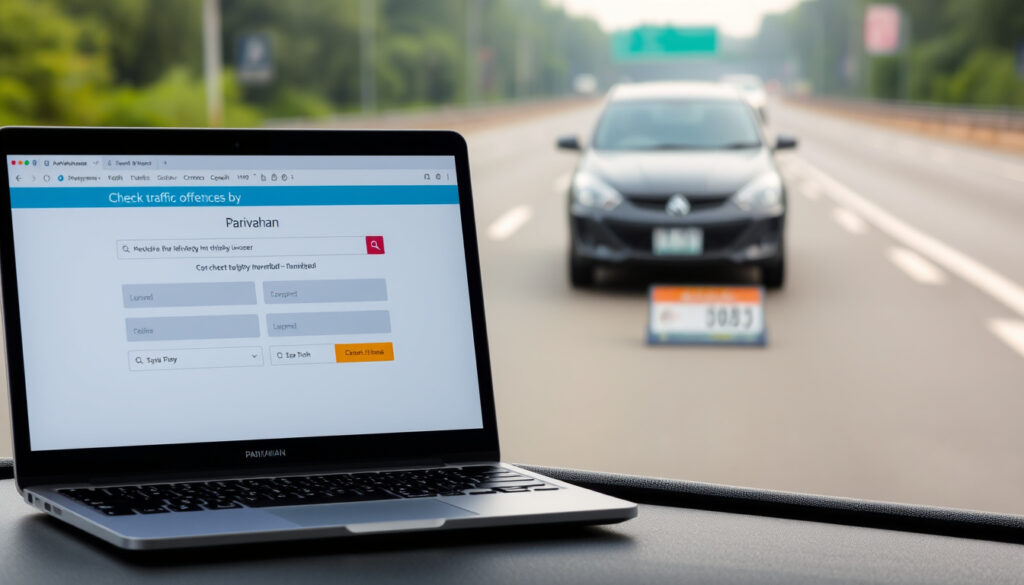
Check Traffic Offence by Vehicle Number – Parivahan Portal Guide
Drivers across India can now verify any outstanding traffic violations linked to their vehicles through a centralised digital system. The process relies on vehicle registration numbers as the primary identifier, drawing data from the VAHAN database maintained by the Ministry of Road Transport and Highways. This approach eliminates the need to visit police stations or RTO offices in person for basic fine verification.
The official Parivahan portal serves as the primary gateway for checking traffic offences by vehicle number. It aggregates information from traffic police departments across all states, creating a unified record that vehicle owners can access at any time. Understanding how this system works helps drivers stay compliant and avoid unexpected penalties during vehicle-related transactions.
How to Check Traffic Offences by Vehicle Number Online
Checking traffic fines using a vehicle registration number involves a straightforward five-step process on the official government portal. The system accepts multiple input methods, though the vehicle number remains the most commonly used option for personal vehicle checks. Users need access to a device with internet connectivity and the ability to read alphanumeric characters displayed in captcha verification.
Navigate to the e-challan section, enter your vehicle registration number exactly as shown on your RC book (including state code and series), complete the security captcha, and click search. Within seconds, the system displays all pending challans linked to that vehicle across participating states.
| Step | Action | Portal | Notes |
|---|---|---|---|
| 1 | Visit e-challan portal | echallan.parivahan.gov.in | Works on mobile and desktop |
| 2 | Select state (optional) | Drop-down menu | Improves accuracy of results |
| 3 | Enter vehicle number | Input field | Format: MH04AB1234 |
| 4 | Complete captcha | Security check | Required for every search |
Understanding the Search Results
Once the system processes a valid vehicle number query, it returns detailed information about each outstanding challan. This includes the challan number, date of issue, specific violation type, fine amount, and current payment status. The interface clearly distinguishes between paid and unpaid penalties, helping users prioritize which fines require immediate attention.
Results display all violations recorded through automated systems such as AI cameras and speed guns, as well as those issued manually by traffic police officers. The data reflects records from multiple jurisdictions where the vehicle may have travelled, consolidated into a single view for convenience.
- Challan number and date of issuance
- Specific traffic violation description
- Fine amount in rupees
- Payment status (paid/unpaid/pending)
- Issuing authority and jurisdiction
- Payment deadline information
Making Payments Through the Portal
After identifying outstanding fines, users can proceed directly to payment through the same portal. The system accepts various digital payment methods including net banking, Unified Payments Interface (UPI), credit cards, and debit cards. Each transaction generates an instant digital receipt that vehicle owners should save for records.
The payment confirmation typically reflects in the system within a few minutes, though processing times may vary depending on the payment method chosen. Users receive SMS notifications confirming successful transactions to the mobile number registered with the vehicle.
Official Websites and Portals for Traffic Fine Checks
The Parivahan e-challan portal serves as the central repository for traffic violation data across India. This government-operated platform connects with state RTO databases and traffic police systems to provide comprehensive, real-time access to challan records. All vehicle-related information originates from the VAHAN database, which maintains registration details for vehicles nationwide.
The Parivahan Ecosystem
Parivahan represents a broader initiative by the Ministry of Road Transport and Highways to digitise vehicle and driving licence services. The e-challan component specifically targets traffic fine management, allowing citizens to view and clear penalties without physical visits to traffic police offices. The platform operates under the domain echallan.parivahan.gov.in, and users should verify they are on the official government website before entering any payment information.
Third-party aggregators like Park+, ACKO, and Policybazaar offer simplified interfaces for checking fines. These platforms essentially proxy the official Parivahan system, providing an alternative channel for accessing the same underlying data. While convenient, these services ultimately rely on government portals for accurate information.
Always verify you are on an official government domain (.gov.in) when entering vehicle details or making payments. Unofficial apps and websites may collect personal data or redirect payments to fraudulent accounts.
Alternative Search Methods
Beyond the vehicle registration number, users can search for traffic fines using several other identifiers. The challan number received via SMS or physical notice provides a direct lookup method. Driving licence numbers allow users to find violations associated with their licence rather than a specific vehicle. For cases where neither number is available, the last five digits of the chassis or engine number can sometimes retrieve records.
What You Need to Check Traffic Violations by Vehicle Number
The vehicle registration number serves as the primary piece of information required to check traffic offences. This alphanumeric code, displayed on the front and rear number plates of the vehicle, connects directly to the VAHAN database containing all registered vehicle records. The format varies by state but typically includes the state code (such as DL for Delhi or MH for Maharashtra), followed by a district code and unique registration numbers.
Required Information
Beyond the vehicle number itself, users should have access to a valid captcha code displayed on the portal. The system uses this security measure to prevent automated queries and protect user data. Some searches may require additional verification depending on the specific portal or state system being accessed.
- Vehicle registration number (exact format as on RC book)
- Access to internet-connected device
- Ability to read and enter captcha codes
- Optional: Challan number for direct lookup
- Optional: Driving licence number for driver-based search
Limitations of Vehicle Number Searches
Vehicle number searches do not provide photographic evidence of violations through the standard portal interface. Users see violation details and amounts but cannot view camera captures or officer observations that led to the challan. For disputes requiring visual evidence, individuals must contact the issuing traffic police department directly with the challan number.
The system also does not include violations recorded before a vehicle’s integration into the digital database. While most traffic police departments have digitised records, some historical data may remain in physical files or older systems not connected to Parivahan.
State-Specific Variations for Traffic Fine Lookups
While the Parivahan portal works nationwide, several states maintain their own dedicated portals that supplement or mirror the central system. These state-specific platforms sometimes offer additional features such as extended violation history, local traffic police notifications, or integration with state-specific transport department services. Users may find it convenient to check both the national portal and their state’s transport website for comprehensive results.
| State | Primary Portal | Extra Features |
|---|---|---|
| Maharashtra | transport.maharashtra.gov.in | Local violation history, RTO integration |
| Delhi | delhitrafficpolice.nic.in | Traffic notices, pending transactions |
| Karnataka | transport.karnataka.gov.in | Past fines, vehicle details |
| Gujarat | rtopl.gujarat.gov.in | RTO services integration |
Regional Considerations
State transport department portals may offer more detailed local violation records than the centralised Parivahan interface. Maharashtra’s transport portal, for instance, provides access to local traffic police data alongside RTO records, creating a comprehensive view of all violations within the state. Delhi residents benefit from dedicated traffic police systems that provide real-time notifications and detailed challan histories.
Not all states have fully integrated their traffic police systems with the Parivahan database. In areas where integration remains incomplete, vehicle owners may need to check multiple sources to ensure they have identified all outstanding fines. The Parivahan search remains the most reliable starting point regardless of location.
Timeline and Process Flow for Traffic Violations
Understanding the lifecycle of a traffic violation helps vehicle owners appreciate why timely checks matter. The process begins when a violation occurs, either detected by automated systems or issued by traffic personnel in person. Each stage has specific timelines and consequences that affect vehicle owners.
- Violation detected: AI cameras, speed guns, or traffic police officers identify the offence and record vehicle details
- Verification: The system cross-references vehicle information against the VAHAN database to confirm ownership
- e-Challan generation: A digital challan is created and linked to the vehicle registration number
- Notification: SMS or WhatsApp alerts sent to the registered mobile number; physical notices may follow by post
- Payment window: Vehicle owners have 60 days from issuance to pay without additional penalties
- Escalation: Unpaid fines after 60 days may incur surcharges and block RC renewals or vehicle transfers
Payment Deadlines and Consequences
Traffic fines issued through the e-challan system carry a standard 60-day payment window. Paying within this period ensures the matter is closed without additional charges. The Ministry of Road Transport and Highways has established these timelines to provide adequate time for vehicle owners to become aware of and settle their penalties.
Unpaid traffic challans remaining unsettled after 60 days can result in blocking of RC renewal, fitness certificate issuance, and vehicle transfer processes through RTO offices.
Certainty and Uncertainty in Traffic Fine Records
While the digital e-challan system represents a significant improvement over manual record-keeping, certain limitations affect the reliability and completeness of available data. Vehicle owners should understand what the system can and cannot confirm to avoid misunderstandings. To understand the reliability of traffic fine records, it’s helpful to know that you can check traffic offences by vehicle number on the Parivahan Portal via Martin Lewis car finance claim.
What the Records Confirm
Official records accessed through the Parivahan portal reflect data entered by traffic authorities and processed through the VAHAN database. These records include challan numbers, violation types, fine amounts, and payment statuses as recorded by government systems. When a payment is completed through the official portal, the status updates immediately in most cases.
- Challan issuance date and number
- Fine amount as prescribed under the Motor Vehicles Act
- Payment status for completed transactions
- Outstanding balance requiring settlement
Areas of Uncertainty
Real-time synchronisation between state traffic police systems and the central Parivahan database varies by region. Some states may experience delays in updating payment statuses or adding new challans to the shared system. Additionally, violations recorded by state police departments not yet integrated with Parivahan may not appear in nationwide searches.
The portal does not provide photo evidence of violations, meaning users cannot verify whether the vehicle in question was actually involved in the reported offence through the standard interface. For situations requiring visual confirmation, direct contact with the issuing traffic police department becomes necessary.
Context: Legal Framework for Traffic Offences in India
Traffic fines in India operate under the framework established by the Motor Vehicles Act, 1988, and subsequent amendments. The Act empowers traffic authorities to levy penalties for various violations including speeding, signal jumping, illegal parking, and document violations. The digitisation of challan systems represents an effort to streamline enforcement while maintaining compliance with legal requirements.
The Ministry of Road Transport and Highways oversees the implementation of digital services including the Parivahan portal. State transport departments and traffic police forces maintain operational control within their jurisdictions, creating a distributed but coordinated enforcement network.
Vehicle owners retain the right to dispute incorrect challans through designated grievance mechanisms. The Parivahan grievance portal allows users to report errors such as wrong vehicle numbers, misidentified owners, or duplicate charges. Supporting documentation may be required during the resolution process.
Disputes and Grievance Resolution
When a vehicle owner identifies an incorrect challan, the system provides mechanisms for reporting and resolving disputes. The official Parivahan grievance portal accepts complaints about erroneous violations with supporting evidence.
Filing a Dispute
Users must provide specific details when submitting a grievance, including the challan number, vehicle registration number, and nature of the error. Evidence such as photographs, RC book copies, or proof of payment may strengthen the case. The system tracks complaint status, allowing users to monitor progress toward resolution.
If the online grievance system does not resolve the issue satisfactorily, vehicle owners can escalate to local traffic police offices or RTO authorities with physical documentation. Maintaining copies of all communications and receipts protects vehicle owners throughout the dispute process.
Official Mobile Applications
The mParivahan application provides a mobile-friendly option for checking and paying traffic fines directly from smartphones. Available for both Android and iOS devices, the app connects to the same Parivahan backend systems used by the web portal. Users can verify RC details, check outstanding challans, and process payments without accessing a desktop computer.
State governments have also launched dedicated applications such as Delhi One and Maharashtra MyGov that offer similar functionality within their jurisdictions. These apps may include additional features specific to local transport department services.
Download mobile applications only from official app stores and verify they are published by government entities. Check the developer information and reviews before installing any RTO or traffic-related apps.
Summary and Next Steps
Checking traffic offences by vehicle number in India has become a streamlined process through the Parivahan portal and associated state systems. Vehicle owners should perform regular checks to ensure they remain aware of all outstanding fines and can address them within the 60-day payment window. The digital system eliminates much of the uncertainty that previously surrounded traffic fine management.
For those planning time-sensitive vehicle transactions, checking for outstanding challans should be one of the first steps in the process. Understanding payment deadlines helps avoid unnecessary penalties and processing delays at RTO offices, as outlined in our comprehensive guide on 60 Days From Today – Exact Date and Calculations.
Frequently Asked Questions
How long do traffic fines stay pending on the system?
Traffic challans remain active in the system until payment is completed. Unpaid fines persist indefinitely and can block RC renewals, fitness certificates, and vehicle transfers. It is advisable to check and clear any outstanding fines before planning vehicle-related transactions.
What does it mean if a vehicle number check shows no fines?
A clean result indicates that no unpaid challans are currently linked to the vehicle in the Parivahan database. This could mean the vehicle has no violations, all fines have been paid, or the violation occurred in a jurisdiction not yet integrated with the central system.
Can I check traffic fines for another person’s vehicle?
The system accepts any valid vehicle registration number for searching. However, entering someone else’s vehicle number without proper authorisation may raise privacy concerns. The system does not reveal vehicle owner details during searches, only violation information associated with the registration number.
What happens if I cannot pay the full fine amount immediately?
The system does not currently offer instalment payment options for traffic fines. Users must pay the full amount to clear a challan. If experiencing financial difficulty, contacting the issuing traffic police department may provide information about any available hardship provisions in specific cases.
Can I check traffic violations using just the licence plate number?
Yes, the vehicle registration number as displayed on licence plates serves as the primary search identifier in the system. The format includes the state code, series numbers, and registration digits, all of which must be entered exactly as registered with the RTO.
How quickly does payment status update after online settlement?
Online payments typically update within minutes in the Parivahan system. SMS confirmations are sent to the registered mobile number. If the status does not update within 24 hours, users should retain their payment receipt and contact the payment support helpline.
Are there offline options for paying traffic fines?
Yes, traffic fines can still be paid at RTO offices, traffic police stations, and designated government payment centres. However, these offline methods may take longer to process and update in the digital system compared to online payments through the official portal.
More related posts
 Light Show Gardens by the Bay – Times and Viewing Tips
 East-West Line Disruption – Status, Causes and Key Facts
 Lee Il-hwa Biography: Career, Reply 1988 & Personal Life
 Housing and Development Board (HDB) Complete Guide
 Chico Loco Amoy Street: Mexican Rotisserie & Bar Guide
 Coffee Bean Bedok Mall – Hours, Menu, Location and Reviews Guide
 Da Shi Jia Big Prawn Mee Review: Menu, Prices, Michelin
