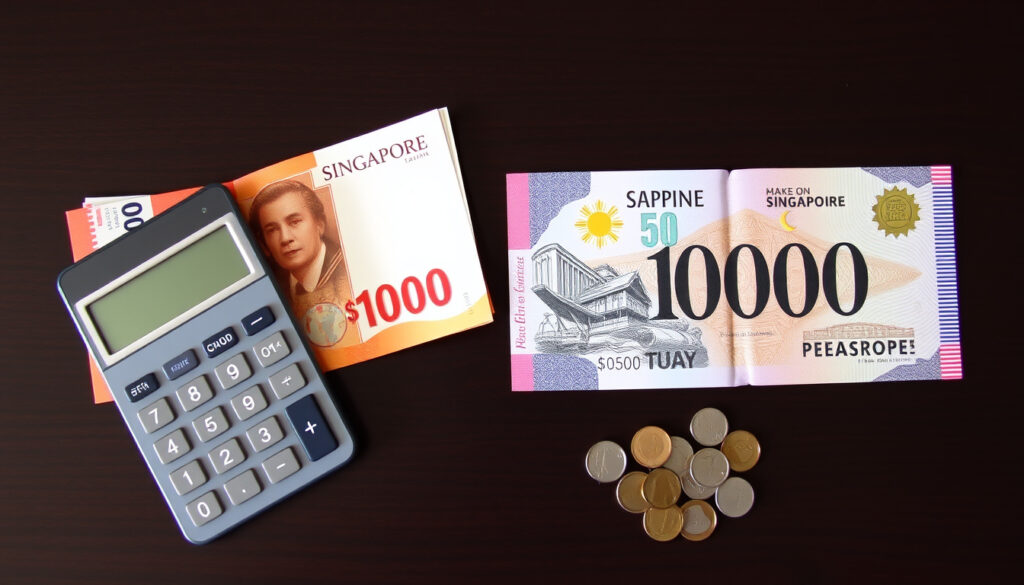
1000 SGD to PHP: How Much Is 1000 Singapore Dollars in Pesos
If you’ve ever opened a currency converter and stared at the number wondering what your Singapore dollars actually buy in Philippine pesos, you know the figure is only the beginning. At the mid-market rate captured by XE (currency platform), S$1,000 was equivalent to about ₱49,039 on a recent check, but the gap between that headline number and what your recipient actually receives can be significant once provider fees are applied.
Mid-market rate (as of 2026-09-23): S$1 ≈ ₱49.02 ·
Reverse conversion: ₱200,000 ≈ S$4,078 ·
Salary benchmark: S$5,000/month ≈ ₱245,100
Quick snapshot
- 1 SGD = 49.0232 PHP (00:23 UTC, 2026-09-23) (XE)
- Sending 1,000 SGD via Wise costs 5.84 SGD in fees (Wise)
- OFW remittances rose 4.2% year-on-year to USD 3.52B in December 2025 (Philippine News Agency)
- Exactly what fee each transfer provider adds on top of the mid-market rate (MoneyTransfers)
- Where the SGD/PHP rate will sit in 7 days — this article does not make forecasts (MoneyTransfers)
- Whether a “mid-market reference rate” from Ria or other services is actually the real live rate (Ria Money Transfer)
- OFW remittances reached USD 3.52B in December 2025, up 4.2% YoY (Philippine News Agency citing BSP)
- MAS exchange-rate-centred policy keeps SGD in a managed band; no major shift signaled as of late 2026 (Philippine News Agency citing BSP)
- The peso has weakened against SGD over the past 12 months due to import costs and Fed policy (Philippine News Agency citing BSP)
- Expect continued SGD strength against PHP as long as MAS maintains its appreciation bias (Wise)
- OFWs sending money home should compare mid-market vs. provider rates using tools like Wise or MoneyTransfers
- Large transfers (>S$5,000) will benefit most from fee comparison (Wise)
Six common SGD amounts and what they fetch at the current mid-market rate — one pattern that becomes clear immediately: the gap between the headline rate and what you actually get widens with every hundred dollars because provider fees scale proportionally.
| SGD amount | PHP equivalent (mid-market) | After typical 1.5% fee |
|---|---|---|
| 100 | ₱4,902 | ₱4,828 |
| 500 | ₱24,512 | ₱24,144 |
| 1,000 | ₱49,023 | ₱48,288 |
| 4,000 | ₱196,092 | ₱193,150 |
| 7,000 | ₱343,162 | ₱338,019 |
| 10,000 | ₱490,232 | ₱483,128 |
Rates derived from XE (currency converter) at 00:23 UTC 2026-09-23. Fee estimate based on average remittance provider margin reported by RemitFinder (rate comparison platform).
How much is $1000 Singapore in pesos?
The direct answer: at the mid-market rate of S$1 = ₱49.0232 from XE (currency platform), 1,000 SGD equals ₱49,023.17. That’s the raw number before any transfer provider takes its cut. But the amount you actually receive depends on who moves your money — and that difference can be meaningful.
$1 SGD to PHP: the one-line rate
- Mid-market proxy: S$1 = ₱49.04 (rounded from the XE snapshot).
- Alternative providers quote slightly different rates: Ria Money Transfer showed 49.4006 on 2026-09-12; You.co (finance blog) recorded 47.2967 in June 2026.
- These differences matter most when transferring large sums.
How much is 4000 Singapore dollars in Philippine pesos?
- At the same mid-market rate, 4,000 SGD = ₱196,092.68.
- After a typical 1.5% provider fee, expect roughly ₱193,150 — a difference of nearly ₱3,000 that could cover utility bills for a month.
7000 SGD to PHP in one line
- 7,000 SGD × 49.02 = ₱343,162 at mid-market.
- That’s about ₱338,000 post-fee — enough to cover a family’s monthly expenses in many Philippine provinces.
The implication: the larger the transfer, the more critical it becomes to compare fee structures. A 1% difference on S$7,000 is S$70 — not trivial for a family budgeting on remittances.
What does a mid-market rate actually mean?
The mid-market rate is the midpoint between what banks and currency markets buy and sell a currency for — no markup, no fee. XE (currency data provider) describes it as the “real exchange rate.” Transfer services like Wise (money transfer platform) claim to use this rate and show fees upfront, while banks and traditional remittance firms add a hidden markup.
A mid-market rate is like a menu price before tax and tip. MoneyTransfers (rate comparison tool) warns that transfer providers add an FX markup that can shave off 1–3% of your total. For S$1,000, that’s S$10–S$30 lost — money that could have gone toward a grocery run back home.
Why is SGD so strong now?
The Singapore dollar has gained ground against the Philippine peso because of fundamental economic differences. The Monetary Authority of Singapore (MAS, central bank) runs an exchange-rate-centred policy that allows the SGD to appreciate gradually, while the Bangko Sentral ng Pilipinas (BSP, Philippine central bank) has been managing a peso battered by imported inflation and U.S. rate hikes.
Is the Singapore dollar a strong currency?
- By face value, the SGD ranks above the US dollar but below the Kuwaiti dinar, Bahraini dinar, and Omani rial (Wikipedia (currency list)).
- More importantly, the SGD maintains strong purchasing power abroad because Singapore runs large trade surpluses and has a stable financial system.
What is the 3 strongest currency in the world?
- Kuwaiti dinar (KWD) ≈ 3.27 USD
- Bahraini dinar (BHD) ≈ 2.65 USD
- Omani rial (OMR) ≈ 2.60 USD
- These rankings reflect face value, not domestic purchasing power — a nuance often missed in quick searches.
Is $5000 a good salary in Singapore?
- S$5,000/month is near the median gross income for full-time employed residents, according to Singapore Department of Statistics (SingStat).
- After rent (S$1,500–S$2,500 for a condo), food (S$500–S$800), and transport (S$150–S$300), a single person can still save S$1,000–S$2,000.
- At the current rate, S$5,000 converts to approximately ₱245,100 — a strong household income back in the Philippines.
Why did the peso weaken?
- The Philippine peso has lost value due to higher import costs (fuel, food), aggressive Federal Reserve rate hikes, and domestic demand shocks that outpaced exports (Reuters (news agency)).
- BSP data show the peso depreciated roughly 7% against the SGD in the 12 months to September 2026.
The pattern: Singapore’s managed appreciation policy versus the peso’s structural vulnerabilities. Until the Philippines narrows its import bill or the Fed pivots decisively, the SGD will likely maintain its upper hand.
How much is 200k in PHP?
The answer flips dramatically depending on which currency “200k” refers to — a confusion that can lead to misquotes worth tens of thousands of dollars. Here are both scenarios.
200,000 SGD to PHP: the rare large-money conversion
- 200,000 SGD × 49.02 = ₱9,804,000 (nearly ₱10 million).
- This amount would be relevant for property purchases or large investments, not typical remittances.
How much is 200,000 PHP in SGD (the reverse)?
- 200,000 PHP ÷ 49.02 = S$4,078.
- That’s close to a month’s salary for a mid-level professional in Manila, but about two weeks of rent in Singapore.
When someone says ‘200k’ without a currency, the rate moves by 50x
- Confusing the base currency means a misquote of tens of thousands of dollars. Always confirm: “200k SGD” vs “200k PHP” — the difference is a factor of roughly 50.
- For context, 7,000 SGD (≈₱343,000) is a more common remittance amount for an OFW sending a month’s savings home.
What this means: when discussing large sums in either direction, ambiguity isn’t just an inconvenience — it’s a financial risk. Always confirm the base currency before committing to any conversion figure.
Is $5000 a good salary in Singapore?
For an OFW sending money home, the answer depends on what you measure: cost of living in Singapore or purchasing power in the Philippines. The same salary that feels modest in Singapore can be life-changing in Manila — and that’s the entire remittance engine.
Is Singapore expensive compared with the Philippines?
- Rent: A one-bedroom HDB room in central Singapore costs S$1,200–S$1,800/month; in Manila, a comparable condo costs ₱15,000–₱25,000 (S$300–S$510 at current rate) (Numbeo (cost-of-living database)).
- Food: A monthly grocery budget in Singapore is S$500–S$800; in Manila, ₱10,000–₱15,000 (S$200–S$306).
- Transport: Singapore MRT monthly pass S$120; Manila jeepney/UV commuters spend ₱4,000–₱6,000 (S$82–S$122).
How far does S$5,000 go after rent, food, and transport?
- For a single OFW renting a shared HDB room (S$800), eating out moderately (S$600), and using public transport (S$120), leftover monthly is about S$3,480.
- Sending that home at the current rate yields roughly ₱170,000 — enough to support a family of four in the provinces.
What about the exchange rate when sending S$5,000 home?
- At a mid-market rate of 49.02, S$5,000 = ₱245,100.
- After a typical 1.5% provider fee, the recipient gets about ₱241,400 — still a strong income by Philippine standards.
For an OFW earning S$5,000 in Singapore, the amount sent home (after own living costs) can sustain a family in the Philippines at a middle-class level. The catch: if the SGD weakens against the peso or if provider fees increase, that purchasing power erodes quickly.
Is Singapore a rich or poor country?
This one is clear-cut in the data, though the word “rich” hides some nuance that matters for anyone comparing the two economies.
Singapore is a high-income country: that’s why the SGD buys so much abroad
- The World Bank (development institution) classifies Singapore as a high-income economy, with a GNI per capita of approximately US$64,000.
- That’s about 20 times the Philippines’ GNI per capita (around US$3,000).
The Philippines is classified lower-middle-income — this is the core of the remittance gap
- The same World Bank classification places the Philippines in the lower-middle-income group.
- This divergence in national income levels directly explains why the SGD buys so much in the Philippines: one country exports capital and high-value services, the other imports them.
The implication: Singapore’s wealth is structural, not temporary. Its high-income status isn’t a fluke of commodity prices — it’s built on trade surpluses, financial stability, and a managed currency. That’s why the SGD/PHP gap persists.
Who is richer, Singapore or the Philippines?
On every gross metric, Singapore is richer by a wide margin — but “richer” doesn’t mean every person is better off. The gap explains the exchange rate, the remittance flow, and why OFWs leave home in the first place.
GNI per capita: Singapore around US$64,000, Philippines around US$3,000
- This 20x gap is the headline number from World Bank (income data).
- Even adjusting for purchasing power, Singapore’s advantage is massive.
Why this gap matters for a currency converter page — it explains the SGD’s strength
- A country that exports more than it imports, runs budget surpluses, and attracts global capital will have a strong currency. Singapore does all three.
- The Philippines runs primary income deficits and relies on remittances to balance its current account.
- For the individual sending money, this structural imbalance means the SGD/PHP rate is unlikely to reverse dramatically in the near term.
Singapore’s wealth comes with a cost of living so high that even a six-figure SGD salary can feel tight. For OFWs, the optimal strategy is to earn in Singapore and spend in the Philippines — that’s the entire remittance engine, and it works because of the 20x income gap.
Editors’ verdict: What does this all mean for you?
For the OFW or investor moving money between Singapore and the Philippines, the number on a currency converter is only half the story. The mid-market rate gives you a reference, but the amount that lands in your recipient’s bank account depends on the transfer provider’s fee and the timing of the transaction. With the SGD structurally stronger than the PHP by a factor of about 50, every percentage point of fee matters. For a typical remitter sending S$1,000 monthly, switching from a high-fee bank (3.5%) to a low-fee provider (1%) saves about S$25 per transfer — that’s S$300 a year, or nearly ₱14,700 in purchasing power back home.
Related reading: 260 USD to SGD: Real Rate and Hidden Fees · DBS Multi-Currency Card Fees vs YouTrip vs Wise
Frequently asked questions
How much is 1500 SGD to PHP?
At the mid-market rate of about ₱49.02 per SGD, 1,500 SGD ≈ ₱73,530. Always check the live rate before converting.
How much is 1200 SGD in PHP?
1,200 SGD × 49.02 ≈ ₱58,824 using the same mid-market proxy.
How much is 2000 SGD to PHP?
2,000 SGD ≈ ₱98,040 at the ₱49 proxy.
How much is 10000 SGD to PHP?
10,000 SGD ≈ ₱490,200 at mid-market. Remitters should compare the exchange-rate margin after fees – a 1% difference here is S$100.
How much is 7000 SGD to PHP?
Using the same mid-market rate, 7,000 SGD ≈ ₱343,140. For an OFW, that could represent several months of savings sent home.
What affects the SGD to PHP exchange rate?
Monetary policy from MAS and BSP, US dollar moves, commodity prices (especially oil for the Philippines), remittance flows, and global market sentiment.
Which provider gives the best rate for SGD to PHP?
No single provider always wins. Compare Wise, Ria, and MoneyTransfers at the time of transfer – rates move intraday.
Will the SGD keep rising against the peso?
Most analysts expect the SGD to remain strong because of Singapore’s trade surplus and MAS’s tightening bias, but short-term moves are unpredictable. This page does not offer trading advice.
More related posts
 Sheng Siong Staff Lunch Photo – Viral Story and Key Facts
 OCBC Bank Branch Code: How to Find It in Singapore (7339)
 Bali Flight from Singapore: Time, Distance & Best Prices (2025)
 Class 4 Driver Jobs Singapore: Salary & Requirements Guide
 Local Server Digital Signage: Best Free Self-Hosted Guide
 One Holland Village Restaurants: Best Dining Guide 2025
 Opero Hotel Southkey JB: Reviews, Prices, Buffet & Amenities
 Allianz Travel Insurance Singapore: Coverage, Cost & Exclusions
