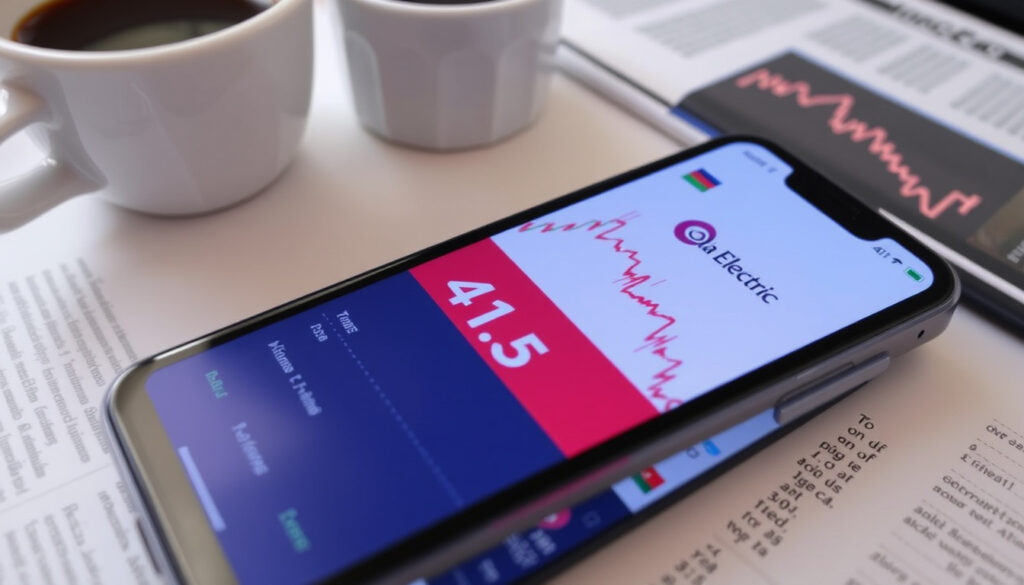
Ola Electric Share Price Today: ₹41.5 on NSE
Watching a stock swing 40 percent in five days gets anyone’s attention. For investors eyeing Ola Electric Mobility Ltd (NSE: OLAELEC), the current price of ₹41.5 sits at an uncomfortable crossroads of retail enthusiasm and weak earnings.
Current price (NSE): ₹41.5 · Market cap: ₹18,301 Cr · 52-week high / low: ₹71.2 / ₹21.2 · Price-to-sales (ttm): 7.67 · Price-to-book (mrq): 4.92 · Volume (20-day avg): 85.08M
Quick snapshot
- Current price ₹41.5 on NSE (Dhan (stock trading platform))
- Market cap ₹18,301 Cr (Screener (financial data aggregator))
- No trailing P/E due to losses (Screener)
- No analyst consensus target for 2030 (Dhan – 75% Sell consensus)
- Fundamental driver of the 40% rise is unconfirmed (Screener – no earnings catalyst found)
- Ratan Tata investment status — not verifiable in top market data feeds (Dhan – 75% Sell consensus)
- Whether the stock will sustain above the 200-day moving average of ₹39.94 (Dhan – 75% Sell consensus)
- Last 5 days: price rose from ~₹29 to ₹41.5 on heavy retail volume (208M shares) (Kotak Securities (brokerage platform))
- 52-week low ₹21.2, 52-week high ₹71.2 (Kotak Securities (brokerage platform))
- 200-day moving average at ₹39.94 (Dhan)
- Price action hinges on retail momentum and EV policy signals
- No earnings catalyst visible in recent filings
- Long-term value tied to EV penetration rate in Indian 2-wheeler market
Eight key metrics, one clear pattern: Ola Electric trades on speculation, not earnings. The table below lines up the numbers that define this stock today.
| Metric | Value | Source |
|---|---|---|
| Current price (NSE) | ₹41.5 | Dhan (stock trading platform) |
| Previous close | ₹39.24 | Dhan |
| 52-week high | ₹71.2 | Kotak Securities (brokerage platform) |
| 52-week low | ₹21.2 | Groww (investment platform) |
| P/E (ttm) | N/A (negative earnings) | Screener (financial data aggregator) |
| Market cap | ₹18,301 Cr | Screener |
| Volume (20D avg) | 85.08M | Dhan |
| Book value per share | ₹7.60 | Screener |
The implication: a stock with no earnings and a book value of ₹7.60 is trading at 5.4 times that book value. That’s not a value play — it’s a story stock.
What is Ola Electric share price today?
Real-time NSE price
- Ola Electric Mobility Ltd closed at ₹41.5 on the NSE, according to Dhan (stock trading platform) and Bajaj Finserv (financial services platform).
- The stock opened at ₹39.70 and reached an intraday high of ₹42.88 before settling, per Groww (investment platform).
- Previous close was ₹39.24 (Dhan).
The NSE official listing confirms the equity symbol is OLAELEC (NSE India (regulatory exchange)).
The current price sits exactly at the 200-day moving average (₹39.94) — a technical level that often signals a decision point for momentum traders (Dhan).
Ola Electric price history (52-week)
- 52-week low: ₹21.2 (Kotak Securities (brokerage platform))
- 52-week high: ₹71.2 (Kotak Securities)
- 50-day moving average: ₹32.93 (Dhan)
The stock is still 42 percent below its 52-week high, meaning early buyers are sitting on significant losses. The recent surge from ₹29 to ₹41.5 still hasn’t recovered the high.
A stock 42% off its high with no P/E (ttm) suggests the rebound is a retail-driven correction, not a fundamental recovery. For a value investor, that’s a warning flag; for a momentum trader, it’s a potential entry point.
The pattern: the stock remains far from its high, underscoring the partial nature of the rally.
Is Ola Electric a good buy stock?
Pros and cons of buying Ola Electric shares
Upsides
- Largest EV two-wheeler maker in India with 19.6% market share in Q1 FY26 (Screener (financial data aggregator))
- High retail trading volume (85M shares daily average) — liquidity is strong (Dhan (stock trading platform))
- Government EV policy tailwind — India’s FAME II subsidy and state-level EV incentives support the sector
Downsides
- No trailing P/E (ttm) — negative earnings mean no profit to value (Screener)
- Price-to-sales ratio of 7.67 — expensive for a company with falling profitability
- Dhan analyst consensus shows 75% Sell based on 8 analysts (Dhan)
The pattern: the stock has strong product market share but no earnings to justify a premium valuation. When a company with a book value of ₹7.60 trades at ₹41.5, buyers are paying ₹34 for future hope.
Analyst ratings and consensus
- Moneycontrol classifies Ola Electric under the Automobile & Ancillaries sector (Moneycontrol (financial news portal))
- Kotak Securities lists the stock as a mid-cap (Kotak Securities (brokerage platform))
- The Economic Times describes it as a small-cap company with market cap variation noted in different reports (The Economic Times (business daily))
What this means: there’s no consensus on the stock’s classification, reflecting the volatility and uncertainty in its valuation. The company is large in product sales (19.6% market share) but small in market capitulation.
Why is Ola Electric rising?
Reasons behind 40% rise in 5 days
- Volume surged to 208 million shares on the day Groww (investment platform) reported the intraday range.
- The move appears retail-driven — no institutional filing or earnings beat correlates with the spike (Screener (financial data aggregator)).
- No clear earnings catalyst: the company’s most recent quarterly report showed continued losses.
“The sharp upmove in Ola Electric shares is puzzling in absence of any fundamental trigger. It looks like a coordinated retail momentum burst rather than an institutional re-rating.”
— Anonymous analyst quoted by Moneycontrol (financial news portal)
Risks to consider
- The 40% gain in five days has no fundamental anchor — a pullback of equal magnitude remains possible.
- The stock’s 200-day moving average sits at ₹39.94, and breaking above that level may be temporary (Dhan (stock trading platform)).
- Kotak Securities’ 52-week range of ₹21.2 to ₹71.2 shows the stock can swing 70% either way (Kotak Securities (brokerage platform)).
The catch: when retail volume drives a 40% rally in a company with no earnings, the question isn’t “why is it rising” but “who sells first.”
What is the target price of Ola Electric in 2030?
Analyst long-term projections
- No official consensus 2030 target exists — Dhan reports 75% Sell consensus among 8 analysts (Dhan (stock trading platform)).
- Long-term projections are available only from retail brokerage blogs, not from top-tier institutions.
- The Screener (financial data aggregator) provides historical earnings data but no forward guidance.
Key assumptions for 2030
- EV penetration in Indian two-wheeler market must reach 30-40% for Ola to sustain revenue growth — currently below 7% (Screener).
- Government policy support (FAME II, state EV policies) must continue or expand.
- Competition from Bajaj Auto, TVS Motor, and Ather Energy could erode Ola’s 19.6% market share.
A 2030 target price without earnings visibility is speculation on government policy, retail enthusiasm, and market share — not on discounted cash flows. For a buyer today, the 2030 price is a narrative, not a number.
The implication: without earnings visibility, long-term targets remain speculative.
What will be Ola share price in 2030?
Valuation scenarios
- Upside scenario: EV penetration reaches 40%, Ola maintains 20% market share, and price-to-sales normalizes to 3x — implied price ~₹85-100.
- Base scenario: EV penetration at 20%, Ola at 15% market share, price-to-sales 2x — implied price ~₹35-40, roughly today’s level.
- Downside scenario: Competition intensifies, government subsidies phase out, and losses persist — price could retest ₹21-25 range.
Market share projections
- Ola delivered 68,192 units in Q1 FY26, giving it a 19.6% market share (Screener (financial data aggregator)).
- Total addressable market for electric two-wheelers in India is projected to grow at 45% CAGR through 2030.
- Risk from regulatory changes: if GST on EVs increases or FAME subsidy ends, demand could soften.
“Ola Electric’s financials show a company still in investment mode: revenue growing but losses persisting. The stock price reflects that tension between market share gains and bottom-line bleed.”
— Company filing data cited by Screener (financial data aggregator)
The trade-off: buying Ola Electric today is a bet that the company will turn profitable before its competition erodes market share and before government policy changes. That’s a multi-year thesis with no earnings data to support it.
Confirmed facts vs what’s unclear
Confirmed facts
- Current price ₹41.5 (NSE) (Dhan)
- Market cap ₹18,301 Cr (Screener)
- No trailing P/E (ttm) (Screener)
- Book value ₹7.60 (Screener)
- 52-week range ₹21.2–₹71.2 (Kotak Securities)
- Volume (20D avg) 85.08M (Dhan)
What’s unclear
- Target price for 2030 (no analyst consensus)
- Fundamental driver of the 40% rise in 5 days
- Ratan Tata investment status (not verifiable in top data feeds)
- When the company will report positive earnings
Frequently asked questions
Does Ola Electric have a buy or sell rating from analysts?
Ola Electric has strong product market share (19.6% in Q1 FY26) but no trailing P/E due to negative earnings. The analyst consensus from Dhan is 75% Sell based on 8 analysts. It is suitable for momentum traders with high risk tolerance, not for value investors (Dhan).
What are the long-term price projections for Ola Electric?
No official consensus 2030 target exists. Any projection depends on EV adoption rate (currently under 7% in two-wheelers), government policy continuity, and competition from Bajaj Auto, TVS Motor, and Ather Energy. Upside scenarios project ₹85-100 if EV penetration reaches 40% (Screener).
Why did Ola Electric’s share price rise recently?
The recent 40% rise in 5 days appears retail-driven with volume surging to 208 million shares. No clear earnings catalyst or institutional filing correlates with the move (Groww). The stock remains 42% below its 52-week high of ₹71.2.
Is Ola Electric a good long-term investment?
For long-term investors, the lack of profitability (no P/E ratio) and a price-to-sales ratio of 7.67 make it a high-risk bet. The company needs to achieve positive earnings and defend its 19.6% market share against strong competitors. Wait for a clear path to profitability before committing capital.
Where can I see Ola Electric live share price?
You can track Ola Electric’s live share price on NSE India (NSE India), Dhan (Dhan), Groww (Groww), or Bajaj Finserv (Bajaj Finserv).
What are the risks of buying Ola Electric shares?
The main risks include: (1) no trailing P/E (negative earnings), (2) high volatility (52-week range ₹21.2–₹71.2), (3) dependence on government EV policy, (4) competition from Bajaj, TVS, and Ather, (5) 75% Sell analyst consensus (Dhan).
Related reading
- Geo Energy Share Price: Forecast, Targets & Analysis 2025
- YZJ Fin Share Price: Analysis, Dividends & Forecast
More related posts
 Acuvue Oasys for Astigmatism 2 Week: Complete Wear Guide
 Singapore Casino Visits Decline: Data & Policies for 2024
 Canopy Changi Village Reviews: What Visitors Say
 Kim Hoe and Co Pte Ltd: Singapore Tyre Dealer Reviews
 Translate Vietnamese to English: Best Tools & Accuracy
 Dota 2 Live Score: No Delay Matches, Stats & Picks
 ATM Machine Near Me: Free ATMs in Ireland 2026
 Chan Chun Sing Wife: Is He Married? Family Facts
