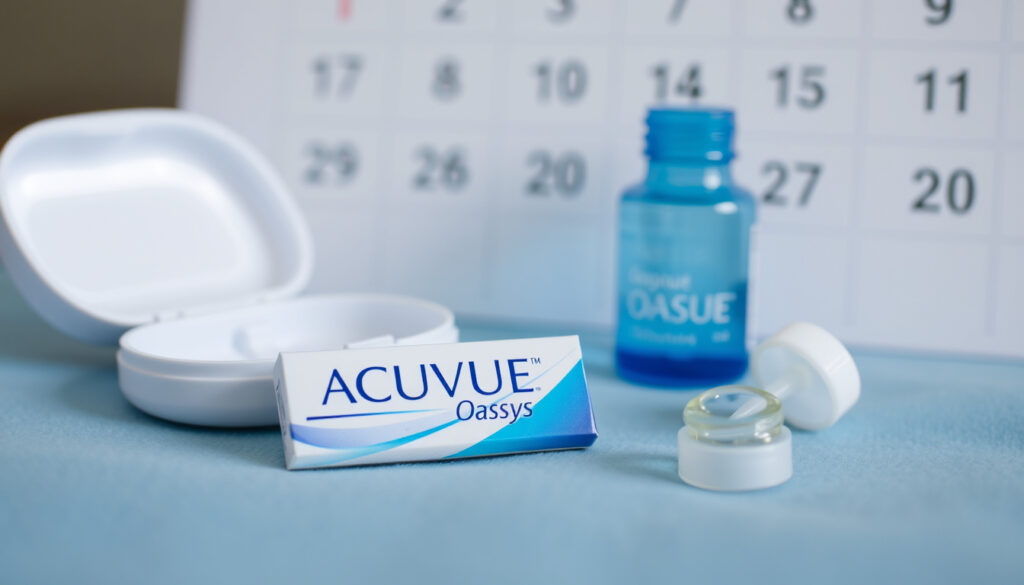
Acuvue Oasys for Astigmatism 2 Week: Complete Wear Guide
Anyone who’s worn toric lenses knows that stable vision can be elusive — one blink and the lens rotates, blurring the world. The Acuvue Oasys for Astigmatism, designed with a BLINK STABILIZED lens design, promises to lock the lens in place; clinical data from the manufacturer indicates that at least 93% of wearers achieve 20/20 vision after one week of use.
Replacement schedule: Every 2 weeks ·
FDA extended wear approval: Up to 6 nights ·
Material: Senofilcon A ·
Oxygen transmissibility (Dk/t): 147
Quick snapshot
- Replace every 2 weeks (J&J Vision Pro)
- FDA approved for up to 6 nights extended wear (J&J Vision Pro)
- Material: Senofilcon A (J&J Vision Pro)
- Exact year supply count may vary by retailer and prescription (Warby Parker)
- Individual vision stability results can differ depending on fit and eye shape (J&J Vision Pro)
- 93% 20/20 statistic is from manufacturer data; individual results vary (J&J Vision Pro)
- The 2-week schedule is designed to minimize protein deposit buildup and maintain oxygen flow (ACUVUE)
- Schedule an eye exam for a proper toric lens fitting (ACUVUE patient guide)
- Consider buying 6-lens boxes for a three-month supply (Warby Parker)
Six key specs define this toric lens, and one stands out: its oxygen transmissibility of 147 Dk/t, among the highest for 2-week silicone hydrogel lenses.
| Specification | Value |
|---|---|
| Material | Senofilcon A |
| Water content | 38% |
| Oxygen transmissibility (Dk/t) | 147 |
| FDA extended wear approval | Up to 6 nights |
| Lenses per box | 6 |
| UV blocking | Yes, Class 2 |
How long does Acuvue Oasys for Astigmatism last?
What is the official replacement schedule?
The manufacturer explicitly states these lenses are designed for a 2-week replacement schedule — that is, 14 days of daily wear after opening. Each lens should be discarded after two weeks, regardless of how many times you’ve worn it. J&J Vision Pro’s product page confirms that the standard pack of 6 lenses covers about 3 months’ worth of contact lenses (J&J Vision Pro).
Can you extend the wear time?
- No — wearing beyond 14 days increases the risk of protein deposits, reduced oxygen transmission, and infection. Warby Parker echoes that these are reusable for up to two weeks before disposal (Warby Parker).
- Signs of overuse include redness, discomfort, blurred vision, and sensitivity to light. ACUVUE’s patient instruction guide says not to wear lenses if you experience any eye problems until evaluated by a professional (ACUVUE patient guide).
The implication: the 2-week schedule isn’t a suggestion — it’s a safety boundary. Ignoring it puts your corneal health at risk for no visual benefit.
Can you sleep in Acuvue Oasys for 2 weeks?
Is it FDA approved for overnight wear?
Yes, the FDA has approved Acuvue Oasys for Astigmatism with Hydraclear Plus for up to 6 consecutive nights of extended wear. The manufacturer’s description notes that the lenses are designed for stable vision during extensive head and eye movements, which includes overnight use (J&J Vision Pro).
What are the risks of sleeping in contact lenses?
- Studies show that sleeping in any contact lens increases the risk of corneal ulcers and infections by six to eight times compared to daily wear. The American Academy of Ophthalmology strongly advises against routine overnight wear unless specifically prescribed.
- The phrase “for 2 weeks” refers to the replacement schedule, not continuous wear. Wearing the same lens overnight for 14 nights straight would violate the extended wear approval — you must remove and clean the lens each night after the first 6 consecutive nights.
You get up to 6 nights of approved extended wear, but each night you sleep in the lens increases the risk. For astigmatic wearers, who already have an irregular cornea shape, the risk of lens adherence and microbial keratitis is even higher.
The catch: even with FDA approval, overnight wear amplifies infection risk for astigmatic eyes. Daily removal is safer.
Is Acuvue Oasys a 2-week contact?
How often should you replace Acuvue Oasys lenses?
Yes — the product is explicitly a 2-week (bi-weekly) disposable toric lens. ACUVUE’s own product page lists the replacement schedule as every two weeks (ACUVUE). This is distinct from daily disposables (1-day) or monthly lenses.
What does ‘2-week’ mean for toric lenses?
- It means the lens is designed to be worn for up to 14 days from the moment you open the blister pack. After that, you discard it and insert a fresh lens.
- Toric lenses like this one use a BLINK STABILIZED design to keep the lens aligned with the astigmatic axis. The design remains effective throughout the 14-day period as long as you follow proper cleaning and storage (Warby Parker).
Why this matters: confusion between “2-week replacement” and “2-week continuous wear” leads many to overwear the lens. The lens will degrade in comfort and oxygen permeability by day 14 — pushing past that invites deposits.
How many boxes of 2-week contacts is a year supply?
How many lenses are in a box?
Each box of Acuvue Oasys for Astigmatism contains 6 lenses (J&J Vision Pro).
How many boxes needed per eye per year?
- For daily wear (no overnight), each eye uses 26 lenses per year (52 weeks ÷ 2 weeks). That equates to 4.33 boxes per eye, or ~5 boxes per eye when rounding up. A complete year supply for both eyes is typically 8–10 boxes.
- J&J Vision Pro also sells 12-lens and 24-lens packages, which correspond to about 6 and 12 months’ worth respectively (J&J Vision Pro).
- Warby Parker states that a 6-pack box gives about 3 months of lenses (Warby Parker).
The catch: year supply definitions vary by retailer and prescription. Some define it as 8 boxes (4 per eye), others as 10. Always check with your supplier and eye doctor to ensure continuity.
Can you wear 2-week contacts longer than 2 weeks?
What happens if you wear contacts past the recommended schedule?
Manufacturer and eye care professionals strongly advise against extending use beyond 14 days. The risk of deposits, reduced oxygen, and infection rises sharply after day 14. ACUVUE’s own guidance emphasizes following the wear and replacement schedule provided by your eye doctor (ACUVUE patient guide).
How to recognize signs of overuse?
- Symptoms include redness, discomfort, blurred vision, photophobia, and a feeling that something is in your eye. If any of these occur, remove the lenses immediately and seek professional evaluation.
- The FDA has not approved these lenses for use beyond 14 days. Overwearing can lead to corneal neovascularization and permanent scarring.
For the astigmatic wearer who values both clear vision and eye health, the 2-week schedule is a non-negotiable limit. Extending it trades a few dollars saved for a significant rise in clinical risk.
The pattern: the 14-day boundary is a clinical firewall, not a suggestion. Overstepping it invites irreversible damage.
Detailed specifications of Acuvue Oasys for Astigmatism
Beyond the basics, seven specs define how this lens performs: from its material to UV protection.
| Specification | Value |
|---|---|
| Material | Senofilcon A |
| Water content | 38% |
| Oxygen transmissibility (Dk/t) | 147 |
| UV blocking | 82% UVA / 97% UVB (Warby Parker) |
| Lens design | BLINK STABILIZED (Warby Parker) |
| Replacement schedule | 2 weeks (14 days) |
| Lenses per box | 6 |
What this means: the material and design specs support high oxygen flow and alignment, but only if the replacement schedule is followed.
Pros and cons of Acuvue Oasys for Astigmatism
Upsides
- High oxygen transmissibility (147 Dk/t) supports corneal health
- FDA approved for up to 6 nights of extended wear
- BLINK STABILIZED design keeps the lens aligned for stable astigmatism correction
- UV Class 2 protection blocks 82% UVA and 97% UVB
- Widely available in 6-lens, 12-lens, and 24-lens packages
Downsides
- Must be replaced every 14 days — not as convenient as dailies for occasional wear
- Extended wear carries significant infection risk, especially for astigmatic eyes
- Year supply cost can vary widely between retailers
- Not reusable after removal for extended wear cycle
The bottom line: the lens’s advantages hinge on disciplined adherence to the 14-day schedule. If you can’t commit to that, a daily disposable might be a better fit.
What experts say about these lenses
“The lenses should be replaced every two weeks to maintain optimal eye health and minimize deposit buildup.”
— Johnson & Johnson Vision Care, J&J Vision Pro product page
“Sleeping in contact lenses increases the risk of corneal ulcers and infections by six to eight times compared to daily wear. For astigmatic patients, the risk may be even higher due to lens adherence.”
— American Academy of Ophthalmology, AAO contact lens safety
For related eye care services, visit Kindred Family Clinic Macpherson. For a consumer product review example, see the Canmake Marshmallow Finish Powder Review.
Summary
Acuvue Oasys for Astigmatism delivers strong clinical performance — 93% of wearers see 20/20 after one week — but the lens’s value depends entirely on how you use it. The 2-week replacement schedule is the linchpin: follow it and you get a comfortable, high-oxygen toric lens with proven UV protection. Ignore it, and you invite infection. For the astigmatic wearer in the U.S., the choice is clear: treat the 14-day limit as a hard deadline, not a suggestion, or risk trading clear vision for corneal damage.
Frequently asked questions
What is Acuvue Oasys for Astigmatism made of?
It is made of Senofilcon A, a silicone hydrogel material with 38% water content. The material offers high oxygen transmissibility (Dk/t 147).
Can I reuse lenses after a few days?
No — each lens is designed for one use cycle up to 14 days. If you remove a lens, you must clean and store it appropriately before reinserting, but the total wear time cannot exceed 14 days from opening.
Are Acuvue Oasys for Astigmatism the same as regular Acuvue Oasys?
No — the astigmatism version is a toric lens that includes the BLINK STABILIZED design to keep the lens aligned on an astigmatic cornea. The regular Acuvue Oasys is a spherical lens.
How much do Acuvue Oasys for Astigmatism typically cost?
Prices vary by retailer. A 6-lens box typically ranges from $50 to $80 without insurance. Year supply costs can be $300–$600 depending on packaging and insurance coverage.
Do I need a prescription for Acuvue Oasys for Astigmatism?
Yes — contact lenses are medical devices. You need a valid prescription that includes your astigmatism correction (cylinder and axis) and base curve.
Can I wear them while swimming?
No — contact lenses should not be exposed to water. Swimming with lenses increases the risk of bacterial and amoebic infections, which can cause severe corneal damage.
How do I clean Acuvue Oasys toric lenses?
Use a multipurpose contact lens solution recommended for silicone hydrogel lenses. Rub and rinse each lens before storing, and always use fresh solution. Do not use saline alone — it does not disinfect.
More related posts
 Lion City Sailors vs Brunei DPMM – Result, H2H and Stats
 Yamaha MT-15: Price, Specs, Mileage & Beginner Review
 Sengkang Polyclinic Opening Hours: Mon-Fri 8:00am-1:00pm
 How to Fix a Slow Computer in Windows 11: 5 Proven Methods
 Tale of the Nine Tailed: Seasons, Ending & Season 3 News
 Is Influenza A Contagious? Spread, Risks & Isolation Guide
 Houston Rockets vs Golden State Warriors: Stats, Odds & History
 How to Schedule WhatsApp Messages on Android, iPhone, Web
