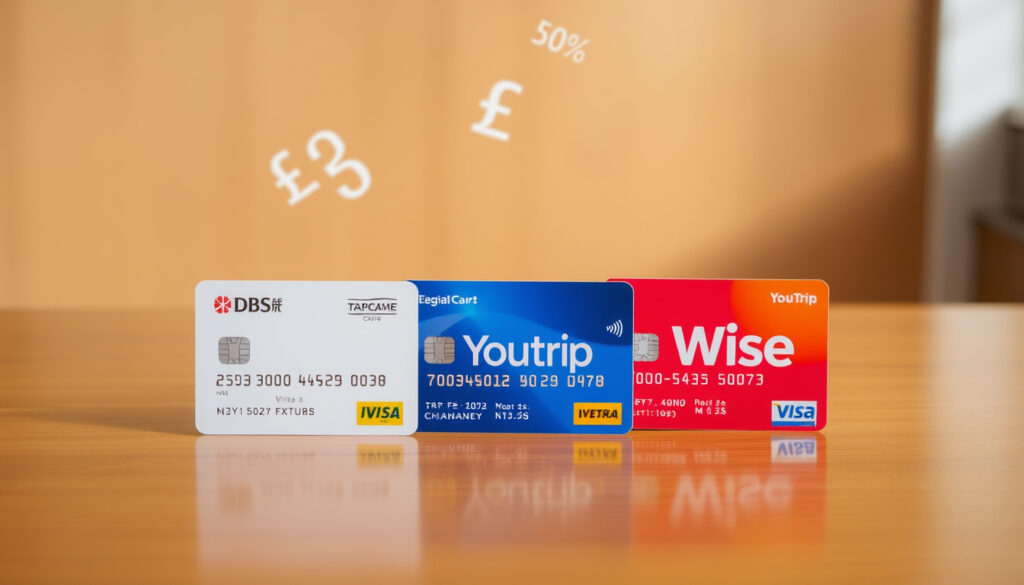
DBS Multi-Currency Card Fees vs YouTrip vs Wise
You’re packing for a holiday, and the usual question comes up: which card should I use to avoid hidden fees? The DBS Multi-Currency Visa Debit Card promises to let you spend in 11 foreign currencies without paying a cent in transaction fees — but only if you have those currencies pre-loaded in your travel wallet. This article breaks down the fees, the fine print, and how it stacks up against alternatives like YouTrip and Wise.
Currencies supported: 11 foreign currencies ·
Foreign transaction fee: 0% for supported currencies ·
ATM withdrawal fee overseas: S$7 per withdrawal ·
Link to account: DBS My Account
Quick snapshot
- No foreign transaction fee for the 11 supported currencies in the travel wallet (DBS foreign transaction fee guide)
- Overseas ATM withdrawal fee is S$7 per transaction (DBS card rates page)
- Up to 4% cashback on eligible overseas spending (DBS cards terms & conditions)
- Exact exchange rate mark-up when using a non-supported currency (stated as ‘Visa rate’ but the actual mark-up percentage is not disclosed)
- Whether the 4% cashback applies to all overseas merchants or only select merchant categories
- The card has been available for several years; no major fee changes announced in 2025 (DBS card rates page)
- DBS may introduce new currencies; watch for updates on the My Account travel wallet
| Attribute | Value |
|---|---|
| Card type | Debit card linked to DBS My Account |
| Supported currencies | 11 (AUD, CAD, CHF, EUR, GBP, HKD, JPY, MYR, NZD, THB, USD) |
| Foreign transaction fee | 0% for wallet currencies; Visa rate for others |
| Overseas ATM fee | S$7 per withdrawal |
| Cashback | Up to 4% on eligible overseas spending (T&Cs apply) |
Is the DBS debit card a multi-currency card?
The DBS Visa Debit card is a standard debit card linked to a DBS My Account. The multi-currency feature lives inside the account’s travel wallet — you can hold and spend in 11 foreign currencies. According to the DBS cards terms & conditions, the card is a debit card, not a credit card, so you can only spend what you have in your account.
What is the DBS My Account travel wallet?
- Think of it as a separate compartment within your DBS My Account where you can stash up to 11 different currencies.
- When you pay overseas, the card deducts from the corresponding currency wallet if you have sufficient balance. If not, it falls back to SGD and triggers a foreign exchange fee.
- You can top up the wallet via the DBS app or internet banking.
The travel wallet only saves you fees if you pre-load the exact currency you need. A traveler who often visits Japan will benefit from keeping JPY in the wallet, but a last-minute trip to a less common destination may still incur the 3.25% conversion fee.
The implication: the DBS multi-currency card is a good fit for travelers who plan ahead and frequent countries with supported currencies, but it’s not a universal fee-free solution.
What are the fees for using a DBS multi-currency card?
Three fee types matter most: ATM withdrawals, foreign transaction fees, and conversion fees. The DBS card rates page confirms a flat S$7 fee per overseas ATM withdrawal. For spending in a currency not held in your wallet, the DBS foreign transaction fee guide breaks down a 1% association fee plus a 2.25% bank fee, totaling 3.25%.
ATM withdrawal fees overseas
Every time you withdraw cash from an overseas ATM, DBS charges S$7. This is higher than some competitors: YouTrip offers free withdrawals at partner ATMs up to S$400 per month, and Wise (comparison review) allows up to 2 free withdrawals per month totalling S$350 before charging S$1.50 plus 1.75%.
Foreign transaction fees for non-supported currencies
If you spend in a currency not in your travel wallet, the card converts from SGD at the Visa exchange rate plus the 3.25% administrative fee. This is a common scenario for travelers visiting countries like South Korea, India, or Indonesia — none of which are in the 11-currency list.
The DBS card’s fee structure creates a clear split: zero cost for 11 specific currencies, but a steep 3.25% for everything else. A traveler who spends S$1,000 in a non-supported currency would pay S$32.50 in fees alone.
The trade-off: the DBS card is excellent for supported-currency destinations but can be expensive for others. Planning your currency pre-loading is essential to avoid the 3.25% hit.
Which multi-currency card is the best?
We compared the DBS Multi-Currency Visa Debit against YouTrip and Wise — the two most popular alternatives in Singapore. The table below highlights the key differences.
| Feature | DBS Multi-Currency | YouTrip | Wise |
|---|---|---|---|
| Supported currencies | 11 | 10 | 40+ |
| Foreign transaction fee | 0% for wallet currencies; 3.25% for others | 0% (Mastercard rate) | Mid-market rate + variable fee (from 0.43%) |
| ATM withdrawal fee | S$7 per withdrawal | Free up to S$400/month, then 2% | Free up to S$350/month (2 withdrawals), then S$1.50 + 1.75% |
| Annual fee | None | None | None |
| Top-up fee | Free via DBS bank transfer | Up to 1.5% via credit card; free via bank transfer or debit card | Free via PayNow or bank transfer |
Sources: DBS foreign transaction fee guide, Wise comparison review, You.co multi-currency card comparison.
DBS Multi-Currency Card vs YouTrip
YouTrip uses Mastercard’s wholesale exchange rate and charges no foreign transaction fee on any currency — not just a limited set. According to the Wise comparison review, YouTrip also offers free ATM withdrawals at partner ATMs up to S$400 per month, whereas DBS charges S$7 per withdrawal. The main advantage of DBS is the ability to hold multiple currencies in one account and the 4% cashback promotion, which YouTrip does not offer.
DBS Multi-Currency Card vs Wise Card
Wise supports over 40 currencies and uses the real mid-market exchange rate with a low conversion fee (starting from 0.43%). For frequent travelers to many countries, Wise is more flexible. However, DBS’s cashback and the fact that fees are zero for the 11 most common currencies (AUD, EUR, JPY, USD, etc.) can make it cheaper for those specific destinations. The Wise review of the DBS multi-currency account notes that the DBS card’s ATM fee is a drawback for cash-heavy travelers.
What are the benefits of the DBS Multi-currency Visa Platinum debit card?
Beyond fee avoidance, DBS promotes two main perks: cashback on overseas spending and wide acceptance.
Cashback on overseas spending
DBS offers up to 4% cashback on eligible overseas transactions. The exact terms are outlined in the DBS cards terms & conditions. However, it’s unclear whether this applies to all merchant categories — some user reports on social media suggest it may be limited to dining and shopping.
The upshot: the cashback can offset the ATM fee if you spend enough, but the lack of transparency on merchant eligibility means you shouldn’t rely on it for your entire trip budget.
Contactless payments and acceptance
The card works wherever Visa is accepted — millions of merchants worldwide. It supports contactless payments via Apple Pay and Google Pay, making it convenient for tap-and-go transactions.
The upshot: the cashback can offset the ATM fee if you spend enough, but the lack of transparency on merchant eligibility means you shouldn’t rely on it for your entire trip budget.
Which debit card is best for international travel?
Choosing the right card depends on your travel habits. For a Singaporean traveler, the DBS card is a strong option if you stick to the 11 covered currencies and avoid cash withdrawals. YouTrip and Wise offer more flexibility.
Debit card vs credit card abroad
Debit cards with no foreign transaction fees (like DBS, YouTrip, and Wise) are generally better for everyday spending because they don’t incur interest charges. However, credit cards may offer better purchase protection and rewards. The You.co comparison notes that cash is still better in countries with high card surcharges or limited acceptance, such as parts of Southeast Asia.
How to avoid foreign transaction fees
- Use a multi-currency card that supports the currencies you need.
- Pre-load the currency at a good exchange rate before your trip.
- Avoid dynamic currency conversion at the point of sale — always choose to pay in the local currency.
- Withdraw cash in large amounts to minimise per-transaction ATM fees.
The implication: the DBS card is a solid choice for structured travel to supported countries, but for spontaneous trips or diverse destinations, YouTrip or Wise may save you more.
Can I use my DBS multi-currency card overseas?
Yes, the DBS Visa Debit card works at any merchant that accepts Visa, including overseas ATMs. According to user reports on social media, the card functions reliably in popular destinations like Japan, Thailand, and Europe. Each ATM withdrawal incurs a S$7 fee, as noted on the DBS card rates page (see snapshot card above).
The implication: while the card is widely accepted, the S$7 ATM fee makes cash-heavy travel expensive. For destinations where card acceptance is high, this card works well.
Confirmed facts
- No foreign transaction fee for 11 supported currencies (DBS guide)
- Overseas ATM withdrawal fee is S$7 (DBS card rates)
- Up to 4% cashback on eligible overseas spending (DBS terms)
- It is a debit card, not a credit card (DBS terms)
What’s unclear
- Exact Visa exchange rate mark-up for non-supported currencies
- Whether the 4% cashback applies to all overseas merchants or only specific categories
- Whether the S$7 ATM fee is the same at all banks’ ATMs worldwide
“Pay for shopping, dining and leisure with your DBS Visa Debit Card in up to 11 foreign currencies with no foreign exchange fees.”
DBS official website product page
“The DBS Multi-Currency Visa Debit Card offers contactless payments and easy ATM withdrawals.”
Wise.com review article
For the Singaporean traveler who frequents Japan, Thailand, Europe, or Australia, the DBS Multi-Currency Card is a genuinely fee-free option — as long as you pre-load the right currency. But for those who touch down in multiple countries or rely on cash, the S$7 ATM fee and the 3.25% penalty for non-wallet currencies quickly eat into the savings. The choice is clear: stick with DBS if your travel pattern aligns with its 11 currencies, or look at YouTrip and Wise for broader coverage and lower ATM costs.
wise.com, dbs.com.sg, you.co, you.co, you.co, worldfirst.com
Frequently asked questions
Can I use a DBS multi-currency card to withdraw cash overseas?
Yes, you can use the DBS Visa Debit card at any overseas ATM that accepts Visa. Each withdrawal costs S$7, as per the DBS card rates page.
What happens if I spend in a currency not in my DBS travel wallet?
If you spend in a currency not held in your travel wallet, DBS will convert the transaction from SGD using the Visa exchange rate plus a 3.25% administrative fee (1% association fee + 2.25% bank fee).
Is the DBS multi-currency card better than a travel credit card?
It depends on your spending habits. The DBS card has no foreign transaction fees for supported currencies and no interest charges, but it doesn’t offer rewards miles. Credit cards may offer better purchase protection and rewards but often charge foreign transaction fees.
How do I top up my DBS My Account travel wallet?
You can top up via the DBS digibank app or internet banking. Transfers from your DBS My Account are free. You can also set up recurring transfers for specific currencies.
Does the DBS multi-currency card have an annual fee?
No, there is no annual fee for the DBS Multi-Currency Visa Debit card. The card is linked to a DBS My Account, which also has no monthly maintenance fee if you opt for eStatements.
Can I apply for the DBS multi-currency card if I am not a DBS customer?
You need to open a DBS My Account first. You can apply online if you are a Singaporean or PR. Once the account is opened, you can request the debit card.
What is the daily spending limit for the DBS Visa Debit card?
The daily spending limit is typically S$2,000 for overseas transactions, but you can adjust it via the DBS digibank app. The limit may vary based on your account type and history.
Related reading: DBS Multi Currency Account Minimum Balance Guide 2026 · Best Credit Card for Miles Singapore: Top Picks Compared
More related posts
 Simple Resignation Letter Sample: Free Template & Guide
 YZJ Fin Share Price: Analysis, Dividends & Forecast
 Hotel Jen Tanglin Buffet Price: 1-for-1 Deals & Promotions
 Where to Watch Ne Zha 1 Full Movie: Streaming Guide (2025)
 Dairy Farm Nature Park: Opening Hours, Trails & Dog Policy
 Samsung Galaxy Watch Ultra2: Price, Specs & Worth
 iOS 26 release date: launch, compatible iPhones, and features
 Tudor Black Bay 58: Price, Value, Variations, Durability
