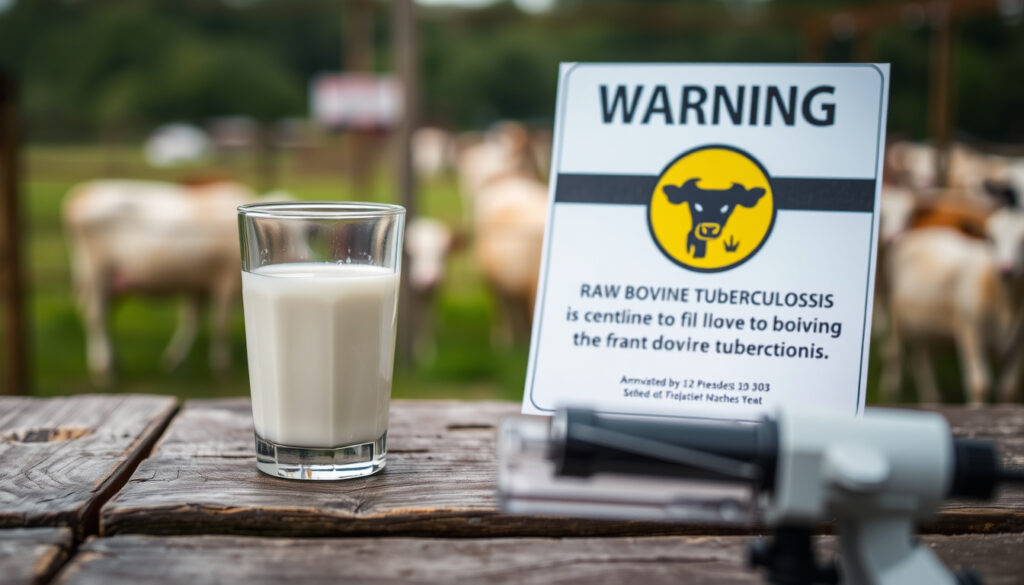
Singapore’s First Human Bovine TB Case: Raw Milk Risk
A 73-year-old former dairy farmer in Singapore spent decades drinking a glass of raw cow’s milk every day — a habit that, years after he stopped farming, would lead to a medical first for the country. Singapore’s Communicable Diseases Agency confirmed in December 2025 that the man had contracted bovine tuberculosis, caused by Mycobacterium bovis, marking the nation’s first known human case of the disease.
Singapore’s first human bovine TB case: 1 · Patient age at diagnosis: 73 years old · Years of raw milk consumption: 28 years · Year case identified: 2021
Quick snapshot
- First human bovine TB case in Singapore confirmed by Communicable Diseases Agency (The Straits Times)
- Patient is a 73-year-old Indian man who worked as a dairy farmer for 28 years (Malay Mail)
- Infection confirmed by whole genome sequencing as Mycobacterium bovis (Malay Mail)
- Patient completed standard TB treatment; no contacts infected (Malay Mail)
- Exact year the infection originally occurred during his farming days
- Whether other individuals who consumed the same raw milk supply may be infected
- Long-term health outcome of the patient after completing treatment
- 1970s–1990s: Patient works as dairy farmer, drinks raw milk daily (The Straits Times)
- 2021: Diagnosed with pulmonary TB; M. bovis identified (The Straits Times)
- December 2025: Public report published in The Straits Times
- Enhanced surveillance for bovine TB by Communicable Diseases Agency
- Public health advisory on avoiding unpasteurized milk
- Potential review of dairy import and raw-milk regulations
Six key facts — one pattern: a single, decades-old exposure route that led to a rare zoonotic infection.
| Disease | Bovine tuberculosis (Mycobacterium bovis) |
|---|---|
| First human case in Singapore | Yes (identified 2021, reported 2025) |
| Patient profile | 73-year-old Indian male, ex-dairy farmer |
| Probable source | Regular consumption of unpasteurized cow’s milk |
| Latency period | Decades (exposure stopped years before diagnosis) |
| Outcome | Treated with anti-TB drugs; recovery status not publicly detailed |
The table draws a clear line from raw-milk habit to rare infection, showing how a zoonotic pathogen can remain hidden for decades.
Are bovine TB and human TB the same?
Two different bacteria, one similar set of symptoms — here’s how bovine TB and human TB compare.
| Aspect | Bovine TB (M. bovis) | Human TB (M. tuberculosis) |
|---|---|---|
| Causative agent | Mycobacterium bovis (CDC (US public health authority)) | Mycobacterium tuberculosis |
| Transmission | Zoonotic: through unpasteurized milk or direct contact with infected animals (CDC) | Human-to-human via airborne droplets |
| Treatment | Standard anti-TB drugs, but may require longer regimens (Malay Mail) | Standard anti-TB drugs (isoniazid, rifampin, etc.) |
The implication: while both diseases present similarly in the lungs, the source and control strategies differ radically — bovine TB is a food-borne zoonosis that pasteurisation virtually eliminates.
Differences in bacteria: M. bovis vs. M. tuberculosis
- Mycobacterium bovis is part of the M. tuberculosis complex but primarily infects cattle (CDC).
- M. tuberculosis is almost exclusively a human pathogen.
- Both can cause identical pulmonary symptoms, but M. bovis often affects the lymph nodes and gastrointestinal tract when ingested.
The pattern: the same clinical picture can have two very different origins — one airborne, one dietary.
Transmission routes: zoonotic vs. human-to-human
- Bovine TB spreads from animals to humans, most commonly through unpasteurised dairy products (CDC).
- Human TB spreads through coughs and sneezes between people.
- Person-to-person transmission of M. bovis is possible but very rare; none found in this case (Malay Mail).
The catch: the same cough-symptom can mislead doctors if they assume only human-to-human transmission.
Clinical presentation and treatment
- Symptoms include cough, fever, night sweats, weight loss — same as human TB.
- The patient in Singapore was treated with standard TB medication and completed therapy (Malay Mail).
- Some M. bovis strains are naturally resistant to pyrazinamide, requiring tailored regimens.
Is TB endemic in Singapore?
Tuberculosis has never disappeared from Singapore, though incidence remains low and stable.
- Singapore reports around 30-40 cases per 100,000 population annually — a moderate burden for an Asian city-state.
- The National TB Programme conducts active case finding, contact tracing, and directly observed therapy.
- Most cases are due to M. tuberculosis; bovine TB had never been detected in a human until this case (The Straits Times).
Singapore’s low TB rate means a single rare zoonotic case stands out. The public health system must remain alert to infection sources outside the usual human-to-human chain.
Current TB incidence rates in Singapore
- In 2023, the incidence was 33.5 per 100,000, according to the Ministry of Health (Singapore’s health authority) (via CDC data).
- Rates have declined steadily over the past two decades due to robust control programmes.
The data confirms TB remains present but manageable — until a zoonotic wild card emerges.
Historical trends and control measures
- BCG vaccination has been universal at birth since the 1950s.
- Directly observed therapy (DOT) ensures completion of treatment.
- Active surveillance includes migrant screening and outbreak investigation.
Role of migrant populations
- Foreign-born individuals account for a disproportionate share of TB cases in Singapore.
- The patient in this case is an Indian-origin Singaporean, not a recent migrant.
What is the update on the tuberculosis situation in Singapore?
The most significant recent development is the announcement of Singapore’s first human bovine TB case, though the diagnosis itself dates back to 2021.
- The Communicable Diseases Agency confirmed the case in December 2025, based on a 2021 report from the National TB Programme (The Straits Times).
- The patient, a 73-year-old Indian man, had worked as a dairy farmer and consumed raw milk daily for 28 years (Malay Mail).
- Whole genome sequencing confirmed Mycobacterium bovis, and no other linked cases have been found (Malay Mail).
Announcement of first human bovine TB case in 2025
- The case was published as a letter in the Singapore Medical Journal by researchers from Tan Tock Seng Hospital, the National Public Health Laboratory, and Singapore General Hospital.
- The Straits Times broke the news on December 29, 2025.
Details of the 73-year-old ex-dairy farmer
- He worked as a dairy farmer until 1990 and drank at least one glass of raw cow’s milk daily.
- He had no known contact with other TB patients (Malay Mail).
- He completed treatment with standard TB drugs; his contacts all tested negative (Malay Mail).
The pattern: a closed-case — one patient, no secondary spread — but a warning that the pathogen entered Singapore’s food chain decades ago.
Public health response and recommendations
- Enhanced surveillance for bovine TB has been initiated by the Communicable Diseases Agency.
- Public advisory reiterates the importance of consuming only pasteurised milk and dairy products (CDC).
A disease linked to raw milk from decades ago surfaces in a city where pasteurised milk is ubiquitous. The case shows that old habits can have very long tails.
Are Singaporeans vaccinated against TB?
Yes, BCG vaccination has been standard at birth in Singapore since the 1950s.
- The BCG vaccine is part of the National Immunisation Schedule, given at birth (Ministry of Health Singapore).
- BCG provides partial protection against severe forms of TB, including some protection against M. bovis in animal studies.
- Coverage rates exceed 95% in Singapore.
BCG vaccination policy in Singapore
- Mandatory for all newborns; catch-up vaccination for children up to age 15 who missed the shot.
- Booster doses are not routinely recommended.
The implication: near-universal BCG coverage helps, but it does not eliminate the risk of bovine TB from raw milk.
Effectiveness of BCG against bovine TB
- BCG is derived from M. bovis and can confer cross-protection, but it is not 100% effective.
- Studies suggest it reduces the risk of severe disease but not necessarily infection.
Vaccination coverage rates
- Singapore reports >95% BCG coverage at birth.
- Despite high coverage, TB persists at low endemic levels, meaning vaccination alone cannot eliminate the disease.
Do cows with TB have to be slaughtered?
Yes — in most countries, cattle that test positive for bovine TB are culled to prevent spread within herds and to humans.
- Singapore does not have a large cattle population, but it imports dairy products and enforces strict veterinary controls.
- The patient worked on a local dairy farm; it is unclear whether the herd was tested or culled at the time.
- Globally, culling is the primary control measure, though testing-and-slaughter policies vary (CDC).
Bovine TB control measures in livestock
- Skin tests and interferon-gamma assays are used to identify infected cattle.
- Positive animals are usually slaughtered to stop transmission.
The pattern: culling breaks the transmission cycle at the animal level, but human cases like this one reveal historical exposures that testing missed.
Slaughter policies in Singapore and globally
- Singapore requires all imported dairy to be pasteurised; fresh milk from local farms is limited.
- The UK and Ireland operate large-scale culling programmes for badgers and cattle.
Economic and ethical considerations
- Culling has economic impact on farmers and raises animal welfare concerns.
- Vaccination of cattle (BCG) is used in some countries but not widely adopted.
Timeline: Singapore’s first human bovine TB case
- 1970s–1990s: Patient works as a dairy farmer, drinks raw milk daily (Malay Mail).
- 2021: Patient diagnosed with pulmonary tuberculosis; laboratory identifies Mycobacterium bovis via whole genome sequencing (Malay Mail).
- December 2025: The Straits Times publishes report of Singapore’s first human bovine TB case (The Straits Times).
Confirmed facts
- Case of human bovine TB in Singapore confirmed by molecular testing.
- Patient history of raw milk consumption for 28 years.
- No evidence of person-to-person transmission from this case.
What’s unclear
- Exact year when infection occurred (likely during farming period).
- Whether other individuals who consumed the same raw milk are infected.
- Long-term health outcome of the patient after treatment.
“This case highlights that bovine TB can remain dormant for decades and emerge long after exposure ends. It reminds us that zoonotic risks don’t disappear just because a person leaves the farm.”
— Dr. Gan SH, lead author of the case letter in the Singapore Medical Journal
“We have enhanced surveillance systems to detect any further cases of bovine TB. The public is advised to consume only pasteurised milk and dairy products.”
— Spokesperson, Communicable Diseases Agency (as reported by The Straits Times)
For Singapore’s public health authorities, this case is a wake-up call that pasteurisation awareness cannot be taken for granted. For the general population, the takeaway is clear: raw milk carries a real, if rare, risk of bovine TB infection. For dairy regulators, the implication is equally direct — strengthen import controls and consumer education, because the next case might not be delayed by decades.
Related reading: Hepatitis B Vaccine Singapore: Costs & Guide · Rodent Found in Miso Soup: Sukiya Closes 2000 Stores
pmc.ncbi.nlm.nih.gov, facebook.com, geneticliteracyproject.org
Medan opastöriserad mjölk kan bära smittor som bovin tuberkulos, används andra bovina produkter, såsom bovint kollagen som tillskott, ofta i hälsokostsammanhang.
Frequently asked questions
Can bovine TB be transmitted from person to person?
Person-to-person transmission of M. bovis is extremely rare. In this Singapore case, no close contacts tested positive (Malay Mail).
How is bovine TB diagnosed in humans?
Through chest X-rays, sputum culture, and molecular tests like whole genome sequencing that identify M. bovis (CDC).
Does pasteurization kill Mycobacterium bovis?
Yes, pasteurisation at 63°C for 30 minutes or 72°C for 15 seconds kills M. bovis (CDC).
What are the symptoms of bovine TB in humans?
Symptoms include persistent cough, fever, night sweats, weight loss, and fatigue — identical to human TB.
Is bovine TB treatable with standard TB drugs?
Yes, but some strains are resistant to pyrazinamide, so drug susceptibility testing is important. The patient in Singapore completed standard treatment successfully (Malay Mail).
Should I avoid all raw milk products in Singapore?
Yes, health authorities advise consuming only pasteurised milk and dairy products. Raw milk is not widely sold but still available in some specialty outlets.
What is the BCG vaccine’s role against bovine TB?
The BCG vaccine provides partial protection, especially against severe forms, but does not guarantee immunity against M. bovis infection.
Are there any other known cases of bovine TB in humans in Singapore?
No. The Communicable Diseases Agency states this remains Singapore’s only known human case (Malay Mail).
More related posts
 Lilo & Stitch at Gardens by the Bay: Complete Visitor’s Guide
 RHB Fixed Deposit Rate: Current Rates & Comparisons
 Margaret Drive Hawker Centre: 10 Must-Try Stalls & 2026 Guide
 Transtar Bus to JB: Schedule, Price & Booking
 Jimmy Kimmel Suspended Over Charlie Kirk Comments: Fallout
 Human Made T-Shirts: Styles, Prices & Buying Guide
 Words with Friends Cheat: How Word Finders Work
 Go Hyun-jung: Actress Bio, Career, Family & News
