Yang Chow Fried Rice: What It Is, Recipe & Comparison
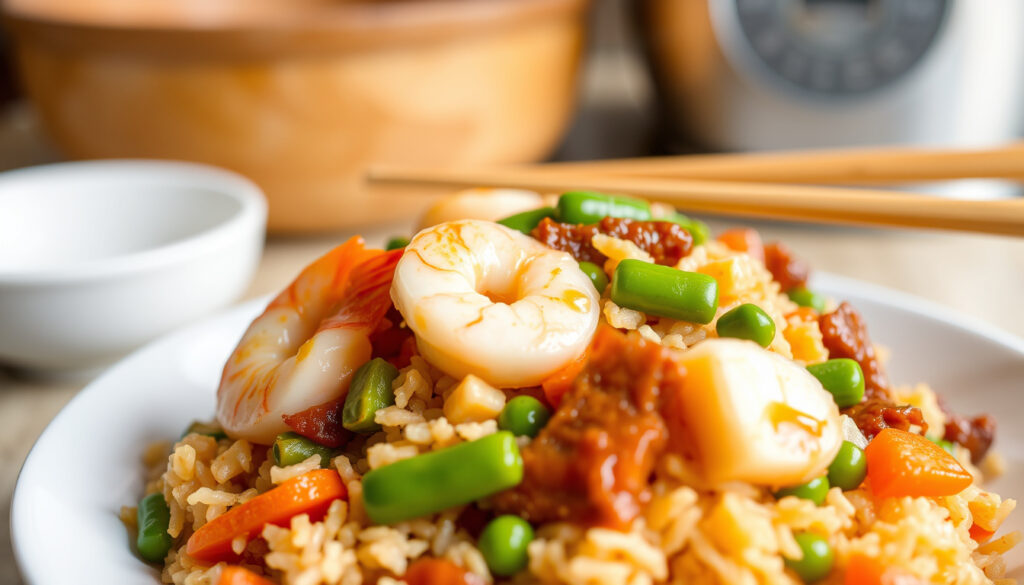
There’s something about a heaping plate of Yang Chow fried rice that feels like the ultimate comfort takeout — studded with shrimp and pork, each grain separate, carrying that faint smoky char from a screaming-hot wok. This guide traces the dish from its origins in Yangzhou, China, through its many variations across Cantonese kitchens and Western Chinese takeout menus, so you can tell the authentic versions from the adaptations and make a solid one at home.
Origin: Yangzhou, China ·
Key Ingredients: Rice, eggs, shrimp, pork, scallions ·
Calories (per serving): Approximately 400-500 kcal ·
Cooking Technique: Wok hei (high heat stir-fry)
Quick snapshot
- Classic Chinese fried rice from Yangzhou (The Food Dictator (culinary history blog))
- Also called Young Chow or Yeung Chow (The Woks of Life (recipe authority)) (The Food Dictator (culinary history blog))
- Features shrimp, pork, egg, and vegetables (Taste Asian Food (Chinese cooking site)) (The Food Dictator (culinary history blog))
- Day-old rice for texture (The Woks of Life (recipe authority)) (Lee Kum Kee UK (sauce manufacturer))
- Shrimp, char siu, or ham (Lee Kum Kee UK (sauce manufacturer))
- Eggs, peas, carrots, scallions (Taste Asian Food (Chinese cooking site)) (Lee Kum Kee UK (sauce manufacturer))
- Soy sauce, sesame oil, white pepper (Lee Kum Kee UK (sauce manufacturer)) (Lee Kum Kee UK (sauce manufacturer))
- ~400-500 calories per serving (Healthline (nutrition resource))
- Moderate protein and fat (Healthline (nutrition resource)) (Healthline (nutrition resource))
- Sodium can be high; consider reduced-sodium soy sauce (Healthline (nutrition resource)) (Healthline (nutrition resource))
- Use high heat for wok hei (smoky flavor) (Taste Asian Food (Chinese cooking site))
- Cook in batches to avoid steaming (The Woks of Life (recipe authority))
- Add soy sauce at the end to prevent burning (Lee Kum Kee UK (sauce manufacturer))
What is Yung Chow fried rice?
Yang Chow fried rice is a specific style of Chinese fried rice that originated in Yangzhou, a city in Jiangsu province. Restaurants across China and abroad serve it, though the name and ingredients shift slightly depending on where you order.
History and origin
- The dish emerged from Yangzhou, a historical trading and cultural center in Jiangsu province (Encyclopaedia Britannica (historical reference)).
- It likely developed during the Qing dynasty as a way to use leftover ingredients in a visually appealing stir-fry (The Food Dictator (culinary history blog)).
- Early versions might have included sea cucumber, bamboo shoots, and scallops alongside the simpler proteins used today (The Food Dictator (culinary history blog)).
Alternative names
- The dish is also spelled Young Chow, Yeung Chow, and Yangzhou fried rice (The Woks of Life (recipe authority)).
- These variations come from different romanization systems for Mandarin and Cantonese pronunciation (Encyclopaedia Britannica (linguistic reference)).
- In some Chinese takeout menus, it appears as “Special Fried Rice” alongside the Yang Chow name (ChinandChoo (YouTube cooking channel)).
The name “Yeung Chow” persists mainly in Cantonese-speaking regions and overseas Chinatowns. For English-language menus, “Young Chow fried rice” is the most common transliteration — a direct consequence of 19th-century Cantonese immigration patterns.
The implication: the spelling a restaurant uses tells you which diaspora community shaped its recipe, which matters when you are trying to predict what will arrive on your plate.
What is yang chow fried rice vs fried rice?
The fundamental difference between Yang Chow fried rice and plain fried rice comes down to ambition: Yang Chow piles on multiple proteins and specific technique, while standard fried rice often makes do with whatever is on hand.
Ingredient differences
- Plain fried rice often uses only egg and vegetables as protein additions (The Spruce Eats (home cooking resource)).
- Yang Chow fried rice “invariably includes a combination of proteins” — at minimum shrimp and pork (char siu or ham) (The Food Dictator (culinary history blog)).
- Ping Coombes, a MasterChef winner, says Yang Chow fried rice “has to contain char siu and prawns as the main protein” (Lee Kum Kee UK (sauce manufacturer)).
- The Woks of Life uses Virginia ham instead of char siu, showing regional substitution is common (The Woks of Life (recipe authority)).
Cooking technique
- Yang Chow requires cooking over extreme heat to achieve wok hei — the smoky, charred flavor unique to high-temperature wok cooking (Serious Eats (food science authority)).
- Standard fried rice can be made in a skillet at medium-high heat; the result is less smoky (The Spruce Eats (home cooking resource)).
- Day-old, cold rice is preferred because fresh rice clumps and steams instead of frying (The Woks of Life (recipe authority)).
Flavor profile
- Yang Chow has a more layered savoriness because the multiple proteins contribute different fat and umami qualities (Taste Asian Food (Chinese cooking site)).
- White pepper and sesame oil are signature seasonings, whereas plain fried rice often uses only soy sauce and garlic (Lee Kum Kee UK (sauce manufacturer)).
- The color is lighter — Yang Chow is often less “dark” than basic fried rice because it uses a lighter hand with soy sauce (The Woks of Life (recipe authority)).
Three key differences, one picture: Yang Chow demands a protein trio and wok hei, while standard fried rice is a flexible leftover vehicle.
| Feature | Yang Chow Fried Rice | Standard Fried Rice |
|---|---|---|
| Protein count | ≥ 2 (shrimp + pork/char siu) | 1 or none (usually just egg) |
| Essential ingredient | Char siu or ham | Any leftover protein |
| Heat level | Extreme (wok hei required) | Medium-high (any pan) |
| Rice prep | Day-old, cold, fluffed | Can use fresh rice in a pinch |
| Seasoning base | White pepper + sesame oil + light soy | Soy sauce + garlic + sometimes oyster sauce |
| Visual appearance | Pale gold, grains separate, colorful | Often darker brown, sauces cling |
| Restaurant price point | Premium (specialty menu) | Standard (house fried rice) |
What this means: ordering Yang Chow at a restaurant signals you want the chef’s focused attention on technique, not just a quick stir of leftovers.
Why is it called Yang Chow?
The name comes from the dish’s birthplace, and tracing the spelling variations tells a story of migration and language adaptation.
City of Yangzhou
- Yangzhou is a historic city in Jiangsu province, east China, known for its canals, gardens, and culinary tradition (Encyclopaedia Britannica (historical reference)).
- The city’s cuisine is part of the Huaiyang culinary tradition, one of China’s four great regional cooking styles (Encyclopaedia Britannica (Chinese cuisine)).
- Huaiyang cuisine emphasizes precision cutting, freshness, and subtle seasoning — values reflected in the careful layering of ingredients in Yang Chow fried rice (Encyclopaedia Britannica (Chinese cuisine)).
Historical context
- The dish likely dates to the Qing dynasty (1644–1912), when Yangzhou was a wealthy salt-trading hub (Encyclopaedia Britannica (historical reference)).
- The abundance of fresh ingredients and disposable income among merchants created demand for elaborate dishes from simple staples (The Food Dictator (culinary history blog)).
- Authentic historical records on exactly when the dish first appeared are scant — food historians rely on culinary tradition rather than written archives (The Food Dictator (culinary history blog)).
Spelling variations
- “Yang Chow” is the Cantonese romanization; “Yangzhou” is the official pinyin form (Encyclopaedia Britannica (linguistic reference)).
- “Young Chow” appears widely in Western Chinese restaurants, a phonetic rendering of the Cantonese pronunciation (The Woks of Life (recipe authority)).
- “Yeung Chow” uses an older Cantonese romanization system still seen in Hong Kong menus (ChinandChoo (YouTube cooking channel)).
Despite its name, Yang Chow fried rice in Western takeout often bears little resemblance to what you would find in Yangzhou today. The diaspora version adapted to local tastes and available ingredients, creating a parallel culinary tradition that many diners now consider the “real” one.
The pattern: every spelling variant marks a distinct migration wave — Cantonese “Yeung Chow” in Hong Kong, anglicized “Young Chow” in American Chinatowns, and pinyin “Yangzhou” in modern China.
What’s in Yang Chow rice?
The ingredient list for Yang Chow fried rice is wider than many assume, with regional variations being the rule rather than the exception. But a core set of components appears in almost every version.
Protein elements
- Shrimp (or prawns) are present in virtually every recipe — the standard calls for small cooked shrimp (Taste Asian Food (Chinese cooking site)).
- Chinese barbecue pork (char siu) appears in the majority of mainland and Hong Kong versions (Lee Kum Kee UK (sauce manufacturer)).
- The Woks of Life substitutes Virginia ham, arguing it was the original ingredient available to overseas Chinese cooks (The Woks of Life (recipe authority)).
- Some historical recipes also include diced chicken, sea cucumber, bamboo shoots, or scallops (The Food Dictator (culinary history blog)).
Vegetable elements
- Scallions (spring onions) are nearly universal as a garnish and flavor base (Taste Asian Food (Chinese cooking site)).
- Frozen peas add color and sweetness to most versions (The Woks of Life (recipe authority)).
- Diced carrots or corn appear in some restaurant adaptations, though not in traditional recipes (ChinandChoo (YouTube cooking channel)).
- Bell peppers and onion are occasionally added in Westernized versions for extra crunch and flavor (ChinandChoo (YouTube cooking channel)).
Rice and seasoning
- Day-old jasmine rice is preferred — it has less moisture and better individual grain separation (The Woks of Life (recipe authority)).
- Eggs are scrambled into the rice and are considered an essential structural component (Taste Asian Food (Chinese cooking site)).
- Light soy sauce, white pepper, and sesame oil form the primary seasoning base (Lee Kum Kee UK (sauce manufacturer)).
- MSG is used by many Chinese restaurants to enhance savoriness, though it is optional at home (ChinandChoo (YouTube cooking channel)).
Is Yung Chow fried rice healthy?
The health profile of Yang Chow fried rice depends heavily on portion size, preparation method, and ingredient choices. It can fit into a balanced diet, but there are trade-offs.
Calorie and nutrition content
- A typical restaurant serving of Yang Chow fried rice contains approximately 400–600 calories (Healthline (nutrition resource)).
- Protein content ranges from 15–25 grams depending on the amount of shrimp and pork (Healthline (nutrition resource)).
- Carbohydrates account for roughly 50–60% of total calories, mainly from white rice (Healthline (nutrition resource)).
Sodium level
- Soy sauce, the primary seasoning, drives sodium content — one tablespoon contains roughly 900 mg of sodium (Healthline (nutrition resource)).
- A single serving from a restaurant can exceed 1,500 mg of sodium, approaching the daily limit recommended for most adults (CDC (U.S. public health authority)).
- Low-sodium soy sauce cuts sodium by roughly 40% while maintaining comparable flavor (Healthline (nutrition resource) – soy sauce article).
Healthier modifications
- Substituting brown rice adds fiber and micronutrients while increasing volume with fewer calories (Healthline (nutrition resource)).
- Reducing oil to 1 tablespoon per serving lowers fat content by roughly 50% compared to restaurant portions (Healthline (nutrition resource) – stir-fry tips).
- Loading extra vegetables (peas, carrots, bell peppers, bok choy) adds fiber and micronutrients without significantly increasing calories (CDC (U.S. public health authority)).
Can I eat fried rice while losing weight?
Yes, but the math requires attention. Fried rice is calorie-dense, and the question is whether you can fit it into your daily energy targets without overshooting.
Portion control
- A standard restaurant plate of Yang Chow fried rice (roughly 2 cups) provides 400–600 calories (Healthline (nutrition resource)).
- For someone on a 1,500-calorie weight-loss diet, that single dish accounts for 27–40% of daily calories (NIDDK (U.S. health research body)).
- Reducing the portion to 1 cup (a side-dish size) brings the calorie hit to 200–300 calories, a far more manageable figure (Healthline (nutrition resource)).
Calorie density
- Fried rice is calorie-dense because the cooking method adds oil — roughly 100–150 calories from oil per serving (Healthline (nutrition resource) – stir-fry tips).
- White rice itself has a moderate glycemic index, which can affect blood sugar and hunger levels if eaten in large quantities (Harvard Health (academic medical resource)).
- The protein from shrimp and pork helps with satiety, potentially preventing overeating later in the day (Harvard Health (academic medical resource)).
Balanced meal options
- Pair a half-portion of fried rice with steamed vegetables and a side of broth-based soup to increase volume without many calories (CDC (U.S. public health authority)).
- Order “no MSG” and “less oil” when ordering takeout to reduce sodium and fat — restaurants will usually accommodate (Healthline (nutrition resource) – stir-fry tips).
- Homemade versions allow precise control over oil, sodium, and rice type, making the dish easier to fit into a weight-loss plan (Healthline (nutrition resource) – stir-fry tips).
How to make yang chow fried rice?
Making Yang Chow fried rice at home requires technique more than exotic ingredients. The key variables are heat management, rice preparation, and ingredient order. These five steps walk you through the process from start to table.
Essential equipment
- A carbon-steel wok or a heavy-bottomed skillet that can withstand very high heat (Serious Eats (food science authority)).
- A long-handled spatula for tossing and breaking up clumps of rice (Serious Eats (food science authority)).
- A kitchen thermometer to verify oil temperature (optional, but helpful for consistent wok hei).
- A bowl for separating egg yolks and whites if following the two-stage egg method.
Step-by-step instructions
- Prepare the rice. Cook jasmine rice with slightly less water than usual (1:1.2 ratio) to keep grains firm. Spread on a tray to cool, then refrigerate uncovered for at least 4 hours or overnight (The Woks of Life (recipe authority)).
- Prep proteins and vegetables. Dice char siu (or ham) into small cubes. Peel and devein shrimp. Slice scallions diagonally. Thaw frozen peas (Taste Asian Food (Chinese cooking site)).
- Stir-fry the proteins. Heat 1 tablespoon oil in a wok over high heat until shimmering. Fry the shrimp until pink, about 1 minute, then remove. Add char siu and fry for 30 seconds, tossing. Remove and set aside (Lee Kum Kee UK (sauce manufacturer)).
- Scramble the egg and fry the rice. Add a little more oil, pour beaten egg (or yolks) into the wok, and immediately toss in the cold rice. Break up the rice and stir-fry for 2 minutes, letting each grain hit the wok surface. The egg coats the rice as it scrambles (Taste Asian Food (Chinese cooking site)).
- Combine and finish. Return the proteins to the wok along with peas and scallions. Season with light soy sauce, white pepper, and sesame oil. Stir-fry for 1 more minute, then serve immediately (Lee Kum Kee UK (sauce manufacturer)).
Tips for authentic flavor
- Preheat the wok until it just starts to smoke before adding oil — this creates the wok hei effect (Serious Eats (food science authority)).
- Use two separate bowls for egg yolks and whites: coat the rice with yolks first for a richer coating, then add whites later (Lee Kum Kee UK (sauce manufacturer)).
- Avoid over-stirring: let the rice sit on the hot surface for 15–20 seconds at a time to develop the dry, slightly charred texture that distinguishes Yang Chow (Taste Asian Food (Chinese cooking site)).
- Add soy sauce only at the end — adding it too early can burn the sugars and create bitterness (The Woks of Life (recipe authority)).
“Yang Chow fried rice has to contain char siu and prawns as the main protein. It’s a very common dish in Chinese restaurants and it’s usually very colourful and has that lovely smoky wok hei.”
— Ping Coombes, MasterChef winner, via Lee Kum Kee UK (sauce manufacturer)
The authentic Yang Chow method demands a screaming-hot wok that home stove tops rarely produce. Chefs like Jet Tila recommend using the highest heat your range can manage and preheating the pan longer than you think necessary. Without that heat, you end up with steamed rice in a wok.
The implication: home cooks should treat wok hei as an aspiration, not a deal-breaker — a well-made version on a strong home burner still beats most takeout.
Confirmed facts vs. what’s unclear
Confirmed facts
- Dish originates from Yangzhou, Jiangsu province, China. (Encyclopaedia Britannica (historical reference))
- Core ingredients include shrimp, char siu (or ham), eggs, day-old rice, scallions, and peas. (Taste Asian Food (Chinese cooking site))
- Wok hei (high-heat smoky char) is a defining flavor component. (Serious Eats (food science authority))
- The dish has multiple spelling variants: Young Chow, Yeung Chow, Yangzhou fried rice. (The Woks of Life (recipe authority))
- A typical serving contains 400–600 calories. (Healthline (nutrition resource))
- Eggs are scrambled into the rice and are considered essential. (Lee Kum Kee UK (sauce manufacturer))
What’s unclear
- The exact historical moment of creation — no written record from the Qing dynasty survives. (The Food Dictator (culinary history blog))
- Whether the original recipe was a royal court dish or a street food innovation. (The Food Dictator (culinary history blog))
- Original proportion ratios — different sources prioritize different proteins. (The Woks of Life (recipe authority))
- Whether char siu or ham was the original base protein. (The Woks of Life (recipe authority))
Related reading: Yang Chow Fried Rice · Young Chow Fried Rice
While this guide focuses on the classic version, an excellent Yung Chow fried rice article provides further detail on regional variations and cooking techniques.
Frequently asked questions
Here are answers to the most common questions about Yang Chow fried rice, covering preparation, substitutions, and dietary considerations.
Is Yang Chow fried rice gluten-free?
Traditional Yang Chow fried rice is not gluten-free because soy sauce and oyster sauce (both made from wheat) are common seasonings. You can make a gluten-free version by using tamari or certified gluten-free soy sauce. The other ingredients — rice, shrimp, pork, eggs, and vegetables — are naturally gluten-free (Healthline (nutrition resource) – gluten-free soy sauce).
Can I make Yang Chow fried rice without shrimp?
Yes, and it is common. Many home versions substitute chicken, extra char siu, or additional egg for the shrimp. The key is maintaining two protein types. The Food Dictator notes that historical recipes sometimes included scallops or even sea cucumber in place of shrimp (The Food Dictator (culinary history blog)).
What type of rice is best for Yang Chow fried rice?
Jasmine rice is the most commonly recommended variety for its slightly sticky yet separate texture. Long-grain white rice also works. The most important factor is age — use day-old, refrigerated rice that has had time to dry out. The Woks of Life stresses that fresh rice becomes mushy and clumps during stir-frying (The Woks of Life (recipe authority)).
How long does it take to cook Yang Chow fried rice?
The actual stir-frying takes about 5–7 minutes. The rice needs at least 4 hours of cooling time, though overnight is best. With prep (dicing proteins, chopping vegetables, cooking and cooling rice), plan for 30 minutes active work plus the rice cooling time (Taste Asian Food (Chinese cooking site)).
Can I freeze Yang Chow fried rice?
Yes, but with a caveat. Fried rice freezes and reheats reasonably well for up to 3 months. Cool it completely, then portion into airtight containers. To reheat, thaw in the refrigerator and stir-fry in a hot pan with a teaspoon of oil to revive the texture. The crispy elements (wok hei) will not fully return after freezing (Healthline (nutrition resource) – freezing rice).
What’s the difference between Yang Chow and Singapore fried rice?
Singapore fried rice is an entirely different dish: it uses curry powder as its primary seasoning, giving it a yellow color and spiced flavor. It also typically includes nuts (cashews or peanuts), dried shrimp, and sometimes pineapple. Yang Chow fried rice relies on soy sauce, white pepper, and the natural flavors of its proteins, with no curry seasoning (The Spruce Eats (home cooking resource)).
Is Yang Chow fried rice authentic Cantonese cuisine?
Not strictly. The dish originated in Yangzhou, Jiangsu province, which is in eastern China — far from the Cantonese-speaking region of Guangdong and Hong Kong. However, it became popular in Cantonese restaurants through migration and is now a staple of Cantonese-style Chinese takeout menus worldwide. In Hong Kong, it is spelled Yeung Chow and considered a classic of the local cuisine (ChinandChoo (YouTube cooking channel)).
How many calories are in yang chow fried rice?
A typical restaurant serving of Yang Chow fried rice contains 400–600 calories. Homemade versions can range from 300–500 calories depending on oil usage and rice quantity. The variation comes mainly from oil (100–150 calories per serving) and protein content (Healthline (nutrition resource)).
For home cooks trying to recreate the dish, the sprawling variation in recipes online can be confusing. The core pattern — two proteins, day-old rice, high heat, minimal seasoning — cuts through the noise. Everything else is regional adaptation, not authority.
Related reading
- Yang Chow Fried Rice – Taste Asian Food
- Young Chow Fried Rice – The Woks of Life
For the home cook, the decision about which Yang Chow recipe to follow depends on what is in your fridge. The char siu version from Taste Asian Food demands a trip to a Chinese barbecue shop. The Virginia ham version from The Woks of Life uses ingredients available at any Western supermarket. Both produce a recognizable, satisfying Yang Chow fried rice. The choice is not between right and wrong — it is between two legitimate culinary lineages, each with its own history and audience. For the diaspora cook in North America or Europe, the ham variation is the more practical path. For the purist seeking the closest version to what a Yangzhou cook might recognize, char siu is the way to go.
More related posts
 SGD to PHP Rate Today: Live Exchange & Cost Guide
 YZJ Share Price Forum: Yangzijiang Buy or Sell? (2026)
 Dr Wong Heng Fok – Urogynaecologist in Tampines Singapore
 Lyf Sukhumvit 8 Bangkok: Reviews, Location, Check-Out
 Royal China Raffles Sentosa: Menu, Dress Code & Review
 Keppel DC Share Price: Target, Dividend, and Forecast 2026
 Tata Gold ETF Share Price: Current Price, NAV & Analysis
 SGD to INR Forecast 2026: Will Singapore Dollar Rise or Fall
