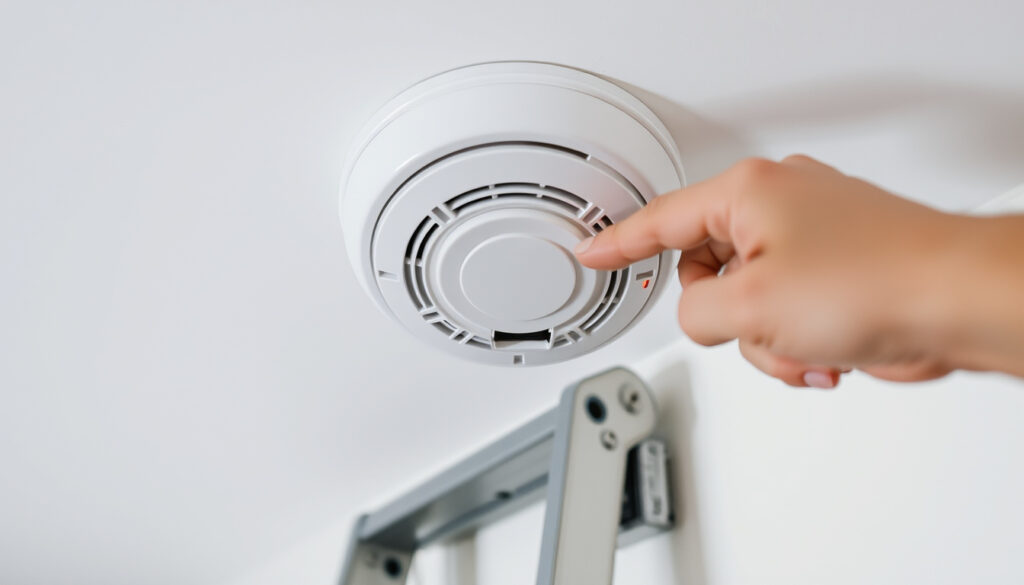
How to Test Smoke Alarm: Step-by-Step Guide and Troubleshooting
You press the test button, hear the beep, and assume your smoke alarm has your back, but a quick button push only checks the electronics, not the sensor that actually detects smoke. This guide walks through the full routine — from the standard test to interpreting lights, chirps, and false alarms — so you know exactly what your detector is telling you.
Optimal test frequency: once a week, per NFPA guidelines ·
Standard test button hold time: 5 to 10 seconds ·
Smoke alarm lifespan: 10 years from date of manufacture ·
Homes with non-functional detectors: 1 in 5 (according to NFPA reports)
Quick snapshot
- Press test button 5–10 seconds weekly per RoSPA (UK safety charity)
- Replace detector after 10 years per NFPA (fire safety authority)
- Chirping every 30–60 seconds signals low battery per CPSC (consumer safety regulator)
- Whether a red light always indicates a fault (varies by manufacturer)
- Precise number of chirps for end-of-life signal across all brands
- Whether a green light guarantees the sensor is functional (it only indicates power)
- Maximum service life: 10 years from manufacture date per NFPA (fire safety authority)
- Replace batteries at least once a year per CPSC (consumer safety regulator)
- Install alarms on every level and inside bedrooms per American Red Cross (disaster response organisation)
- Interconnect alarms so all sound together per U.S. Fire Administration (federal fire agency)
The following table summarizes key smoke alarm testing facts.
| Attribute | Value |
|---|---|
| Test button hold duration | 5 to 10 seconds |
| Alarm sound duration during test | 2 loud sequences |
| Chirp interval for low battery | Every 30–60 seconds |
| Maximum detector lifespan | 10 years |
| Recommended test frequency (UK) | Weekly per GOV.UK (UK government advice) |
| Recommended test frequency (US) | Monthly per U.S. Fire Administration (federal fire agency) |
| Battery replacement | At least once a year per CPSC (consumer safety regulator) |
| Australian recommendation | Monthly per Fire and Rescue NSW (government fire service) |
How to properly test a smoke alarm?
Use the test/hush button method
- Press and hold the test button for 5 to 10 seconds until the alarm sounds — this checks the electronics and sounder per Surety Home (home security support).
- If the sound is weak or absent, replace the battery or the entire unit.
- Repeat weekly if you follow UK guidance, or monthly if you follow US guidance (see table above).
The test button verifies that the alarm’s electronics, power supply, and horn are working. But it does not test the sensing chamber itself. For that, you need an aerosol smoke tester.
Test with canned smoke (optional)
- Hold the aerosol can 12–18 inches away from the detector and spray briefly per GenX Security (commercial security provider).
- The alarm should sound within a few seconds. If not, the sensor may be faulty.
Canned smoke gives you confidence that the actual smoke sensor is responsive. It’s the only way to fully test an alarm’s ability to detect a real fire.
Check the sound and volume
- The alarm should emit a loud, piercing tone (usually 85 dB or higher).
- If the sound is muffled or barely audible, the detector’s speaker may be degrading.
The implication: a silent test response is a clear “replace now” signal. Don’t assume a quiet alarm is still functional.
A test-button-only check still leaves the sensing element untested. One in five homes has a non-functional detector, according to NFPA (fire safety authority). Using canned smoke once a year catches sensors that would otherwise fail when you need them most.
How can you tell if a smoke alarm is bad or faulty?
Chirping or intermittent beeping
- One chirp every 30–60 seconds typically means low battery per CPSC (consumer safety regulator).
- Rapid chirping or pattern changes can indicate end-of-life.
A chirping alarm isn’t necessarily failing — it’s telling you it needs a new battery. But if the chirping continues after a fresh battery, the unit has likely reached its 10-year limit.
No response to the test button
- If pressing the test button produces no sound, check the battery first.
- If a hardwired alarm has power (green light on) but doesn’t respond, the electronics may be dead.
The catch: a dead alarm can still appear normal if its indicator light is on. Always test weekly to catch silent failures.
Age exceeding 10 years from manufacture date
- Check the manufacture date stamped on the back of the unit.
- Replace any detector that has passed its 10-year lifespan per NFPA (fire safety authority).
The pattern: sensor performance degrades over time. A 12-year-old alarm that still passes the test button may still fail to detect smoke.
The pattern is clear: regular testing and prompt replacement are critical for safety.
What do the lights on a smoke detector mean?
Green light continuous
- A steady green light usually means the unit is receiving AC power.
- It does not guarantee the sensor works — only that power is connected.
Red light flashing or solid
- A flashing red light often indicates the alarm detected smoke or was just tested.
- On some models, a solid red light means the unit is in alarm mode.
No light
- No light at all suggests no power — either dead batteries, a tripped breaker, or a failed unit.
What this means: green is good for power, red is normal during an event, and no light is a red flag. Always check the manufacturer’s manual because interpretations vary.
What can falsely set off a smoke detector?
Steam from showers or cooking
- Steam and humidity can trigger ionization detectors more easily than photoelectric.
- This is the most common cause of nuisance alarms per NFPA (fire safety authority).
Dust and insects inside the sensor
- Dust accumulation inside the sensing chamber can cause false alarms per U.S. Fire Administration (federal fire agency).
- Vacuum the detector covers every few months to keep them clear.
Ammonia-based cleaners
- Fumes from ammonia or bleach-based products can trigger alarms.
- Keep cleaning products away from smoke detectors.
The trade-off: nuisance alarms are annoying, but they are far better than a detector that doesn’t sound during an actual fire. Use the hush button if available.
A detector that false-alarms frequently may have a degraded sensor. Repeated steam or dust triggers indicate it’s time to clean the unit or upgrade to a photoelectric model, which is less prone to steam false alarms per CPSC (consumer safety regulator).
The takeaway: nuisance alarms are a sign to clean or upgrade the detector.
How to test a smoke detector without the test button?
Using canned aerosol smoke
- Hold the can 12–18 inches from the detector and spray for 1–2 seconds.
- The detector should sound within a few seconds per GenX Security (commercial security provider).
Using a lit match or incense (caution)
- Some older guides suggest using a match or incense, but this presents a fire risk.
- Avoid open flame methods; use sensor-safe aerosol products instead.
The pattern: canned smoke is the only safe, reliable alternative to the test button. It verifies the sensor itself, which the button cannot do.
“Working smoke alarms cut the risk of dying in a home fire nearly in half. Test yours weekly.”
— NFPA (fire safety authority)
“The test button checks the electronics and sounder. To test the sensor, use an aerosol smoke detector tester.”
For Singapore Current readers, the takeaway is straightforward: test your alarm weekly, replace it after 10 years, and don’t rely solely on the test button. Install interconnected alarms on every level — especially in bedrooms near cooking areas. The choice is clear: five minutes of testing each month, or the risk of a silent detector when a fire starts.
For a more thorough check, consider testing the smoke detector battery as part of your regular maintenance routine.
Frequently asked questions
How often should I test my smoke alarm?
The NFPA recommends monthly testing. The UK government and RoSPA recommend weekly testing. Follow your local guidance and test at least monthly.
What do 3 beeps on a smoke detector mean?
Three consecutive beeps usually mean the detector has sensed smoke or fire. Evacuate immediately and call 911 from outside.
How long does a smoke alarm battery last?
Standard 9V batteries should be replaced at least once a year. Sealed lithium batteries last the life of the alarm (10 years).
Can a dead smoke alarm still chirp?
Yes. A chirping alarm often indicates a low battery — the alarm may still function temporarily but will fail once the battery dies completely.
Why does my smoke alarm go off when I cook?
Steam and smoke from cooking are the most common cause of nuisance alarms. Relocate the alarm or use the hush button to silence it temporarily.
How do I stop a false alarm from a smoke detector?
Fan the area to clear smoke or steam. If frequent, clean the detector with a vacuum or replace it with a photoelectric model less sensitive to cooking fumes.
What is the difference between a smoke detector and a carbon monoxide detector?
A smoke detector senses particles from fire. A CO detector senses carbon monoxide gas from fuel-burning appliances. Many combination units are available.
More related posts
 Kai-Ji Adam Lo: Lapu Lapu Festival Suspect & Brother’s Murder
 Is Influenza A Contagious? Spread, Risks & Isolation Guide
 Chico Loco Amoy Street: Mexican Rotisserie & Bar Guide
 Night Life in Singapore: Best Bars, Clubs & Things to Do
 Aunty Lee’s Deadly Delights: A Complete Guide (2026)
 400°F to Celsius Conversion: Oven, Fan, Air Fryer Guide
 Samsung Galaxy Watch Ultra2: Price, Specs & Worth
 Bukit Timah Plaza Parking: Rates, Free Sunday & NTUC
