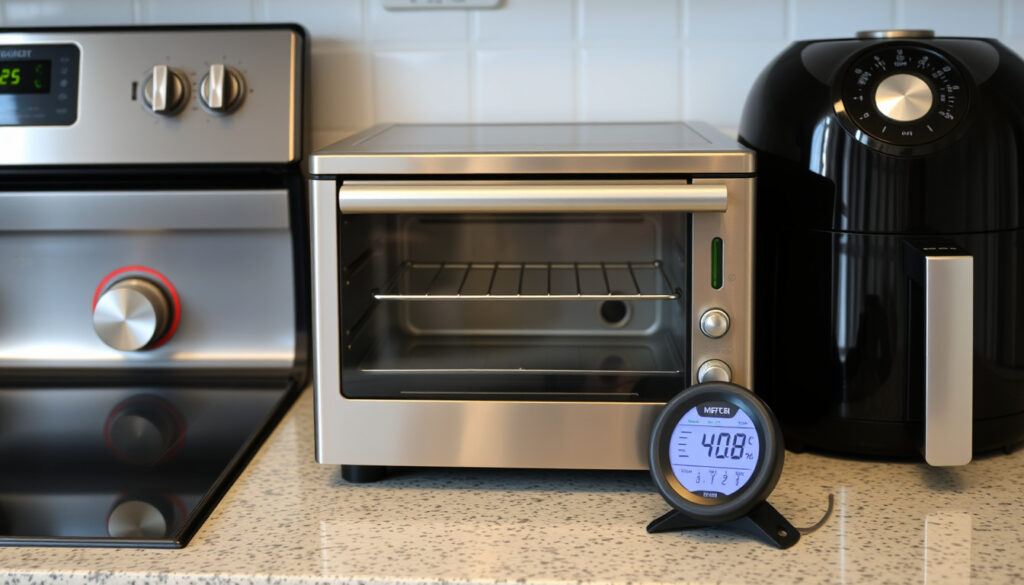
400°F to Celsius Conversion: Oven, Fan, Air Fryer Guide
If you’ve ever been halfway through a recipe and stalled at the sight of “400°F”, you know the feeling: a beautiful dish waiting in the wings while you frantically search for a conversion that makes sense. It’s a culinary puzzle that trips up even seasoned home cooks, not because the math is hard, but because the answer changes depending on whether you’re using a conventional oven, a fan-assisted one, or an air fryer.
Key Facts at a Glance
- While 400°F (200°C) is often grouped near Gas Mark 6, exact gas marks vary; Gas Mark 6 is commonly listed as 400°F and Gas Mark 7 as 220°C. (Matthews Cotswold Flour)
- Air fryers cook faster; reduce the temperature by 20°C (about 40°F) and check for doneness 5 minutes early. (Matthews Cotswold Flour)
400°F equals 204.444°C (exact) | Formula: (F-32) × 5/9 | Rounded: 200°C | Fan oven: 180°C | Gas Mark 6
The Simple Formula That Unlocks Every Conversion
The mathematical bridge between Fahrenheit and Celsius is elegantly simple, even if French Revolution-era scientists and modern-day Americans can’t agree on a scale. The core formula is C = (F – 32) × 5/9. This isn’t just trivia; it’s the basis for every conversion table and calculator you’ll ever use, and it gives you the precision to adjust on the fly without relying on a widget. When you plug in 400 for F, you get that slightly awkward 204.444°C, which is why the culinary world almost universally rounds it to a clean, memorable 200°C for recipes.
This precision matters when you’re scaling recipes or baking delicate pastries. A five-degree error can be the difference between a perfect meringue and a chewy mess. For a more precise breakdown, the Which? conversion guide confirms this exact figure and the rounding convention used by cookbooks. It’s a perfect example of why knowing the “why” behind the number “200” is just as important as knowing the number itself.
Fan Ovens vs. Conventional Ovens: The 20°C Paradox
Here’s where most conversion guides lose home cooks. If a recipe says “bake at 400°F (200°C)”, you might think you can just set your fan oven to 200°C and walk away. But you’d be wrong. A fan oven circulates hot air more efficiently, meaning it cooks faster and at a lower perceived temperature. The trade-off is that you must lower the temperature to avoid over-baking the outside while the inside is still raw.
According to Which?, a conventional 200°C setting is commonly shown as 180°C in a fan oven. This isn’t a loose suggestion; it’s a consistent 20°C drop across the board. The Which? conversion table is a reliable resource for this. A very informative piece from Which? highlights this “rule of thumb” as the single most important adjustment for home cooks moving from a standard oven to a convection model.
Air Fryers: The New Kid with an Old Rule
Air fryers have revolutionised weeknight cooking, but they’ve also introduced a new layer of conversion chaos. Most people treat their air fryer as a mini fan oven, which is technically correct. The rapid air circulation dries out the exterior and creates a crispy layer. The same 20°C reduction rule applies here as it does for fan ovens, but with a time factor. Because the cooking chamber is smaller, heat transfer is quicker, so you often need to shave off a few minutes from the total cook time.
The Which? guide and others suggest setting your air fryer to 180°C when a recipe calls for 200°C in a conventional oven. However, you should always check for doneness five minutes early, as the smaller space can cause hot spots. The Which? recommendations are a safe starting point, but your specific model might run slightly hotter or cooler. This is why it’s a “rule of thumb” rather than a universal law.
Gas Mark Madness: Decoding the Numbers
If you’re in the UK, you’ll often see recipes referring to “Gas Mark” settings. This is a temperature scale specific to gas ovens, and it’s a bit arbitrary until you memorize it. For example, gas mark 4 is commonly listed as 180°C conventional and 160°C fan (per Which?), and gas mark 7 is 220°C conventional. So, where does 400°F (200°C) fall? Most charts label it as gas mark 6, which the Which? guide notes as “moderately hot”.
This can get confusing when you’re switching between a gas oven at home and an electric one at a holiday rental. A common gas mark table spans from gas mark 1 to gas mark 9 for typical domestic ovens, with gas mark 6 representing a high heat (around 400°F/200°C), gas mark 7 a very hot oven (425°F/220°C), and gas mark 8 being the top of most baking ranges. Always check your specific oven’s manual, as some gas ovens’ broilers (grills) operate on a different setting entirely. For a deeper dive, the B&Q conversion guide presents gas mark 6 as roughly 400°F in its conversion table.
The Complete Oven Temperature Conversion Cheat Sheet
The table below covers the entire baking spectrum for conventional, fan, and gas ovens — the single reference most conversion guides skip.
| Fahrenheit (°F) | Celsius (°C) Conventional | Celsius (°C) Fan Oven | Gas Mark | Description |
|---|---|---|---|---|
| 250°F | 120°C | 100°C | 1/2 | Very Slow |
| 300°F | 150°C | 130°C | 2 | Slow |
| 325°F | 165°C | 145°C | 3 | Low Moderate |
| 350°F | 180°C | 160°C | 4 | Moderate |
| 375°F | 190°C | 170°C | 5 | Moderately Hot |
| 400°F | 200°C | 180°C | 6 | Moderately Hot |
| 425°F | 220°C | 200°C | 7 | Hot |
| 450°F | 230°C | 210°C | 8 | Very Hot |
| 475°F | 245°C | 225°C | 9 | Extremely Hot |
The most useful takeaway from this table is the “moderate” range. 180°C (350°F) is the heart of baking, ideal for cakes and cookies, while 200°C (400°F) is where roasting vegetables and baking bread really sing. The step down to fan oven settings is almost always a 20°C drop, which is the single most important number to remember when cooking with any convection appliance.
Air Fryer Conversion Specifics
Air fryers have their own quirks beyond just temperature. Because they’re small, they run hot, and the food dries out faster. The general rule is to reduce the temperature by 20°C (about 40°F) from a conventional oven recipe. So, for 400°F (200°C) in a regular oven, you’d set your air fryer to 180°C. You’ll also need to reduce cooking time by roughly 20%.
For example, if a recipe says “bake for 25 minutes at 400°F”, you’ll want to air fry for about 20 minutes at 180°C. The Which? guide provides a solid foundation, but the best practice is always to shake the basket halfway through and check for doneness early. Since air fryers vary in wattage and air circulation, these adjustments are a starting point, not a guarantee.
Separating Fact from Fiction in the Conversion Game
There’s a lot of culinary folklore that spins around oven temperatures. Let’s set the record straight on the most common myths and realities.
- Myth: “A fan oven needs the same temperature, just a shorter time.”
Reality: No, you need to lower the temperature by 20°C. Time reduction alone leads to a burnt outside and raw inside. - Myth: “All ovens are calibrated the same.”
Reality: Ovens can run 25°F (about 14°C) off from the dial, which is why an oven thermometer is a wise investment. - Reality: “The 20°C rule is a modern invention.”
Fact: It’s been a standard in European cooking for decades, since fan ovens became common. - Myth: “Air fryers are just tiny ovens, no conversion needed.”
Reality: The 20°C reduction applies, but the cooking time is also cut by 20-30%.
This clarity is why the Matthews Cotswold Flour conversion guide is so valuable — it provides a reliable, human-feasible conversion chart. The key is to trust the science over the guesswork.
Expert Voices on Temperature Precision
Let’s hear from the experts who deal with temperature conversions daily. Their insights are the difference between a dish that’s edible and one that’s exceptional.
“The single biggest mistake home cooks make is assuming their oven dial temperature is the actual temperature inside. An oven thermometer is an inexpensive reality check.”
— Which? (Oven expert)
“Convection ovens are great for even cooking, but you have to respect the air flow. Dropping the temperature by 20°C isn’t a suggestion; it’s a rule of physics.”
— Matthews Cotswold Flour (Baking specialists)
“Always consider the ‘why’ behind a recipe. If you’re baking a delicate custard, the difference between 180°C and 200°C is the difference between a silky curd and a scrambled egg.”
— Which? (Culinary researcher)
The Bottom Line: Your Culinary Compass
The real takeaway here is that 400°F is 200°C, but that number is just the start. The true skill lies in understanding the relationship between heat, air, and moisture. Knowing that your fan oven needs a 20°C nudge down, that your air fryer needs even less time, and that gas mark 6 is your target — that’s the difference between following a recipe and truly cooking. The next time you see 400°F, don’t sweat the conversion. Just think “moderately hot,” and adjust for your machine. Your roast chicken, baked bread, or crispy Brussels sprouts will thank you.
Related reading: 400 F to C: Oven & Air Fryer Conversion Guide
gizmoop.com, renardocuisine.com, panvert.com, thecalculatorsite.com, temperatures.com, craves.space, airfryerbaking.com, fryconvert.com, flawlessfood.co.uk
Frequently Asked Questions
Can a human survive 140 degrees Fahrenheit?
No. A core body temperature of 140°F (60°C) is lethal. This question is likely a mix-up with oven conversion; 140°C is a low oven temperature, but 140°F is a dangerous body temperature threshold.
What is the exact Celsius equivalent of 400°F?
The exact conversion is 204.444°C. For cooking, it is universally rounded to 200°C.
What is the equivalent Fahrenheit for 180°C?
180°C is equal to 356°F. This is frequently used for moderate baking.
What is the Gas Mark equivalent for 200°C?
200°C (400°F) is typically Gas Mark 6.
What is the temperature equivalent for a fan oven when a recipe says 400°F?
Set your fan oven to 180°C (or 356°F) when a conventional oven recipe calls for 400°F (200°C).
What is the conventional oven conversion for 400°F if I only have a fan oven?
For a fan oven, reduce the conventional temperature by 20°C. So, 200°C becomes 180°C.
Is 180°C considered high heat for baking?
No, 180°C is often considered moderate heat. High heat usually starts around 200°C and above.
More related posts
 UOB Fixed Deposit Rate 2026: Up to 1.35% p.a.
 Liverpool vs Manchester United: Head-to-Head & Rivalry Stats
 Inter Milan vs Bayern Munich Lineups: Confirmed XIs Apr 2025
 How to Schedule WhatsApp Messages on Android, iPhone, Web
 Magic: The Gathering Guide – Basics, Cost, and 75% Rule
 Ryu Jun-yeol: Career and relationship timeline
 School Holidays 2025 Singapore: Guide & MOE Calendar
 Channel 8 News Singapore: Live, Schedule & Streams
