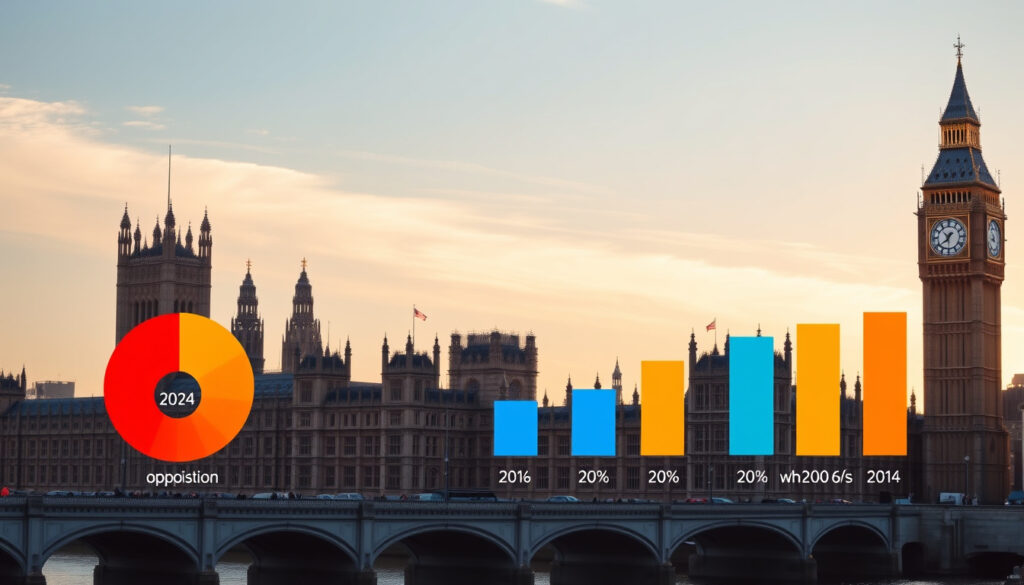
How Many Opposition MPs in Parliament? 2024 UK Breakdown
The 2024 UK general election produced one of the most fragmented oppositions in British political history. Instead of a tidy two-party balance, Westminster now hosts a multi-party landscape where Labour’s majority sits across from a fractured array of 247 opposition MPs. For anyone tracking parliamentary arithmetic, the numbers tell a more complicated story than a simple majority-versus-opposition split.
Total MPs: 650 · Labour (Government): 403 · Conservative (Opposition): 116 · Reform UK: 5 · Green Party: 4 · Opposition Total: 247
Quick snapshot
- 650 total MPs elected to the House of Commons (Wikipedia: 2024 UK General Election)
- Labour won 411 seats in July 2024, down to 403 by April 2026 (Institute for Government: Government majority explainer)
- 247 combined opposition and independent seats as of April 2026 (Institute for Government: Government majority explainer)
- Exact coordination mechanisms between smaller opposition parties and the Conservative front bench
- Whether additional defections from Labour will further alter the arithmetic before the next election
- 350 new MPs entered Parliament in 2024, the highest proportion of parliamentary newcomers ever recorded (Politics Home: 2024 cohort of MPs)
- 132 outgoing MPs chose not to stand again (Institute for Government: MPs who stood down)
- The new Parliament first met on 9 July 2024, beginning a session defined by historic power concentration in Labour hands
- With 165 effective working majority votes, the government faces a minority of opposition MPs who must coordinate across party lines to influence legislation
How many MPs are there?
The House of Commons comprises 650 elected seats, a fixed number since the Parliamentary Boundaries Act 2010 took effect. The 2024 general election, held on 4 July 2024, was the least proportional in British history — Labour secured just 33.7% of the popular vote yet won an overall majority (Wikipedia: 2024 UK General Election). More than half of the 650 MPs elected (335) were new to Parliament, the highest number of parliamentary newcomers in any single election (Wikipedia: List of MPs elected in 2024).
Total seats in the House of Commons
- The fixed 650-seat chamber means parliamentary arithmetic is zero-sum: every government seat is one less for opposition benches
- The new Parliament first met on 9 July 2024, marking the formal beginning of this electoral cycle
Labour MPs in Parliament
Labour entered the 2024 election with 411 seats won on 4 July 2024, securing a 174-seat majority at the time of the result. By April 2026, the party held 403 seats following defections and departures — still commanding a 165-vote working majority with 402 eligible Labour MPs able to vote (Institute for Government: Government majority explainer). Prime Minister Keir Starmer leads the largest government contingent since Tony Blair’s 1997 landslide.
Government majority seats
- Labour’s 33.7% vote share was the lowest of any governing party on record, yet translated into dominant seat count due to First Past the Post
- The effective 165-vote working majority means the government can pass legislation without cross-party support — unless backbench rebellions splinter its own ranks
Labour governs with the fewest governing-party voters since record-keeping began, yet holds more than 60% of Commons seats — a structural imbalance that makes opposition coordination more valuable than ever.
How many Conservative MPs are there?
The Conservative Party won 121 seats on 4 July 2024 — their worst-ever electoral result, losing 251 seats including those of former prime minister Liz Truss and 12 former Cabinet ministers. By April 2026, the count had fallen further to 116 as the party continues to sit as HM Most Loyal Opposition under Rishi Sunak’s successor (Wikipedia: 2024 UK General Election). Nearly a third of Conservative losses in England went to the Liberal Democrats, particularly in South East and South West England.
Official Opposition leader
- The Conservatives hold approximately 53% of opposition seats, down from a historical average of around 75% since 1997
- As the Official Opposition, the Conservative front bench holds speaking rights and scrutiny privileges reserved for the largest non-government party
With the Conservatives holding less than half of all opposition seats for the first time in decades, the traditional two-party parliamentary dynamic has fractured — smaller parties now wield disproportionate influence in key divisions.
The implication is that the Official Opposition cannot rely on sheer numbers to block legislation; it must now build cross-party coalitions on most politically contested votes.
How many Reform MPs in Parliament?
Reform UK won 5 seats and 14.3% of the popular vote in July 2024, their best parliamentary result to date. Leader Nigel Farage secured Clacton, completing a political journey from UKIP that spanned two decades. The party emerged as an emerging opposition force particularly in traditionally Conservative heartlands, though its seat count remains small relative to its vote share (Wikipedia: 2024 UK General Election).
Reform UK seats post-2024
- Five Reform MPs represent a breakthrough for a party that failed to win any seats in 2017 and 2019 under the old UKIP banner
- With smaller parties collectively capturing 42.6% of the total vote, the electoral system underrepresents the multi-party voter mandate
What this means is that Reform UK, despite earning 14.3% of the popular vote, holds just five Commons seats — a disparity that highlights how First Past the Post magnifies major parties while compressing smaller ones.
How many Green MPs are there?
The Green Party won 4 seats in the 2024 election, their best parliamentary result in history. Co-leaders Carla Denyer and Adrian Ramsay both won their seats, with the party consolidating its position as a regional environmental voice. Four Green MPs contribute to the multi-party opposition alongside Reform, independents, and the regional parties — collectively representing nearly half of non-government seats (Wikipedia: 2024 UK General Election).
Other opposition parties
- Six independent MPs were elected in 2024, the highest number in England since 1945, including former Labour leader Jeremy Corbyn
- The Scottish National Party won 9 seats, Plaid Cymru 4 seats, and the DUP 5 seats — regional voices that must coordinate with national opposition blocs on issues affecting their constituencies
The four independent MPs elected on pro-Gaza platforms in previously safe Labour seats signal a new constituency-level rebellion dynamic that cross-party opposition alliances have not yet fully accommodated.
The pattern is clear: independent voices are reshaping constituency-level accountability, forcing Labour to watch not just opposition parties but former loyalists who may vote against the government on specific issues.
Party seat comparison
The seat distribution across Parliament reflects stark contrasts between popular vote and parliamentary representation. The table below breaks down each party’s 2024 election result alongside their current seat count and vote share.
| Party | Seats (2024) | Current Seats | Vote Share |
|---|---|---|---|
| Labour | 411 | 403 | 33.7% |
| Conservative | 121 | 116 | 23.7% |
| Liberal Democrats | 72 | 72 | 12.2% |
| Reform UK | 5 | 5 | 14.3% |
| Green Party | 4 | 4 | 6.9% |
| SNP | 9 | 9 | 4.4% |
| Other parties | 28 | 27 | 14.8% |
The Liberal Democrats’ 72 seats mark their best-ever result, surpassing any Liberal Party performance since 1923, gained largely at Conservative expense in southern England. Meanwhile, smaller parties combined won 42.6% of all votes cast — yet hold proportionally fewer seats due to First Past the Post.
Upsides
- Diverse opposition voices reflect genuine voter preferences across policy spectrums
- Regional parties maintain Scottish and Welsh representation proportional to local mandates
- Record 350 new MPs bring fresh perspectives and reduced party machine incumbency
Downsides
- Fragmented opposition struggles to coordinate effective legislative scrutiny
- Small parties with high vote shares (Reform at 14.3%) are dramatically underrepresented in seat count
- Independent MPs lack formal opposition infrastructure and speaking rights
The catch is that voters who backed Reform UK or smaller parties with nearly half the total vote have minimal direct influence on legislation — their representation depends entirely on which larger party they can pressure or ally with.
State of opposition composition
The Institute for Government calculates 247 combined opposition, independent, and Speaker seats as of April 2026. This figure includes the Conservatives’ 116 seats, smaller party representation, six independents, and the ceremonial Speaker role. With 237 of those opposition MPs eligible to vote in divisions, Labour’s 402 eligible government MPs face a minority that must overcome internal party discipline fractures to influence legislation.
The state of parties after 2024 reflects a fundamental tension: almost half the non-government seats were won by parties other than the Conservative Official Opposition, marking a structural shift from the post-1997 two-party norm.
— Hansard Society analysis of parliamentary composition
Labour held 402 eligible MPs as of April 2026, facing 237 opposition MPs able to vote — giving the government an effective working majority of 165 seats that can pass legislation without cross-party support.
— Institute for Government: Government majority explainer
| Attribute | Value |
|---|---|
| Total MPs | 650 |
| Labour Seats | 403 |
| Conservative Seats | 116 |
| Opposition Total | 247 |
| Government Majority | 165 |
Related reading: Primary School Ranking 2025 – Top England Schools and Insights
youtube.com, en.wikipedia.org, parallelparliament.co.uk, parallelparliament.co.uk
FAQ
How many seats does the opposition have in total?
As of April 2026, the combined opposition total stands at 247 seats, including the Conservative 116 seats, smaller party representation, six independents, and the Speaker’s position. This represents less than 40% of the 650-seat chamber.
Who leads the Official Opposition?
The Conservative Party, as the largest non-government party with 116 seats, holds Official Opposition status. This confers formal speaking rights in Commons debates, the ability to appoint a Shadow Cabinet, and regular scrutiny time allocated by the Speaker.
Are Independent MPs part of the opposition?
Independent MPs sit on the opposition benches but lack formal party infrastructure. The six independents elected in 2024 include Jeremy Corbyn (former Labour leader) and four MPs elected on pro-Gaza platforms in previously safe Labour seats.
How has the opposition changed since the 2024 election?
The 2024 election reduced the Conservative opposition from 365 seats to 121 — a loss of 251 seats that freed up nearly half of all non-government seats for smaller parties. This fragmentation has forced cross-party cooperation on key votes that would have been unnecessary under a stronger two-party dynamic.
What is the effective working majority?
Labour’s effective working majority is 165 votes, calculated from 402 eligible government MPs minus 237 eligible opposition MPs. This majority allows the government to pass legislation without relying on opposition support — unless internal party discipline fractures on specific votes.
How many Liberal Democrat MPs are there?
The Liberal Democrats won 72 seats in 2024 — their best-ever result and better than any Liberal Party performance since 1923. They are the third-largest party in Parliament, with gains concentrated in southern England at Conservative expense.
Where to check live MP counts?
The Institute for Government’s government majority explainer provides regular updates on parliamentary arithmetic. The UK Parliament website tracks current seat distribution by party, and the House of Commons Library publishes periodic state-of-the-parties briefings.
For Westminster-watchers and political analysts, the implications are clear: governing with 33.7% of the vote and 60% of the seats is structurally fragile without stable cross-party relations. The opposition’s fragmented composition means no single party can challenge legislation alone — but coordinated cross-party action on specific votes becomes more viable when smaller parties share strategic interests. For opposition parties, the path to relevance in 2025 and beyond runs through tactical alliance-building, not individual headcounts.
Primary School Ranking 2025 – Top England Schools and Insights
More related posts
 Happy Chinese New Year – 2025 Dates, Greetings and Traditions
 Royal China Raffles Sentosa: Menu, Dress Code & Review
 Cross Street Medical Clinic STD Testing Guide
 Bus Ticket to KL from Singapore: Prices, Payment & Tips
 Houston Rockets vs Golden State Warriors: Stats, Odds & History
 Mersing to Tioman Ferry: Schedules, Prices & Tips (2025 Guide)
 Canopy Changi Village Reviews: What Visitors Say
 DBS, OCBC, UOB 4Q25 Results: Dividend Comparison & Stock Analysis
