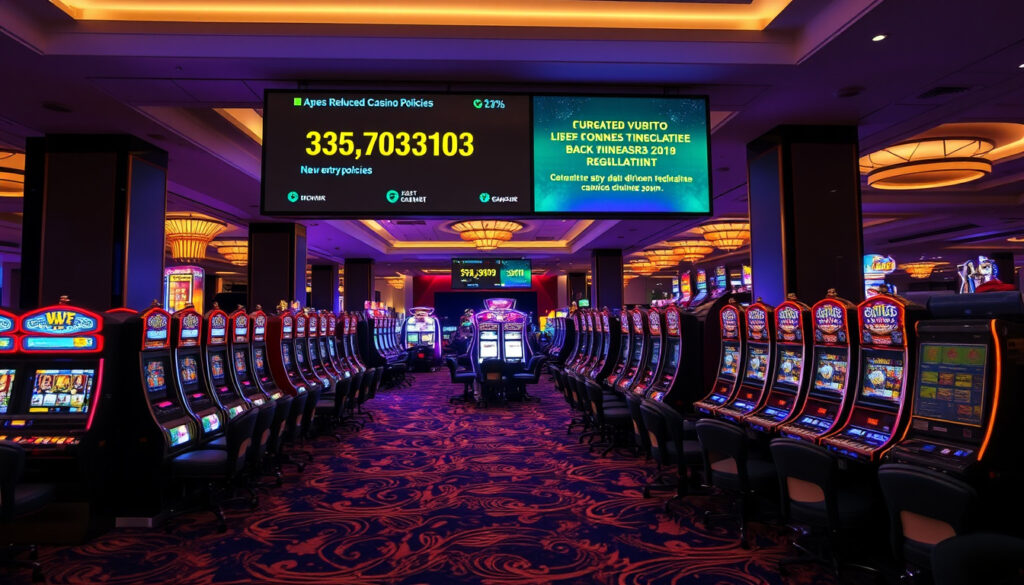
Singapore Casino Visits Decline: Data & Policies for 2024
Singapore’s two integrated resorts have long drawn tourists and locals, but new data shows resident casino visits are declining as entry rules tighten. Tourism arrivals hit 16.5 million through September 2024, yet local access is increasingly restricted by levies and exclusion measures.
“Singapore citizens and permanent residents must pay a daily entry levy of S$150 or an annual levy of S$3,000 to enter casinos.”
— Ministry of Manpower
Tourist arrivals (Jan–Sep 2024): 16.5 million ·
Visitor spending (Jan–Sep 2024): S$22.4 billion ·
Entry levy for citizens/PRs: S$150 (24-hour)
Quick snapshot
- Tourism arrivals up 21% year-over-year to 16.5M through Sep 2024 (iGaming Business)
- Sightseeing, Entertainment & Gaming spend rose 25% and accounts for 21% of total tourism spend (iGaming Business) (iGaming Business)
- Singapore citizens and PRs must pay S$150 for a 24-hour entry levy or S$3,000 for annual access (Ministry of Manpower)
- No casino entry for citizens or PRs under 21 (Ministry of Manpower)
- Whether tourism revenue will keep pace with rising arrivals given regional competition
- Long-term impact of entry levies on resident visitation patterns
- Exact effectiveness of anti-money-laundering controls on casino footfall
- Official data on year-over-year local casino visit counts for 2024 has not been published by authorities
- 2024: Tourism arrivals projected to reach 17-18.5 million, spending up to S$30.5B (iGaming Business)
- Casino entry levy for residents unchanged since introduction (iGaming Business)
- Singapore Tourism Analytic Network expects strong year-end season; casino spend could set new records (iGaming Business)
- Policy focus likely to remain on responsible gambling and exclusion measures (iGaming Business)
The data reveals a stark contrast between visitor spending and resident entry barriers.
| Metric | Value |
|---|---|
| Tourist arrivals (Jan–Sep 2024) | 16.5 million (21% YoY increase) |
| Visitor spending (Jan–Sep 2024) | S$22.4 billion (+10% YoY) |
| Sightseeing, Entertainment & Gaming spend growth | 25% (fastest category) |
| Share of entertainment & gaming in total spend | 21% |
| Annual entry levy for Singapore citizens/PRs | S$3,000 |
| Daily entry levy for Singapore citizens/PRs | S$150 |
| Age restriction for local casino entry | 21 years or older |
Is tourism declining in Singapore?
No — tourism in Singapore is actually growing. Through September 2024, the country welcomed 16.5 million visitors, a 21% increase from the same period in 2023, according to iGaming Business. Visitors spent S$22.4 billion, up 10% year-over-year, setting a new record for that period. The fastest-growing spend category was Sightseeing, Entertainment & Gaming, which rose 25% and accounted for 21% of total tourism expenditure.
The Singapore Tourism Analytic Network projects 17 million to 18.5 million international travellers for all of 2024, with spending reaching as high as S$30.5 billion. So the headline is expansion, not contraction. But the picture is more nuanced for casino-specific metrics.
Tourism revenue vs. arrival numbers
Although arrivals and spending are both up, the rate of spending growth (10%) lags behind arrivals growth (21%). That suggests visitors may be spending less per person or staying for shorter periods. The Sightseeing, Entertainment & Gaming category — which includes casino revenue — is bucking that trend with its 25% surge, indicating that integrated resorts remain a powerful draw for tourist dollars.
Impact of regional competition on Singapore’s tourism
Neighboring destinations such as Japan, the Philippines, and Thailand are investing heavily in tourism infrastructure and gaming options. The Philippines, for instance, has seen a strong recovery in its casino industry, and Japan is preparing to open its first integrated resorts. This competitive pressure could eventually eat into Singapore’s market share, though for now the city-state is still setting records.
Tourism is booming, but the growth in entertainment and gaming spend (25%) is outpacing overall spending growth (10%) — meaning casinos may be capturing a larger slice of a larger pie, even as resident access tightens.
The pattern: Singapore’s tourism growth does not automatically translate to increased casino revenue from locals; policy is the deciding factor.
Is gambling a problem in Singapore?
Singapore has tightly regulated gambling since it allowed casinos in 2010. The government’s dual mandate — capture tourist revenue while minimizing local harm — is enforced through entry levies, exclusion orders, and the strict Casino Control Act (CCA). The CCA requires responsible gambling measures and anti-money-laundering controls.
Gambling prevalence among Singaporeans
Official prevalence data is limited. However, the entry levy system (S$150 for a day, S$3,000 annually for citizens and PRs) is designed to deter frequent local visits. Ministry of Manpower rules also bar anyone under 21 from entering, and exclude individuals under voluntary or third-party exclusion orders.
Rise in problem gambling among elderly Singaporeans
According to case study research from the National University of Singapore’s Lee Kuan Yew School of Public Policy, elderly Singaporeans are reportedly becoming more vulnerable to problem gambling. Social isolation and fixed incomes may drive this trend, though the exact scale is not yet quantified in publicly available government data.
“Singapore’s approach is to manage sin — to allow gambling for economic gain but tightly control access to protect its citizens.”
— National University of Singapore case study on casino policy
The challenge for policymakers: balancing economic benefits with social costs requires constant vigilance.
What is the $20 rule at the casino?
The $20 rule is a budget management strategy popularized by casual gamblers, not a formal casino policy. The idea is to set a strict loss limit — often $20 — and walk away once that money is gone. In Singapore’s casinos, where the entry levy alone costs S$150 for locals, the $20 rule is more of a personal discipline than a practical reality.
Top 5 games to play with a $20 budget
- Penny slots — offer slow play at minimal bet sizes.
- Video poker — with low minimum bets and strategic elements.
- Roulette (outside bets) — even-money bets (red/black, odd/even) stretch the budget.
- Baccarat (Player bet) — low house edge on the Player side.
- Blackjack at low-minimum tables — basic strategy can reduce the house edge to under 1%.
Slot machine mechanics and triggers
Slot machines use random number generators (RNGs) to determine outcomes. Modern slots have a fixed “hit frequency” — the percentage of spins that result in a win, typically between 15% and 40%. Hitting a jackpot is a low-probability event determined by RNG, not by the machine being “due.”
What happens if you win $100,000 at a casino?
A large win in a Singapore casino triggers standard cashier procedures: the casino will issue a cheque or a bank transfer, and the win is recorded for tax reporting. However, Singapore does not impose personal income tax on gambling winnings, as gambling is considered a windfall and not income. This tax policy is consistent with the government’s approach of limiting the financial burden on individuals.
Tax implications on casino winnings
There is no tax on casino winnings in Singapore for casual gamblers. Professional gamblers who trade gambling as a business may face tax, but the line is rarely tested. The Casino Control Act requires casinos to report large transactions for anti-money-laundering purposes, but that does not affect the winner’s tax liability.
Singapore’s tax policy on gambling income
Singapore’s position is clear: gambling is a form of entertainment, not a livelihood. Winners keep 100% of their prize, and the government instead collects revenue through entry levies and casino taxes (the Casino Control Act imposes a tax on gross gaming revenue). For a $100,000 win, the only cost to the player is the entry fee already paid.
For the occasional visitor, a big win is tax-free. But the entry levy system means every local who gambles has already paid S$150 to S$3,000 before placing a single bet.
What this means: the entry levy functions as a pre-commitment device for residents, regardless of win size.
What is the 60 90 rule in Singapore?
The “60 90 rule” is a colloquial term for Singapore’s exclusion framework for problem gamblers. Under the Casino Control Act, individuals can voluntarily exclude themselves for a minimum period of one year, and family members or the government can apply for third-party exclusion orders. The 60/90 label refers to a cooling-off period sometimes associated with visit limit schemes, though the official policy does not use that exact phrase.
Application of the 60 90 rule in casinos
In practice, the “rule” is a budget management tip: set a time limit of 60 minutes and a loss limit of $90, then walk away. It is not a regulatory requirement but a personal discipline tool. The government, however, enforces mandatory visit limits for those on the exclusion list — typically a ban on all casino entries.
Effectiveness of annual casino entry fee policies
The annual entry levy of S$3,000 is designed to discourage frequent local gambling. According to research from the Lee Kuan Yew School of Public Policy, Singapore’s model of “managed sin” has been effective in limiting the growth of problem gambling among residents, though data on long-term outcomes is still emerging.
Clarity check
Confirmed facts
- Tourism arrivals and spending both rose in 2024, with entertainment & gaming spend leading at 25% growth.
- Singapore imposes a S$150 daily entry levy and a S$3,000 annual levy on citizens and PRs.
- Persons under 21 are prohibited from entering casinos.
- The Casino Control Act mandates responsible gambling and anti-money-laundering controls.
What remains unclear
- Exact year-over-year change in local casino visits (official 2024 data not yet released).
- Long-term effectiveness of entry levies on problem gambling rates.
- Impact of regional integrated resort competition on Singapore’s casino market share.
What the data adds up to
Singapore’s casino story is not one of decline, but of deliberate design. Tourist dollars are flowing in at record levels — S$22.4 billion in nine months — and the gaming category is the fastest spender. Yet for residents, the barriers remain high: a S$150 daily levy, a S$3,000 annual pass, and the constant threat of exclusion orders. The government has built a system that lets the money in but keeps the locals at arm’s length. For Singapore’s policymakers, the trade-off is clear: capture the revenue, contain the harm, and bet that the calculus doesn’t tip the other way.
Explore related: Night Life in Singapore
Recent data shows a decline in local casino visits, and the Singapore casino guide 2025 outlines the entry fee policies that may be contributing to this trend.
Frequently asked questions
What is the casino entry fee for Singapore citizens and PRs?
Singapore citizens and permanent residents pay S$150 for a 24-hour entry or S$3,000 for an annual levy.
How much is the entrance fee for foreigners at Singapore casinos?
Foreigners do not pay an entry levy; they can enter for free with a passport. However, they must be at least 21 years old.
What is the dress code at Marina Bay Sands casino?
Marina Bay Sands enforces a smart casual dress code. Slippers, singlet tops, and torn clothing are not allowed. Gentlemen must wear long pants and covered shoes.
Can you win real money at Singapore casinos?
Yes, Singapore casinos offer real-money gambling. Winnings are paid out in cash or check. Gambling winnings are not subject to personal income tax in Singapore.
Are there free games to play at the casino on a $20 budget?
Some casinos offer free slot play or low-stakes tables (minimum bets as low as S$1). With S$20, a player can enjoy a few rounds of penny slots or video poker.
What are the visit limits for problem gamblers in Singapore?
Problem gamblers can be placed on a voluntary or third-party exclusion list, which bans them entirely from entering casinos. The minimum exclusion period is one year.
How does Singapore compare to other countries in gambling addiction rates?
Singapore’s problem gambling prevalence is relatively low (estimated below 1% of adults), thanks to strict entry controls and exclusion measures. Countries like Australia and the United States report higher rates due to widespread slot machine access and fewer barriers to entry.
More related posts
 Sindhorn Kempinski Hotel Bangkok: 5-Star City Wellness Hotel
 Lyf Sukhumvit 8 Bangkok: Reviews, Location, Check-Out
 Arsenal Latest Transfer News: Eze, Alvarez & More – Live
 Honor Magic V5 Singapore: Price, Specs & Review
 Agoda Credit Card Promotion 2025: Best Discounts Compared
 Joshua 1:9 – Meaning, Context and Application
 How to Cancel Your Citibank Credit Card in 2025
 Korea Weather in December: Temps, Snow & What to Wear
