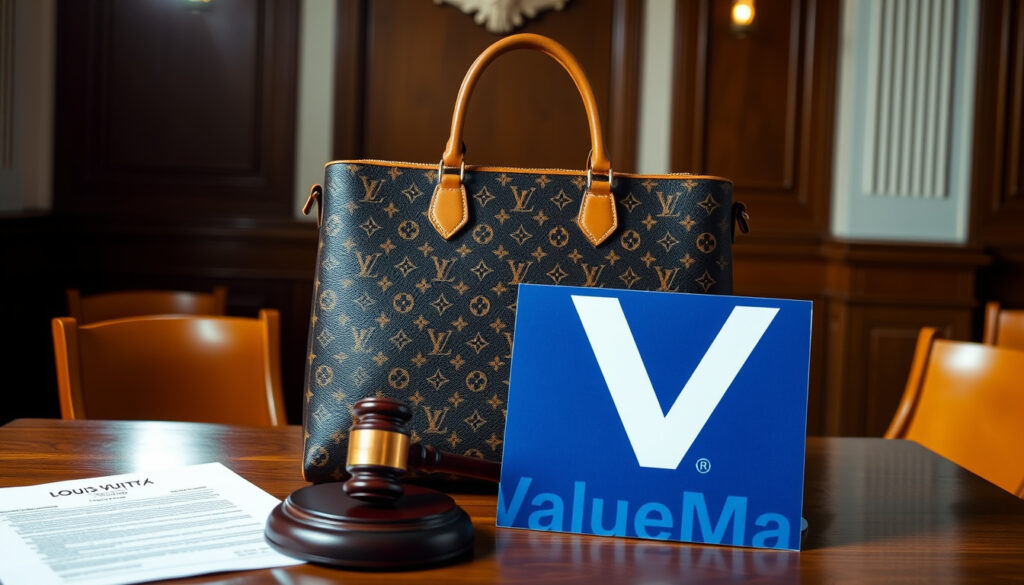
Louis Vuitton Sues ValueMax Over Trademark Infringement
The first time shoppers hear about the lawsuit, it usually starts with a double take: a French luxury house known for four-figure handbags has dragged a Singapore-listed pawnbroking and jewellery retail chain into the High Court. Louis Vuitton filed the trademark action in December 2025 against ValueMax Retail, the retail unit of SGX-listed pawnbroking and jewellery group ValueMax, The Business Times (Singapore’s financial daily) reported. The case turns on whether certain jewellery markings are too close to the French house’s registered monogram and related designs — and in a market where pre-owned luxury and brand-protection law collide, the outcome could reshape how secondhand retailers in Singapore stock and describe prestige goods.
Filed: December 2025 · Court: Singapore High Court · Defendant: ValueMax Retail (SGX-listed ValueMax Group) · Claim: Trademark infringement and passing off · Trial date: None set
Confirmed facts
- Louis Vuitton filed the lawsuit in December 2025 at the Singapore High Court. (The Business Times)
- The claim alleges trademark infringement and passing off. (The Business Times)
- Plaintiff: Louis Vuitton Malletier. (The Business Times)
- Defendant: ValueMax Retail, a subsidiary of SGX-listed ValueMax Group. (The Business Times)
- Alleged breaches of the Trade Marks Act. (The Business Times)
- A separate common law claim of passing off. (Inside Retail Asia)
- ValueMax denies infringement and passing off. (The Business Times)
- It says the disputed items were secondhand and carried no identical or similar LV symbols. (The Business Times)
The commercial logic of the suit becomes clearer when the dispute is reduced to a few lines.
| Field | Detail |
|---|---|
| Lawsuit filing date | December 2025 |
| Plaintiff | Louis Vuitton Malletier |
| Defendant | ValueMax Retail (subsidiary of SGX-listed ValueMax Group) |
| Court | Singapore High Court |
| Legal basis | Trademark infringement (Trade Marks Act) and passing off |
| Allegations | Jewellery carrying designs allegedly identical or similar to LV marks |
| ValueMax position | Denies infringement; claims products are secondhand and not competing directly |
Put a famous monogram on a pawnshop shelf and the law suddenly has to decide whether that is a defence or a deception. That is the real weight of this filing.
What exactly is Louis Vuitton’s trademark claim against ValueMax?
Trademark infringement is the core of the complaint. Louis Vuitton says the jewellery at issue carries symbols that are identical or similar to its registered LV monogram and related designs, which are protected in Singapore. The Business Times (Singapore’s financial daily) reported the filing in December 2025, and Inside Retail Asia (a regional retail trade publication) added that the suit includes a passing-off claim — a separate allegation that ValueMax’s in-store presentation creates a false impression that LV endorses or is connected with the products.
Louis Vuitton sues ValueMax over alleged trademark infringement
- The Trade Marks Act claim covers use of identical or similar marks in trade.
- The passing-off claim protects the goodwill LV has built in Singapore over decades.
- Coverage from VnExpress (a Vietnamese business news outlet) identifies the retail arm, ValueMax Retail, as the named defendant rather than the parent holding group.
None of the reporting suggests the lawsuit targets ordinary customers or someone reselling a single authentic LV bag. The complaint is aimed at a commercial retailer whose floor displays, LV argues, profit from the brand’s equity.
Passing off does not require proving that a shopper was actually fooled — only that there is a real likelihood of confusion strong enough to damage the brand’s reputation. That is why this dispute is being watched so closely.
The implication: even if no customer walked out confused, LV can still win if the court finds the display created a tangible risk to brand value.
Why would a luxury brand like LV sue a pawnbroking chain?
The alarm for a brand like LV is not that ValueMax sells secondhand luxury goods — every pre-owned retailer does that. It is that the pieces were, according to the sources, covered in designs that sit close to LV’s registered shapes and patterns. The Business Times noted the defendant’s public posture after the suit was filed, while VnExpress described the claim as targeting goods identical or similar to LV products.
- Brand control: the monogram sits at the centre of LV’s licensing and exclusivity.
- Channel protection: secondhand platforms, pawnshops and resellers are all watching how the defence unfolds.
- Precedent: a defendant-friendly reading of “secondhand” would make trademark enforcement less predictable in the wider resale market.
Luxury trademarks are enforced with the same discipline that goes into designing the next handbag. The ValueMax case is a test of how far that enforcement can reach into the secondary market.
The pattern: when a pawnshop shelf becomes a legal frontier, every reseller in Singapore takes note.
How is ValueMax defending itself in the lawsuit?
The heart of ValueMax’s answer is a single sentence: the disputed items were secondhand and carried no identical or similar symbols to an LV mark. The Business Times reported that ValueMax denied infringement and passing off on those grounds. Later reporting after the suit became public, Inside Retail Asia noted, also highlighted that ValueMax said it did not currently carry LV products at all of its outlets.
- Secondhand goods: the defence argues that no reasonable shopper would confuse a pawnshop resale with LV’s own retail.
- Design disconnect: the symbols, in ValueMax’s telling, were neither identical nor similar to any LV mark.
- No current stock: the specific products in the complaint are not, according to the retailer, a live feature of every store.
As a listed company, ValueMax has to speak carefully. Too aggressive a defence invites a David-versus-Goliath story; too soft a line hands LV a public victory before discovery even begins.
What this means: the public statements from ValueMax walk a narrow line between denying wrongdoing and avoiding a PR conflict with one of the world’s most recognisable brands.
What does this mean for pre-owned luxury shoppers in Singapore?
On the consumer side, the ground rules have not changed. The Business Times coverage notes that LV bags generally retain resale value, that the brand does not offer a lifetime warranty, and that repair services are available for genuine pieces. The pre-owned market remains strong — which is precisely why the brand keeps a close eye on how those goods are presented.
- A shopper buying a genuine secondhand LV bag is not the target of this lawsuit.
- A seller labelling items as “inspired by LV” would be taking a compliance risk.
- A civil ruling against ValueMax would not change Singapore’s criminal law — it would change who can sell what in the commercial secondhand trade.
Are Louis Vuitton bags still worth buying?
LV bags generally retain resale value, the brand does not offer a lifetime warranty, and repair services are available for genuine pieces — the pre-owned market remains strong, according to The Business Times. That staying power is precisely why the brand patrols how secondhand goods appear on retail shelves.
What is the lifespan of a Louis Vuitton bag?
With proper care, LV bags can last decades. The company offers paid repair services, and the canvas material is generally more durable than leather alternatives, according to industry reporting. The resale market in Singapore reflects that longevity.
What age group buys Louis Vuitton?
Louis Vuitton buyers span a wide age range from their 20s to 60s. Growing interest among Gen Z and millennials, particularly through the resale market, has broadened the customer base, according to market observations by Inside Retail Asia.
Watch whether online marketplaces and pre-owned platforms adjust their authentication and repurchase policies after this case. Retailers that fail the test could become the next legal target.
The catch for shoppers: the lawsuit does not change what you can buy, but it could change who is willing to sell it.
What happens next in the Singapore High Court case?
As of this writing, no trial date has been set. Inside Retail Asia reported the filing on December 18, 2025, and VnExpress carried the same story for an international audience. The next visible step will be a directions hearing in which a judge sets out a timetable for pleadings, discovery and, eventually, a trial date.
Other notable trademark cases involving Louis Vuitton
- The public reporting on this filing names no parallel LV case against another Singapore-listed retailer.
- The same three articles contain no consolidated docket of LV’s previous trademark actions in Singapore.
- That reporting gap is itself a useful reminder: Singapore’s IP docket is harder to track from public headlines than a single reliable case tracker.
For now, the clearest statement is the least dramatic one: a famous brand sued a listed firm, the defendant denied every element, and nobody is rushing to schedule a trial. That is how the system is supposed to work.
The implication: the legal machinery is moving at its own pace, and market watchers will have to wait for the next hearing to gauge momentum.
If you want the dispute reduced to a dossier you can carry in your wallet, this is it:
| Case | Louis Vuitton Malletier v ValueMax Retail |
| Court | Singapore High Court |
| Filed | December 2025 |
| Plaintiff | Louis Vuitton Malletier |
| Defendant | ValueMax Retail, a unit of SGX-listed ValueMax Group |
| Claims | Trademark infringement (Trade Marks Act); passing off |
| Defence | Denies infringement; goods secondhand; symbols neither identical nor similar to LV marks |
| Goods at issue | Jewellery items carrying allegedly similar designs |
| Status | No trial date set |
The key dates in the dispute move in a straight line, and the gaps matter as much as the listings:
| Date | Event | Source |
|---|---|---|
| December 2025 | LV files suit at the Singapore High Court | The Business Times |
| December 2025 | LV’s claim is reported by The Business Times | The Business Times |
| December 18, 2025 | Inside Retail Asia covers the filing and adds passing-off context | Inside Retail Asia |
| December 2025 | ValueMax publicly denies infringement and passing off | The Business Times |
| Not yet scheduled | Trial date | – |
ValueMax Retail denied infringing LV’s trademarks and denied passing off, arguing the disputed items carried symbols neither identical nor similar to any LV mark.
— The Business Times
Louis Vuitton filed the lawsuit in the Singapore High Court over jewellery products the luxury house says feature identical or similar marks.
— VnExpress
ValueMax said it did not currently carry LV products at all of its outlets after the suit became public.
— Inside Retail Asia
- The lawsuit was filed in December 2025.
- LV is suing ValueMax Retail, a unit of SGX-listed ValueMax Group.
- ValueMax denies trademark infringement and passing off.
- No trial date has been set.
- The exact range of disputed jewellery designs has not been published.
- The timetable for court case management has not been announced.
- Whether any parallel LV enforcement action exists against other Singapore retailers.
Related reading
- The Business Times — Louis Vuitton sues unit of SGX-listed ValueMax over alleged trademark infringement
- Inside Retail Asia — Louis Vuitton sues listed Singapore retailer over trademark infringement
- VnExpress — Louis Vuitton files trademark lawsuit against Singapore retailer
mothership.sg, sgnewsdesk.com, malaymail.com, insideretail.asia, businesstimes.com.sg, minichart.com.sg, sbr.com.sg, zaobao.com.sg, forbeschicago.com, zaobao.com.sg
Frequently asked questions
Why is Louis Vuitton suing ValueMax?
LV is suing over jewellery products carrying marks that it says are identical or similar to its registered LV monogram and related designs. The complaint alleges trademark infringement and passing off.
What is “passing off”?
It is a separate legal claim that a defendant’s conduct gives consumers the false impression that a brand endorsed or is connected with the products. In Singapore it protects a brand’s reputation built over years of trading.
Does this lawsuit mean I can’t resell an authentic LV bag?
No. The claim targets a retailer’s commercial use of similar designs. Selling an authentic, genuinely used LV bag remains lawful, and reporting on this case notes the pre-owned LV market stays strong.
Has ValueMax admitted to selling LV products?
No. ValueMax denied infringement and argued that the disputed items carried symbols neither identical nor similar to any LV mark.
When will the court decide?
No trial date has been set. The lawsuit was filed in December 2025 and will go through pleadings, discovery and a directions hearing before any decision is made.
Has Louis Vuitton brought similar cases before?
The public reporting on this case does not provide a consolidated list of LV’s prior actions in Singapore, so no reliable public accounting of other enforcement actions is available at this time.
More related posts
 Lai Wah Restaurant Menu: Prices, Signature Dishes & Set Menus
 NTUC Packer Part Time Job: Salary, Duties, and How to Apply
 Translate Vietnamese to English: Best Tools & Accuracy
 Agoda Credit Card Promotion 2025: Best Discounts Compared
 1 Gram Gold Price Singapore Today – 22K, 24K & 916 Rates
 Aston Villa vs Man City lineups: confirmed XI and analysis
 916 Gold Price Today Singapore: SGD 85.00 per Gram
 The Devil Wears Prada: Real Story, Sequel, Quotes, and Cast Facts
