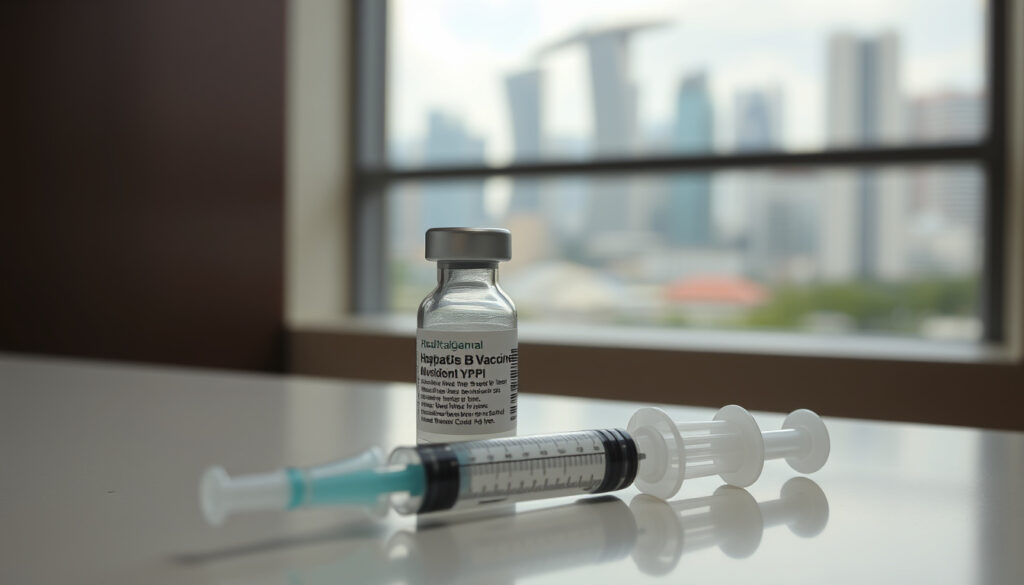
Hepatitis B Vaccine Singapore: Costs & Guide
Protecting yourself from hepatitis B in Singapore starts with a vaccine that has been part of the national strategy since 1985 (research in the PeerJ journal). But the costs, schedules, and booster recommendations can feel tangled. This guide lays out the facts — from polyclinic prices to lifelong immunity — so you can make an informed decision.
Vaccine introduced in Singapore: 1985 ·
Adult vaccination cost at polyclinics: from $9 ·
Adult vaccination cost at private clinics: $54.50 per dose ·
Recommended for: all infants and unvaccinated adults
Quick snapshot
- Hepatitis B vaccine is part of Singapore’s childhood immunisation schedule (Healthway Medical, a private clinic group)
- Cost at polyclinics starts from $9 per dose (Singapore Ministry of Health)
- Adult schedule: three doses over six months (Health Screening Singapore, a private clinic)
- Private clinics charge around $54.50 per dose (ATA Medical, a private clinic)
- Whether booster doses are routinely needed for healthy adults beyond childhood vaccination (CDC guidance)
- Whether the vaccine is legally compulsory for all adults (it is not, but strongly recommended) (HealthHub, Singapore’s health portal)
- 1985: Singapore launched a comprehensive immunisation programme to prevent perinatal transmission (PeerJ research article)
- 2023: Hepatitis B vaccination included in Healthier SG adult vaccination subsidies (Singapore MOH)
- Adults can check immunity via a blood test and receive subsidised vaccination under Healthier SG (Raffles Health, a private medical group)
- CHAS cardholders and Pioneer/ Merdeka Generation may pay reduced caps per dose (Thomson Medical, a private hospital)
Six key facts at a glance — the table below summarises the core data every resident should know.
| Fact | Detail |
|---|---|
| Vaccine type | Recombinant hepatitis B vaccine |
| Doses recommended | 3 doses (0, 1, 6 months) (Health Screening Singapore) |
| Cost (polyclinic) | From $9 per dose (MOH Singapore) |
| Cost (private clinic) | $54.50 per dose (ATA Medical) |
| Introduction year | 1985 (PeerJ research) |
| Childhood schedule | Included in National Childhood Immunisation Schedule (Healthway Medical) |
How much is the hepatitis B vaccine in Singapore?
Price at polyclinics: from $9 per dose
Singapore’s public polyclinics offer the hepatitis B vaccine at heavily subsidised rates for eligible citizens. Under the Healthier SG vaccination framework, the Ministry of Health (MOH Singapore) lists adult prices starting at $0, $9, $19, or $38 per dose depending on the subsidy tier. The $9 tier applies to standard-dose HepB for most adults; renal-dose variants cost slightly more. Bottom line: a full three-dose course at a polyclinic can cost as little as $27.
Price at private clinics: $54.50 per dose
Private clinics set their own fees. ATA Medical (ATA Medical, a private GP clinic) lists Engerix-B at $54.50 per dose, a price that Health Screening Singapore (a dedicated screening clinic) also quotes, noting it is “NETT inclusive of GST.” Raffles Health (a large private healthcare group) offers a three-dose package for $163.34 total. The pattern: private vaccination costs about six times the polyclinic rate per dose.
Using Medisave for payment
Medisave, Singapore’s national medical savings scheme, can be used to cover the hepatitis B vaccine for eligible individuals. Bethesda Medical (a CHAS-accredited clinic) confirms that both Medisave and CHAS cards can subsidise the cost, reducing out‑of‑pocket expenses for Singaporeans and PRs.
For a healthy adult earning a median income, the $45 difference between polyclinic and private per‑dose cost means a full course could cost $27 at a polyclinic versus $163.50 at a private clinic — a six‑fold gap that makes subsidy awareness critical.
The implication: polyclinics are clearly the cheapest option, but Medisave eligibility and CHAS tiers can narrow the private‑clinic gap for those who prioritise convenience.
Is the HepB vaccine required in Singapore?
For children: part of National Childhood Immunisation Schedule
Yes, the hepatitis B vaccine is included in Singapore’s National Childhood Immunisation Schedule (NCIS). Healthway Medical (Healthway Medical, a network of GP clinics) lists it as a standard vaccination given at birth, at one month, and at six months. All children residing in Singapore are strongly recommended to complete this series.
For adults: recommended but not mandatory
Adults who were not vaccinated as children or who lack proof of immunity are advised to receive the three‑dose series. HealthHub (Singapore’s official health portal) states that the vaccine is “recommended for all unvaccinated adults.” However, only diphtheria and measles vaccinations are legally compulsory under the Infectious Diseases Act. HepB is strongly encouraged but not enforced.
For travellers: advised for at‑risk destinations
If you are travelling to a country where hepatitis B is highly endemic — most of Asia, Africa, and parts of South America — the vaccine is advised. The US Centers for Disease Control and Prevention (CDC travel health) recommends the three‑dose series for all unvaccinated travellers to these regions.
The trade‑off: Singapore’s low but persistent endemicity (PeerJ research article) means local exposure is possible, but the main push is still for routine childhood vaccination and high‑risk adults.
Is hepatitis B common in Singapore?
Prevalence rates in Singapore
Hepatitis B is considered endemic in Singapore, though carrier rates have dropped significantly since the 1985 immunisation programme. A PeerJ research article (research from the National University of Singapore) reports that carrier rates among Singaporeans are now around 1–2%, down from over 10% before the programme. That still translates to tens of thousands of chronic carriers.
Risk groups and transmission
Perinatal transmission from mother to child was historically the main driver. The same PeerJ study credits the 1985 universal infant vaccination programme with breaking that cycle. Today, the highest risk groups include adults born before 1985 who were not vaccinated, healthcare workers, dialysis patients, and men who have sex with men. The Singapore Ministry of Health (MOH Singapore) offers subsidised vaccination for these groups under Healthier SG.
What this means: while no longer hyper‑endemic, the virus is still present, and the vaccine remains the single most effective defence.
Do you need a HepB booster every 5 years?
Routine booster not recommended for healthy adults
For most healthy adults who completed the three‑dose series, a booster is not routinely recommended. The CDC (US CDC hepatitis B guidelines) states that “a booster dose is not recommended for immunocompetent people who have completed the vaccine series.” The NHS in the UK (UK National Health Service) agrees: “You do not need a booster if you had a full course.”
Booster for immunocompromised or after exposure
Exceptions exist. People on haemodialysis, those with HIV, or others with compromised immunity may need a booster if antibody levels fall below 10 mIU/mL. Post‑exposure prophylaxis (PEP) also involves a booster dose. The CDC (CDC guidelines) details protocols for these scenarios.
CDC and NHS guidelines
Both agencies agree: for a healthy person, the three‑dose series provides protection that lasts for decades without a boost. The CDC (CDC) explicitly says “anti‑HBs may become undetectable, but protection is still present due to immune memory.”
For the vast majority of vaccinated adults in Singapore, a routine five‑year booster is unnecessary. The money and time are better spent on ensuring the initial three‑dose series was completed.
Do hepatitis B vaccines last for life?
Duration of immunity from full vaccination
Yes, the evidence points to lifelong protection from the complete three‑dose series. The CDC (US CDC) states that “long‑term protection, likely decades, is provided by the full vaccine series.” Antibody levels may wane over time, but immune memory cells can rapidly mount a response upon exposure.
When to test for immunity after vaccination
Routine testing after vaccination is not needed for most people. However, Raffles Health (Raffles Health, a private healthcare provider) offers a blood test to check for hepatitis B antibodies before deciding whether to start vaccination. For those who want certainty — especially healthcare workers or immunocompromised individuals — a post‑vaccination serology test (anti‑HBs) can confirm response.
The pattern: while antibody levels can become undetectable, the vaccine’s protection persists. The NHS (UK NHS) summarises: “Most people do not need a booster dose because the vaccine provides long‑term protection.”
Pros & Cons of Hepatitis B Vaccination in Singapore
Upsides
- Highly effective — >90% protection after three doses (CDC)
- Lifelong immunity for most people, no boosters needed (NHS UK)
- Subsidised at polyclinics: from $9 per dose (MOH Singapore)
- Medisave and CHAS eligible for many Singaporeans (Bethesda Medical)
- Part of the National Childhood Immunisation Schedule — universal coverage for infants (Healthway Medical)
Downsides
- Three doses required over six months — compliance can be an issue (Health Screening Singapore)
- Private clinic cost is high ($163.50 for full course) (ATA Medical)
- Not legally compulsory for adults — some may skip it (HealthHub)
- Mild side effects possible: sore arm, fatigue, low‑grade fever (CDC)
How to get the hepatitis B vaccine in Singapore: step by step
- Check if you need it. If you were born after 1985 and had the infant series, you’re most likely covered. Otherwise, a blood test at a clinic can confirm your immunity status. Raffles Health (Raffles Health) offers this serology test.
- Choose a provider. Public polyclinics (subsidised rates from $9/dose) or private clinics (~$54.50/dose). Use the MOH Healthier SG locator (MOH Singapore) to find an enrolled clinic.
- Bring your identification. For subsidy eligibility, bring your NRIC and any CHAS/Merdeka/Pioneer card. Bethesda Medical (Bethesda Medical) confirms CHAS and Medisave can be used.
- Get the first dose. The standard 0‑1‑6 schedule means dose 1 today, dose 2 in one month, dose 3 at six months. AHG Clinic (AHG Clinic, a private GP clinic) outlines this timeline.
- Complete the series. Mark your calendar. Missing dose 3 is the most common reason for incomplete protection. The full three‑dose course gives >90% protection (CDC).
- No booster needed — for healthy adults, the series is the final step. No further action required (NHS UK).
What’s confirmed vs what’s still unclear
Confirmed facts
- Hepatitis B vaccine is part of Singapore’s childhood immunisation schedule (Healthway Medical)
- Cost at polyclinics starts at $9 per dose (MOH Singapore)
- Private clinics charge around $54.50 per dose (ATA Medical)
- Vaccine introduced in 1985 to prevent perinatal transmission (PeerJ research)
- Three‑dose series (0,1,6 months) is standard for adults (Health Screening Singapore)
What’s still unclear
- Whether booster doses are needed for healthy adults many years after childhood vaccination (CDC says routine booster not recommended)
- Whether the vaccine is compulsory for all adults (it is not, but strongly recommended) (HealthHub)
“The hepatitis B vaccine helps to prevent infection caused by the Hepatitis B Virus. It is recommended for all unvaccinated adults.”
— HealthHub.sg (Singapore’s official health portal)
“A booster dose is not recommended for immunocompetent people who have completed the vaccine series.”
— US Centers for Disease Control and Prevention (CDC hepatitis B guidelines)
For Singapore residents, the path to hepatitis B protection is clear: complete the three‑dose series, take advantage of polyclinic subsidies and Medisave, and then forget about boosters. The 1985 programme already slashed carrier rates by over 90% (PeerJ research). For an adult who missed vaccination as a child, the choice is simple: $27 at a polyclinic and three clinic visits, or risk a chronic infection that can lead to cirrhosis and liver cancer.
For those wanting to understand the condition before vaccination, a review of hepatitis B basics can be helpful.
Frequently asked questions
What are the side effects of the hepatitis B vaccine?
The most common side effects are mild: soreness at the injection site, fatigue, headache, or low‑grade fever. Serious reactions are extremely rare. The CDC (CDC) notes that severe allergic reactions occur in about 1 in 1.1 million doses.
Can I get the hepatitis B vaccine if I am pregnant?
Yes, the hepatitis B vaccine is considered safe during pregnancy. The CDC (CDC) recommends vaccination for pregnant women who are at risk or unvaccinated.
How long after vaccination am I protected?
Protection begins after the second dose (one month) and reaches peak effectiveness after the third dose at six months. The full series provides >90% protection that lasts for decades (CDC).
Is the hepatitis B vaccine free for Singapore citizens?
Not free for most, but heavily subsidised. Under Healthier SG, eligible Singapore citizens can pay as little as $0 to $9 per dose at polyclinics depending on subsidy tier (MOH Singapore). Some groups, like Pioneer Generation, may pay $0 at polyclinics.
Can I take the hepatitis B vaccine at any polyclinic?
Yes, all public polyclinics under the National Healthcare Group and SingHealth clusters offer the hepatitis B vaccine. Check the MOH Healthier SG page (MOH Singapore) for a list of participating clinics.
Do I need a booster if my antibody test shows low levels?
For healthy adults, the CDC (CDC) says no — immune memory means protection outlasts detectable antibodies. A booster is only recommended for immunocompromised individuals or after needle‑stick injury.
What if I missed a dose of the hepatitis B vaccine?
You do not need to restart the series. Just take the missed dose as soon as possible and continue with the remaining doses at the recommended intervals (CDC).
More related posts
 R&D Meaning: Definition, Types & Examples in Business
 Thailand Arrival Card Online: How to Complete TDAC 2025
 Physical Therapist Near Me: Chartered Physios in Ireland
 Katong Mei Wei Chicken Rice: Menu, Locations, Reviews Singapore
 SIA Online Check In: 48 Hours to 1.5 Hours, Steps & Tips
 Singtel Customer Service Number: Official Contacts
 Plants vs Brainrots Codes – Active April 2026 List
 Juliette Has a Gun: Popular Perfumes, Scents & Reviews
