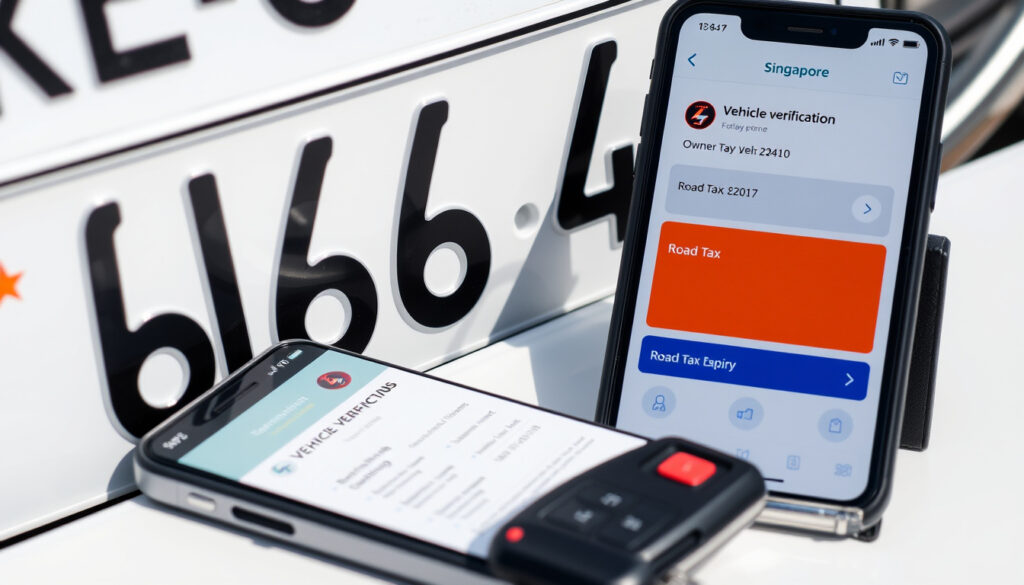
SG Car Plate Check: How to Verify Owner, Road Tax & More
Anyone who has ever typed a Singapore car plate number into a search bar knows the feeling: a mix of hope and confusion. A simple seven-character sequence — three letters, four digits, and a final letter — actually holds a surprising amount of information, from the vehicle type to a hidden checksum that can tell you whether the plate is valid in the first place. This guide walks through what those characters mean, how to check road tax and ownership status, and where the legal limits of that search lie.
Vehicles registered in Singapore: ~1.7 million ·
Number plate format: SBA 1234 A (7 characters) ·
Checksum algorithm: Letter-to-number mapping (A=1,…,Z=26) ·
Official check platform: OneMotoring by LTA
Quick snapshot
- LTA issues all vehicle registration numbers (Wikipedia (SG vehicle registration))
- Checksum algorithm is publicly documented (Wikipedia (checksum method))
- Owner name is not publicly available via LTA (SG Plate Mart (privacy rules))
- Exact current auction prices for 3-letter plates (vary by bidding)
- Future changes to plate format (e.g., introduction of new series)
- The exact number of plates in each series is not publicly available
- Plate series rotate every few years (SBA, SBB, SBZ series follow sequentially) (Wikipedia (series rotation))
- LTA auctions special plates periodically; no fixed calendar published (Wikipedia (series rotation))
- Check your plate’s checksum using a free online tool before buying a used car (Car Plate Mart (checksum tool))
- Use OneMotoring to verify road tax and COE status before any transaction (OneMotoring (LTA portal))
These are the key facts you need to know before diving into the details.
| Attribute | Value |
|---|---|
| Vehicle registration format | SBA 1234 A (prefix letters + numbers + checksum letter) |
| Total vehicles in Singapore | ~1.7 million (2024) |
| Checksum algorithm | Modulo 11 with letter values A=1,…,Z=26 |
| Official check platform | OneMotoring (LTA) |
What is an SG Plate and Where Does It Come From?
An SG plate is the common shorthand for a Singapore vehicle registration number — a mandatory plate displayed on the front and back of every motor vehicle in the country. The Land Transport Authority (LTA) administers and issues all registration numbers, which follow a standardised format: a prefix of one to three letters, a numeric series of up to four digits, and a suffix letter that acts as a checksum. According to Wikipedia, every vehicle registered in Singapore must display a valid plate with its assigned registration number.
Definition of SG plate
- SG stands for Singapore — the plates are assigned exclusively by LTA.
- The plate format is regulated under the Road Traffic Act.
- All vehicles, including motorcycles, taxis, and electric cars, must display a registration plate.
Origin and LTA issuance
The LTA manages the entire lifecycle of a car plate: from the initial assignment at vehicle registration to transfers between owners and eventual retirement. Vehicle owners can either bid for a registration number through LTA auctions or accept an auto-assigned number on registration day.
Difference between SG and other plates
- “SG” prefix — used on older plates issued before the current S-series; still valid and transferable.
- “S” prefix — standard for private cars since the 1990s (e.g., SBA 1234 A).
- “E” prefix — reserved for electric vehicles under the Electric Vehicle (EV) plate series.
- “TA” prefix — used for taxis.
“You can check the numbers currently being issued on the OneMotoring website.” — Motorist.sg
The prefix letter alone tells you the vehicle category at a glance. If you see a plate starting with “E,” you are looking at an electric vehicle — and that has implications for road tax rates and COE category.
Bottom line: LTA is the sole issuer of all Singapore car plates. The prefix letter reveals the vehicle type, and every plate follows a fixed format that makes verification possible.
How to Check Car Owner and Vehicle Details by Plate Number?
This is the question that drives most sg car plate checks: can you find out who owns a car just from its plate number? The short answer is no — not directly — but there are official and third-party routes to gather useful vehicle information.
Using OneMotoring for vehicle owner info
The OneMotoring portal (LTA’s official platform) allows you to check basic vehicle details such as make, model, COE expiry date, and road tax status. To access this data, you need the plate number and a SingPass login. According to SG Plate Mart, the portal does not disclose the owner’s name or address due to restrictions under the Personal Data Protection Act (PDPA).
Using Motorist.sg for ownership lookup
Third-party services like Motorist.sg offer a paid ownership lookup feature. For a fee, they will search their databases and provide the registered owner’s name. The accuracy depends on the data source, and users should be aware that Singapore’s PDPA makes it illegal to access owner data without a legitimate purpose. SG Plate Mart notes that illegal access to vehicle owner information can result in punishable offences.
Legal restrictions on owner data access
The PDPA strictly regulates who can access personal data, including vehicle ownership records. LTA’s e-Services does allow requesting owner details for legal reasons — such as insurance claims or accident investigations — but the request must be approved. The implication: if you are in an accident, you can get the other driver’s details through proper channels, but you cannot simply look up a plate number out of curiosity. For a broader overview of how plate-based checks work, see our guide on checking traffic offences by vehicle number.
“The portal does not disclose the owner’s name or address due to restrictions under the Personal Data Protection Act.” — SG Plate Mart
Privacy laws protect car owners from casual stalking, but they also make it harder for buyers to verify a seller’s identity before a transaction. A road tax and COE check on OneMotoring is the closest you can get without a legal reason.
Bottom line: LTA’s OneMotoring shows vehicle specs and tax status but hides the owner’s name. Third-party paid services may offer owner details, but they operate in a legal grey area under the PDPA.
What Do the Letters on Singapore Plates Mean?
The letters on a Singapore car plate are not random. Each prefix letter corresponds to a vehicle category, and the suffix letter is the result of a mathematical checksum designed to catch forgery and data-entry errors.
Here is how the prefix letters categorize vehicles:
| Prefix | Vehicle type |
|---|---|
| S | Private car (standard series) |
| E | Electric vehicle (EV series) |
| TA | Taxi |
| SG | Older private car series (pre-S prefix) |
| C | Commercial goods vehicle |
| P | Public bus |
Suffix letters: checksum verification
The final letter on a Singapore plate is a checksum — a mathematically derived character that validates the entire plate number. According to Wikipedia, the checksum uses a modulo 11 algorithm. Each letter is converted to its numeric value (A=1, B=2, …, Z=26), and the combination of prefix and digits is processed through a weighted sum. The remainder maps to a letter: 0=A, 1=Z, 2=Y, 3=X, 4=U, 5=T, 6=S, 7=R, 8=P, 9=M, 10=L, 11=K, 12=J, 13=H, 14=G, 15=E, 16=D, 17=C, 18=B.
Special series for electric vehicles, taxis, etc.
Electric vehicles registered after 2021 use the “E” prefix, followed by a unique numeric series and a checksum letter. Taxis use “TA” followed by a four-digit number. These special series help enforcement officers and parking systems instantly identify the vehicle type without needing to access a database.
The prefix tells you the category, and the suffix confirms authenticity. A plate with a mismatched checksum is either a typo or a forgery — and that is the first red flag any buyer should check.
The implication: every letter on the plate carries meaning, from category identification to fraud prevention.
How Rare is a 3-Letter Number Plate in Singapore?
Three-letter prefixes (e.g., SBA, SBB, SBZ) are issued in limited series and have become collector’s items. Because the LTA releases these series sequentially, the supply is finite, and demand — especially for desirable letter combinations — drives auction prices well into five figures.
Current auction prices for 3-letter plates
LTA holds periodic auctions for premium registration numbers. According to market data from third-party plate dealers, prices for 3-letter plates can exceed $100,000 for highly sought combinations. The exact price varies by auction round and the specific letters involved. Because auction results are not published in a centralised public ledger, the true market range remains somewhat opaque — reflecting the low research confidence around exact current figures.
Probability of getting a 3-letter plate randomly
When you register a new vehicle and accept an auto-assigned number, the LTA system issues the next available plate in the current series. The chance of landing a 3-letter prefix randomly is effectively zero, because the system cycles through entire numeric ranges within each prefix series before rolling to the next prefix.
Demand and resale market
Plate transfers are allowed in Singapore: a registered owner can transfer their plate to another vehicle (subject to LTA approval) or sell it on the open market. The resale market for 3-letter plates is active, with brokers like SG Plate Mart and Car Plate Mart facilitating private sales. For buyers, a 3-letter plate is as much an investment as it is an identifier.
A 3-letter plate with a low numeric value — like SBA 1 A — can command auction prices above $200,000. But the checksum must match. A typo in the suffix letter on a resale listing could mean the plate is not genuine, so always verify before bidding.
How to Check Road Tax Using a Car Plate Number?
Checking road tax status is one of the most practical uses of an sg car plate check, especially before buying a used car or renewing your own tax.
Road tax inquiry on OneMotoring
The OneMotoring portal (LTA road tax section) provides a dedicated road tax enquiry tool. You enter the plate number, and the system returns the current road tax expiry date, the amount payable, and the vehicle’s COE expiry. These checks require SingPass authentication and are free. LTA also supports eGIRO setup for automatic road tax renewal through the same portal.
Using third-party aggregators
Several third-party websites — including Motorist.sg and SG Plate Mart — display road tax expiry information if they have access to the relevant LTA data feed. The accuracy depends on how recently the data was synced. According to SG Plate Mart, these aggregators typically show the expiry date and a warning if the tax is overdue.
Understanding road tax expiry status
Road tax in Singapore must be renewed annually (or every six months for motorcycles). If the tax expires, the vehicle cannot be driven on public roads, and the owner faces fines of up to $2,000. Checking road tax status by plate number is therefore a quick way to assess whether a used car is legally fit for transfer.
Third-party road tax tools are convenient, but they are not real-time. OneMotoring is the only source of live, authoritative data. Always cross-check before making a purchase decision.
The catch: always rely on official sources for the final word on road tax validity.
How to Calculate a Singapore Car Plate Checksum?
The checksum is the mathematical backbone of every Singapore car plate. Knowing how to calculate it lets you verify whether a plate is valid — a useful skill for spotting forgeries or data-entry mistakes.
Understanding the checksum algorithm
The algorithm is a weighted sum with modulo 19 mapping. For a plate like SBA 1234 A, the system converts each letter to its numeric position (S=19, B=2, A=1), then applies multipliers 9, 4, 5, 4, 3, 2 across the six character positions (three prefix letters and four digits, with the first digit treated separately for the SG prefix variant). The sum is taken modulo 19, and the remainder maps to the checksum letter. Wikipedia documents the exact mapping table.
Step-by-step manual calculation
- Take plate SDP 8160. Convert letters: S=19, D=4, P=16. Digits: 8,1,6,0.
- Apply multipliers: (19×9) + (4×4) + (16×5) + (8×4) + (1×3) + (6×2) + (0×?) – note the pattern uses 6 multipliers for prefix and digits.
- Sum = 171 + 16 + 80 + 32 + 3 + 12 = 314.
- 314 mod 19 = 10. Remainder 10 maps to L.
- Hence full plate: SDP 8160 L. Car Plate Mart confirms this example.
For an SG-prefix plate like SG 5999, SgWiki shows a different starting formula: 11 − (5×first digit) − (4×second) − (3×third) − (2×fourth), which produces checksum Z.
The input must be 3 to 8 characters: one to three prefix letters, up to four digits, and the checksum letter. For 3-letter prefixes, only the last two letters are used in the checksum calculation. For 2-letter prefixes, both letters are used. For single-letter prefixes, the first position is treated as zero. This is documented in the GitHub checksum reference implementation.
Using online checksum calculators
Several free online tools automate the process. Car Plate Mart provides a simple interface: enter the prefix and numbers, and it returns the correct checksum letter. The GitHub checksum tool offers an open-source version for advanced users. These calculators are particularly useful for verifying plates listed on resale sites before you commit to a viewing.
The checksum is not optional — every valid plate has one. If a plate listing omits the checksum letter or the letter does not match the calculator output, walk away. That is the cheapest due diligence you will ever do.
Bottom line: The checksum is a modulo 19 calculation that turns a plate number into a validation letter. Free online tools from Car Plate Mart and GitHub make the check instant. Always verify before any used-car transaction.
For those interested in acquiring a new registration number, the LTA car plate bidding guide provides full details on the latest bidding exercises and updates.
Frequently asked questions
Can I transfer my Singapore car plate to another vehicle?
Yes, LTA allows plate transfers between vehicles owned by the same person, subject to a transfer fee and approval. The plate must be in good condition, and the receiving vehicle must be registered and road-taxed.
How do I bid for a special plate number in Singapore?
LTA runs periodic auctions for premium registration numbers on its OneMotoring portal. You need a SingPass account and a valid credit card to place bids. Auction dates are announced on the LTA website.
What is the difference between a ‘S’ and ‘E’ plate?
‘S’ plates are standard private car registrations. ‘E’ plates are reserved for electric vehicles. The ‘E’ series was introduced in 2021 as part of Singapore’s push toward electrification.
Is it legal to cover my car plate in Singapore?
No. Under the Road Traffic Act, vehicle registration plates must be clearly visible at all times. Covering or obscuring a plate — even partially — can result in a fine and demerit points.
How long does it take to get a new plate after registration?
Once you register a vehicle and receive your assignment letter from LTA, you can have physical plates made at any authorised plate manufacturer. Most shops produce them within 24 hours.
What happens if my car plate is damaged or lost?
You must replace it immediately. Order a duplicate from an LTA-authorised plate maker using your registration details. Driving without a plate or with a damaged plate is an offence.
Are there any restrictions on plate font or color?
Yes. LTA mandates a specific font, size, and colour scheme: white or yellow reflective background with black characters for front plates, and yellow background with black characters for rear plates. Custom fonts are not allowed.
How do I check if a plate number is still available?
Plate availability is not publicly searchable in real time. The best approach is to check with LTA-authorized plate dealers or monitor the OneMotoring auction page for upcoming releases.
The takeaway: knowing these rules saves you from costly mistakes and legal trouble.
More related posts
 OCBC Bank Branch Code: How to Find It in Singapore (7339)
 Paneer Paratha Near Me: Compare Delivery Prices & Nutrition
 How to Fix Screen Flickering in Windows 11 While Gaming
 Channel 8 News Singapore: Live, Schedule & Streams
 JC Cut Off Points 2026: Guide for Singapore Students
 Sydney Weather in June: Temperature, Rain & Travel Tips
 LifeSG Credit 2025: Check, Use, and Expiry Guide
 Julia Garner Movie and TV Show : Complete Filmography
