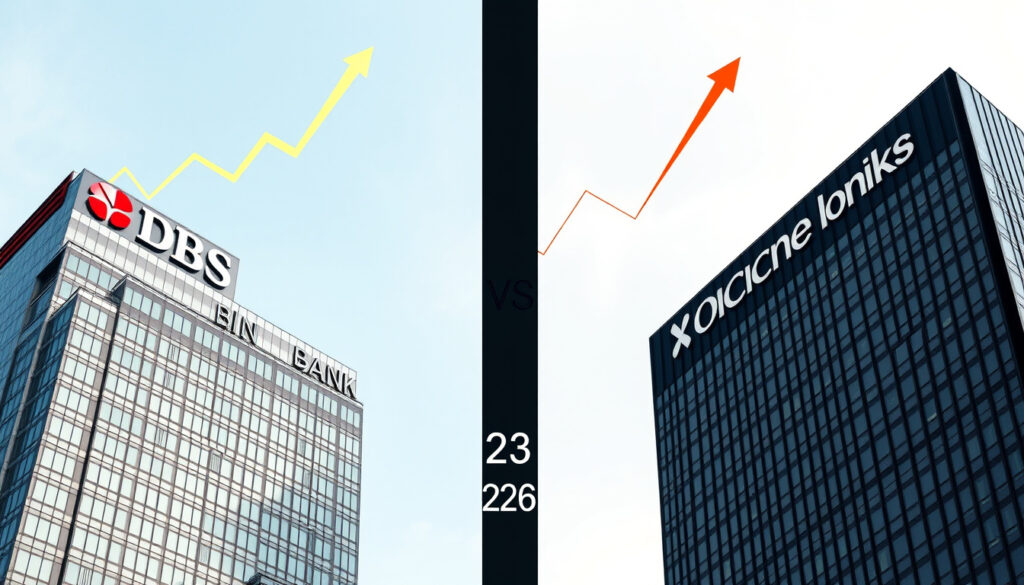
DBS vs OCBC: Which Bank Stock Pays More in 2026
Anyone holding Singapore bank stocks has asked the same question twice this year: DBS or OCBC? DBS just posted a record SGD 3.08 billion second-quarter profit while OCBC’s first-half earnings climbed 13% and its interim dividend rose 15%, with the two stocks answering different questions: one leans toward income, the other toward growth.
DBS dividend per share (2026): $2.64 SGD ·
OCBC dividend per share (2026): $0.82 SGD ·
DBS payout ratio: ~64.4% ·
1Q26 earnings growth (DBS vs OCBC): DBS and OCBC stronger than UOB
Quick snapshot
- OCBC’s first-half 2026 net profit rose 13% to a record SGD 4.19 billion (OCBC 1H26 media release (bank’s official results)).
- DBS 2Q26 total income rose 6% to a record SGD 6.09 billion (DBS 2Q26 press statement (official investor release)).
- DBS continues to lead Singapore peers on dividend yield (The Straits Times (Singapore business press)).
- How much of the DBS–OCBC yield gap survives 2026: by August, Yahoo Finance Singapore (market data desk) estimated DBS’s annualized yield at 4.2% and OCBC’s at 3.3%, down from the March forecast spread (Yahoo Finance Singapore (market data desk)).
- Which bank outperforms in 2027 — that call depends on interest-rate policy, and neither bank guides beyond the current dividend cycle. (Yahoo Finance Singapore (market data desk))
- Whether the DBS–OCBC yield gap stabilizes or narrows further. (Yahoo Finance Singapore (market data desk))
- DBS declared a 2Q26 dividend of SGD 0.81 per share, including a SGD 0.15 capital-return top-up (DBS 2Q26 press statement (official investor release)).
- OCBC raised its 1H26 interim dividend 15% to SGD 0.47 per share (OCBC 1H26 media release (bank’s official results)).
- 2026 dividend forecasts: SGD 3.24 per share for DBS (5.6% implied yield) and SGD 0.99 per share for OCBC (4.6% implied yield) (The Straits Times (Singapore business press)).
- Watch 2H26 final-dividend announcements for any further capital-return surprises. (The Straits Times (Singapore business press))
Ten numbers, one takeaway: both banks are growing earnings and paying shareholders more in 2026.
| Metric | Value |
|---|---|
| DBS dividend per share (2026) | $2.64 SGD |
| OCBC dividend per share (2026) | $0.82 SGD |
| DBS payout ratio | ~64.4% |
| 1Q26 earnings growth (DBS vs OCBC) | DBS and OCBC stronger than UOB |
| DBS 2Q26 net profit | SGD 3.08 billion (record, +9% year on year) |
| DBS 2Q26 total dividend per share | SGD 0.81 (ordinary SGD 0.66 + capital return SGD 0.15) |
| DBS 2Q26 total income | SGD 6.09 billion (+6% year on year) |
| OCBC 1H26 net profit | SGD 4.19 billion (record, +13% year on year) |
| OCBC 1H26 interim dividend per share | SGD 0.47 (+15% year on year) |
| OCBC 1H26 dividend payout | 50% of group net profit (SGD 2.11 billion) |
Which bank is better, OCBC or DBS?
There is no single winner, because the two banks answer different questions. DBS pays out more cash per share today; OCBC keeps more of its record profit inside the bank to fund future growth.
- DBS: 2Q26 total dividend of SGD 0.81 per share, including a SGD 0.15 capital-return component (DBS 2Q26 press statement).
- OCBC: 1H26 interim dividend of SGD 0.47 per share, up 15% from a year earlier (OCBC 1H26 media release).
- Market view: DBS has held the higher dividend yield through the cycle, even after OCBC’s stronger fourth-quarter earnings run (The Straits Times (Singapore business press)).
Dividend yield comparison
March 2026 analyst forecasts put DBS’s implied yield at 5.6% on a SGD 3.24 dividend, versus OCBC’s 4.6% on SGD 0.99 — a roughly one-point spread that had narrowed by August as share prices climbed.
That one-point spread is the entire DBS bull case in one number. DBS pays quarterly, and it has been adding a SGD 0.15 capital-return dividend on top of its SGD 0.66 ordinary dividend. The ordinary portion alone annualizes to about SGD 2.64 per share; the capital-return top-ups are what push the full-year forecast toward SGD 3.24.
OCBC’s payout is more conservative by design. Its interim dividend of SGD 0.47 for 1H2026 is 15% higher, yet it still consumed only half of first-half profit. That is the trade-off: DBS hands you more cash today, OCBC keeps more fuel for compound growth. If you plan to collect DBS’s next quarterly payout, the DBS ex-dividend date 2026 determines whether you qualify.
Earnings growth 2026
- DBS 2Q26 total income: SGD 6.09 billion, up 6% year on year (per the DBS 2Q26 press statement cited above).
- OCBC 1H26 net profit: SGD 4.19 billion, up 13% year on year (per the OCBC 1H26 media release cited above).
- The 1Q26 pattern: both DBS and OCBC grew faster than UOB, as the stats line above shows.
Both banks are growing in the same rate cycle, but with different engines. DBS is converting its scale into record income; OCBC’s profit acceleration leans on a wealth-management franchise that has become the strategic center of the bank. For income investors, the more important detail is payout: DBS paid SGD 0.81 in a single quarter, while OCBC’s entire interim dividend cost SGD 2.11 billion.
The implication: on pure momentum, OCBC is growing faster in 2026; on cash returned, DBS remains the heavyweight.
Risk assessment
- Rate risk: net interest margins at both banks track the Singapore and global rate cycle, and neither bank controls it.
- Valuation risk: bank shares entered a record-high zone in mid-2026, so the easiest gains of the year happened before most investors started comparing the two.
- Concentration risk: both pay out half to three-fifths of earnings — generous until earnings dip.
Neither stock is a speculative bet; the risk is macro, not company-specific. When rate-cut expectations strengthen, bank margins compress, and high-priced shares correct faster. The dividend forecasts in this comparison assume earnings hold near current levels.
Is it a good time to buy OCBC shares now?
Short answer: it depends on your yield target. OCBC is attractive for investors who want a faster-growing dividend at a lower starting yield; it is not the pick for maximum cash today. The 1H26 interim dividend of SGD 0.47 consumed SGD 2.11 billion — exactly 50% of first-half net profit (OCBC 1H26 media release).
- Yield: by August 2026, Yahoo Finance Singapore (market data desk) estimated OCBC’s annualized yield at 3.3%, about a point below DBS’s 4.2%, as noted in the snapshot above.
- Dividend growth: the 15% interim hike is the clearest signal yet that management is shifting toward higher shareholder returns.
- Valuation: the sector has already repriced after a record-high run, so the cheapest entry point of 2026 is behind you.
Current valuation of OCBC
OCBC’s 50% payout ratio means half of every dollar earned stays inside the bank. Cash-seeking investors read that as a drag; growth investors read it as compounding fuel.
OCBC is neither cheap nor expensive against its own history; the market has moved the stock up with the sector. The practical effect is on yield: at a higher share price, the same dividend looks smaller. The 4.6% implied yield from March forecasts had become roughly 3.3% by August — the income entry point was earlier in the year.
Interest rate outlook
- Singapore bank margins expand when rates stay higher and compress when rate cuts arrive; every policy signal gets repriced into bank shares quickly.
- OCBC’s 50% payout gives it more buffer than a higher-paying peer: it can hold the dividend while still funding regional growth.
If the rate cycle turns faster than expected, OCBC’s lower payout ratio is the shock absorber. DBS’s capital-return top-ups are, by name, variable; OCBC’s ordinary dividend is the more predictable income stream.
Analyst ratings
- Analyst commentary in 2026 has focused on DBS’s yield leadership while acknowledging OCBC’s faster earnings momentum.
- The market’s main open question continues to be the direction of rates.
No 2026 report from OCBC gives a reason to avoid the stock. The fair criticism is relative: you accept a lower yield than DBS, and you buy after a strong run. That is a price issue, not a quality issue.
Which is bigger, DBS or OCBC?
DBS is the largest Singapore bank by market capitalization; OCBC is smaller but carries one of the region’s more established wealth-management franchises. Size matters for dividend capacity, and it shows up in the payout numbers already cited.
- Cash returned: DBS also leads the trio in annualized cash returned to shareholders, driven by its quarterly payouts plus capital-return dividends (Yahoo Finance Singapore (market data desk)).
- Business mix: OCBC’s wealth-management franchise is the strategic engine behind its 2026 profit growth.
Market capitalization
- DBS: larger by market cap and by total assets, which is why it can pay a larger total cash dividend.
- OCBC: smaller, with a business mix that leans on wealth management and regional banking rather than pure domestic scale.
Size is more relevant to dividends than to returns. DBS’s larger earnings base funds the highest cash return of the three banks; OCBC’s smaller base is compounding faster. For a long-term holder, the growth rate often matters more than the size.
Revenue comparison
- DBS 2Q26 total income: SGD 6.09 billion, a record (+6% year on year) — per the DBS 2Q26 press statement cited above.
- OCBC 1H26 net profit: SGD 4.19 billion, a record (+13% year on year) — per the OCBC 1H26 media release cited above.
Bigger does not automatically mean better. DBS is the larger revenue machine; OCBC’s growth rate is higher. So the “which is bigger” question is settled quickly — and the “which is growing faster” question then becomes the more useful one.
The pattern: size gives DBS its dividend edge, but OCBC’s faster compounding is the reason the yield gap is expected to narrow over time.
Why Singapore bank stocks are falling today?
The drops you see in Singapore bank stocks are not showing up in the fundamentals. Both DBS and OCBC just reported record profits, and the sector was trading near record highs in mid-2026 with payout ratios around half to three-fifths of earnings (Yahoo Finance Singapore (market data desk)).
- Profit-taking: a rally to record highs invites selling the moment rate expectations shift, even when earnings keep rising.
- Rate expectations: Singapore bank margins move with the interest-rate cycle; each shift in rate pricing changes the sector’s net interest margin outlook.
- Valuation, not earnings: the 2026 reports from both banks have been record-breaking. The pullbacks are about the price paid, not the results delivered.
Recent market drivers
A red day for Singapore bank stocks is usually a rates story in disguise: traders repricing rate cuts hit the margin outlook even while the published profits keep climbing.
That is the pattern to remember: the shares follow the rate cycle, not the earnings calendar. The 2026 rallies ran while DBS and OCBC posted record numbers; the dips come when the outlook for margins — not the results — darkens.
Interest rate impact
- Higher-for-longer rates support net interest margins and bank dividends; rate cuts pressure both.
- The dividend forecasts of SGD 3.24 (DBS) and SGD 0.99 (OCBC) assume earnings stay near current levels.
So when you see “Singapore bank stocks falling today,” look for the rate signal that moved first. If the banks’ reported profits are still climbing, the fall is a valuation reset — not an earnings warning.
Global economic concerns
- Singapore banks carry regional lending exposure, so global growth worries move the sector even when domestic numbers are strong.
- Both banks’ 2026 results beat their year-ago levels, so the global-risk story is currently a sentiment story, not an earnings story.
Which Singapore bank stock to buy?
For Singapore retail investors, the practical answer splits by income style: maximum cash today means DBS; faster dividend growth and a lower payout ratio mean OCBC. Owning both is also a legitimate answer, and it avoids the winner-take-all trap.
DBS vs OCBC vs UOB overview
DBS gives you the higher payout today; OCBC gives you the faster-rising payout; UOB, on the 1Q26 growth measure, lagged both.
- DBS (D05): highest dividend per share, quarterly payments, capital-return top-ups.
- OCBC (O39): 15% interim dividend growth, 50% payout ratio, wealth-management-led profit growth.
- UOB: trailed DBS and OCBC on 1Q26 earnings growth.
Investment criteria
- Income investors: DBS’s forecast 2026 yield of 5.6% beats OCBC’s 4.6% on the same March basis.
- Growth investors: OCBC’s 13% profit growth and 15% dividend hike are the faster trajectory.
- Timing-conscious investors: both stocks are priced after a record-high rally, so position sizing matters more than bank selection.
Risk vs reward
Record earnings and record prices arrived at the same time. The margin of safety in 2026 is thinner than the dividend yields suggest.
Start with the numbers you can verify: DBS paid SGD 0.81 for one quarter and analysts forecast SGD 3.24 for the year; OCBC paid SGD 0.47 for one half and analysts forecast SGD 0.99 for the year. Everything else is valuation timing, which is a weaker edge than dividend arithmetic.
The reward is clear: two bank stocks generating record profits and raising payouts. The risk is equally clear: you are buying near record prices, so the timing buffer is thinner than it was before the 2026 rally.
What this means: the “best” Singapore bank stock in 2026 is the one whose payout style matches your cash-flow needs. Income now — DBS. Income later, growing faster — OCBC.
Six rows, one pattern: DBS leads on payout size and yield, while OCBC leads on growth and payout discipline.
| Metric | DBS (D05) | OCBC (O39) |
|---|---|---|
| Latest reported net profit | SGD 3.08 billion (2Q26, +9% YoY) | SGD 4.19 billion (1H26, +13% YoY) |
| Dividend per share (latest) | SGD 0.81 for 2Q26 (incl. SGD 0.15 capital return) | SGD 0.47 interim for 1H26 |
| 2026 dividend per share forecast | SGD 3.24 | SGD 0.99 |
| Implied 2026 dividend yield (March) | 5.6% | 4.6% |
| Effective annualized yield (August) | 4.2% | 3.3% |
| Dividend frequency | Quarterly ordinary + capital-return top-ups | Semi-annual ordinary |
| Payout ratio | ~64.4% | 50% of 1H26 net profit |
The implication: neither bank dominates every row — the table splits almost evenly between cash and growth. Choose the column that matches your income need, not the one with the better-sounding story.
Upsides
- Record earnings at both banks: DBS 2Q26 profit up 9%, OCBC 1H26 profit up 13%.
- Dividends are rising: OCBC’s interim payout up 15%, DBS adding capital-return top-ups.
- Analyst forecasts give DBS a 5.6% implied yield and OCBC 4.6% for 2026.
Downsides
- Both stocks trade near record highs after the mid-2026 rally.
- Both banks are exposed to the interest-rate cycle.
- The DBS–OCBC yield gap narrowed as prices climbed through 2026.
Confirmed facts
- DBS 2Q26 dividend: SGD 0.81 per share, including a SGD 0.15 capital-return top-up.
- OCBC 1H26 dividend: SGD 0.47 per share, up 15%.
What’s unclear
- Direction of interest rates for 2027.
- Whether the DBS–OCBC yield gap stabilizes or narrows further.
- Which bank delivers the better total return in 2027.
Two independent reads capture the same 2026 story.
“DBS and OCBC delivered stronger 1Q26 results than UOB.”
— Growbeansprout analysis
“DBS leads with an impressive payout of SGD 2.64 per share.”
— StashAway article
DBS is the higher-yield, higher-cash name; OCBC is the faster-growing, more conservative payer. The 2026 numbers settle the factual part of the debate — record profits, rising dividends, a narrowing yield gap — and leave the decision to your cash-flow needs. For Singapore retail investors weighing DBS vs OCBC bank stocks, the choice is clear: if you want maximum ordinary income from a bank stock, DBS is the better envelope; if you want a dividend growing at 15% while the bank keeps half its earnings, OCBC is the better compounding machine. Sitting out is also a position — but with both banks paying meaningful dividends, it is the one choice that guarantees no income at all.
dbs.com.sg, sg.finance.yahoo.com, growbeansprout.com, thekopinotes.com, sg.finance.yahoo.com, dbs.com.sg, dbs.com, dbs.com
Frequently asked questions
What is the dividend yield of DBS vs OCBC?
In March 2026 analyst estimates, DBS’s forecast 2026 dividend of SGD 3.24 per share implied a 5.6% yield, while OCBC’s SGD 0.99 implied 4.6% (The Straits Times). After the share-price rally, Yahoo Finance Singapore estimated the effective annualized yields at about 4.2% for DBS and 3.3% for OCBC in August 2026.
How do DBS and OCBC compare in net interest margin?
Neither bank publishes a forward net interest margin forecast, so the honest comparison is directional: both benefit when rates stay higher, and both feel margin pressure when rate-cut expectations strengthen. DBS’s scale gives it a volume cushion; OCBC’s wealth-management income reduces its reliance on pure lending margins.
Which bank has higher loan growth?
Loan growth is disclosed quarterly, and the published 2026 results show both banks growing earnings ahead of their year-ago levels. For income investors, the more consistent signal has been dividend growth: DBS’s 2Q26 payout of SGD 0.81 and OCBC’s 15% higher interim dividend.
Are DBS and OCBC stocks suitable for income investors?
Yes, with different profiles. DBS pays quarterly, includes capital-return top-ups, and carried the higher implied yield in 2026. OCBC pays semi-annually, ran a 50% payout ratio in 1H26, and raised its interim dividend 15% — a lower starting yield, but a faster-rising one.
What are the risks of investing in Singapore bank stocks?
The main risks are interest-rate direction, valuation after a record-high rally, and global growth. The dividend forecasts in this article assume earnings stay near current levels; if margins compress sharply, payouts would be the first thing investors reprice.
How do DBS and OCBC valuations compare?
On the published 2026 forecasts, DBS offered the higher dividend yield and OCBC the faster earnings growth. After the mid-2026 rally to record highs, both stocks carry higher starting valuations than they did earlier in the year.
What is the market cap of DBS and OCBC?
DBS holds the largest market capitalization among Singapore-listed banks. OCBC is smaller, with a wealth-management franchise that contributes a significant share of its earnings. Their SGX tickers are D05 (DBS) and O39 (OCBC).
Related reading
More related posts
 Central 24-HR Clinic: Locations, Fees & 24-Hour Service
 Opero Hotel Southkey JB: Reviews, Prices, Buffet & Amenities
 Keppel DC Share Price: Target, Dividend, and Forecast 2026
 Medium.com: What It’s Used For, Free Access & 2026 Status
 Gold Price Today: Tamil Nadu, Ireland – 22K, 24K & 916 Pavun
 Swee Guan Hokkien Mee: Best Charcoal-Fried in Geylang
 How to Cancel Your Citibank Credit Card in 2025
 Samsung Galaxy Watch Ultra2: Price, Specs & Worth
