What Is 6/7 – Decimal, Percentage and Facts
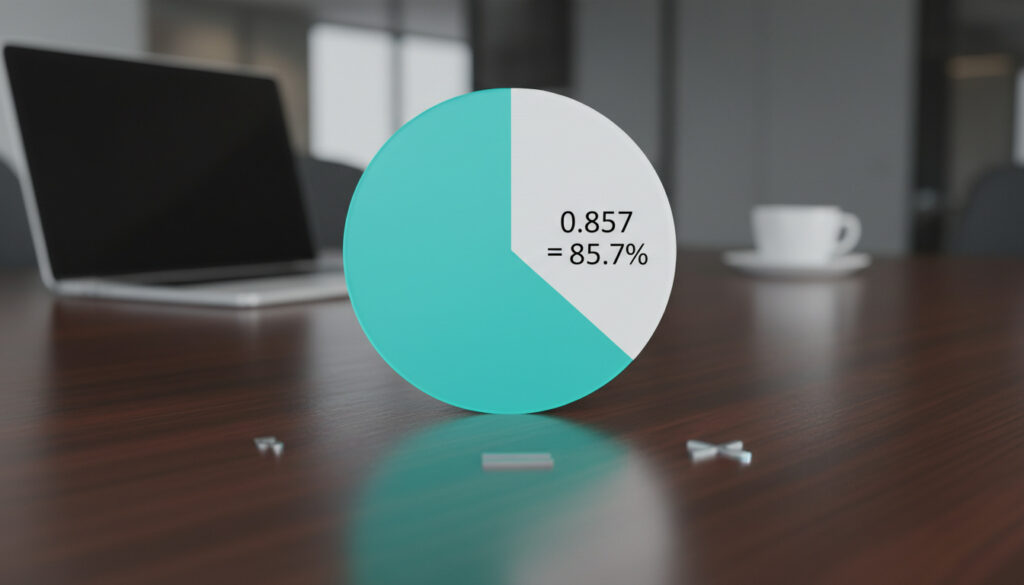
The fraction 6/7 represents six parts of a whole divided into seven equal portions. As a proper fraction where the numerator remains smaller than the denominator, it conveys a specific ratio that translates into one of mathematics’ recognizable repeating decimal patterns.
Understanding this value requires examining its exact decimal expansion, percentage equivalent, and fundamental properties. Unlike decimal approximations that round to 0.857, the precise value extends infinitely without terminating.
This exploration breaks down the calculation method, verifies its simplified status, and identifies practical contexts where this specific ratio appears in probability and measurement scenarios.
What Is 6/7 as a Decimal and Percentage?
| Fraction Form 6/7 |
Decimal Value 0.857142… |
Percentage 85.714% |
Simplest Form Yes (GCD=1) |
Six divided by seven yields a quotient that never resolves to a finite decimal. The exact value is 0.857142857142…, where the sequence 857142 repeats indefinitely. This repeating block, known as the repetend, continues in a cycle of six digits.
When expressed as a percentage, the fraction becomes approximately 85.714%. The precise percentage value is 85.714285…, mirroring the same cyclical pattern shifted by the multiplication factor of 100.
Key Properties of 6/7
- The decimal repeats every six digits: 857142
- It is a proper fraction since 6 < 7
- Cannot be reduced further as 6 and 7 share no common factors other than 1
- Equivalent to 85.714285…% when converted to percentage
- Represents approximately 85.7% of a whole in practical estimation
- Distinct from the decimal 6.7 or percentage 6.7%
Numerical Facts Table
| Aspect | Value |
|---|---|
| Fraction | 6/7 |
| Decimal Expansion | 0.857142857142… |
| Repetend | 857142 |
| Period Length | 6 digits |
| Percentage | 85.714285…% |
| Classification | Proper fraction |
| Simplified Status | Yes (GCD=1) |
| Terminating | No |
| Rational/Irrational | Rational |
| Approximate Value | 0.857 or 85.7% |
How Do You Calculate 6 Divided by 7?
Performing the division of 6 by 7 requires long division since 7 does not factor into 6 evenly. The process involves appending decimal zeros to the dividend and tracking remainders until a repeating pattern emerges.
The Long Division Process
The calculation proceeds through the following steps: 60 divided by 7 equals 8 with a remainder of 4. Bringing down a zero creates 40, which divided by 7 equals 5 with remainder 5. This process continues with 50 ÷ 7 = 7 remainder 1, then 10 ÷ 7 = 1 remainder 3, followed by 30 ÷ 7 = 4 remainder 2, and finally 20 ÷ 7 = 2 remainder 6. At this point,adding another zero returns to 60, and the cycle repeats identically.
The six-digit repeating sequence 857142 is cyclically invariant for all fractions with denominator 7. Multiplying 0.857142 by 7 returns exactly 6, confirming the precise equality of the fraction and its decimal representation.
Converting to Percentage
To convert the decimal to a percentage, multiply by 100. The operation yields 85.714285…, creating a new repeating pattern of 714285. Standard conversion methods confirm that 6/7 equals 85.714% when rounded to three decimal places.
Is 6/7 in Its Simplest Form?
Determining whether a fraction can be reduced requires examining the greatest common divisor (GCD) of the numerator and denominator. For the numbers 6 and 7, mathematical verification confirms that no common factors exist beyond 1.
Checking for Common Factors
The number 6 factors into 2 × 3, while 7 is a prime number divisible only by 1 and itself. Since no prime factors are shared between numerator and denominator, the fraction 6/7 is irreducible. Digo Corporation Pte Ltd Profile records indicate that similar factorization principles apply across computational systems used in technical applications.
Why It Cannot Be Reduced
A fraction is in simplest form when the GCD equals 1. Here, GCD(6,7) = 1, confirming that 6/7 represents the most reduced expression of this ratio. Attempting to divide both numerator and denominator by any integer other than 1 would result in non-integer values, violating the definition of a valid fraction.
Where Does 6/7 Appear in Practical Mathematics?
Beyond abstract calculation, the ratio 6/7 appears in probability theory and proportional reasoning. It represents the likelihood of specific outcomes in uniform distributions and serves as a precise measurement in scaling applications.
Probability Applications
In scenarios involving seven equally likely outcomes, six of which represent success, the probability equals exactly 6/7. This fraction describes an 85.7% chance of occurrence, though the precise repeating decimal eliminates rounding errors in theoretical calculations.
The expression 6/7 differs fundamentally from the decimal 6.7 (which equals 67/10) and from 6.7% (which equals 0.067 or 67/1000). These values share digit sequences but represent vastly different quantities.
Ratio and Proportion
Expressed as a ratio, 6:7 describes the relationship between two quantities where one contains six parts and the other contains seven parts of equal size. This proportion appears in mixing formulas, map scales, and comparative analysis where precise relational values matter more than decimal approximations.
For quick mental calculation, 6/7 approximates to 0.86 or 86%, though precise applications require the full repeating decimal to avoid cumulative rounding errors in multi-step calculations.
What Is the Step-by-Step Calculation Sequence?
- 60 ÷ 7 = 8 remainder 4 (first decimal digit: 8)
- 40 ÷ 7 = 5 remainder 5 (second decimal digit: 5)
- 50 ÷ 7 = 7 remainder 1 (third decimal digit: 7)
- 10 ÷ 7 = 1 remainder 3 (fourth decimal digit: 1)
- 30 ÷ 7 = 4 remainder 2 (fifth decimal digit: 4)
- 20 ÷ 7 = 2 remainder 6 (sixth decimal digit: 2)
- Return to 60 ÷ 7 = 8 remainder 4, beginning the cycle again
This sequence demonstrates why the decimal repeats every six digits. The remainder 6 triggers the return to the initial remainder state of 6 (from the original numerator), creating an infinite loop of the pattern 857142.
Exact Value Versus Common Approximations
| Established Information | Information Subject to Context |
|---|---|
| 6/7 = 0.857142… (repeating infinitely) | Rounded values (0.86, 0.857) vary by required precision |
| GCD(6,7) = 1 (verified simplest form) | Practical applications may truncate to 2-3 decimal places |
| Repetition length is exactly 6 digits | Calculator displays vary by screen size and settings |
| 85.714…% is the precise percentage | Real-world measurements may round to 85.7% or 86% |
What Makes 6/7 Mathematically Significant?
The fraction 6/7 belongs to a special class of fractions with denominator 7, all of which generate cyclic numbers. These decimals exhibit the property that multiples of the fraction produce digit rotations of the same sequence. For example, 2/7 = 0.285714…, 3/7 = 0.428571…, each containing the same six digits rotated to different starting positions.
This mathematical behavior occurs because 7 is a prime number that divides evenly into 999,999 (10^6 – 1), creating a full reptend prime with a period length of 6. Fraction theory identifies such patterns as significant in number theory and cryptography.
In applied contexts, Leeds United vs Liverpool 0-0 Draw statistics demonstrate how probability ratios like 6/7 influence outcome predictions in competitive analysis, though specific match data requires independent verification.
References and Calculation Standards
The conversion values and simplification status of 6/7 are established through standard arithmetic operations verified by mathematical references. Calculation platforms confirm the decimal expansion to multiple significant figures, while educational resources document the long division process step-by-step.
The fraction 6/7 equals approximately 0.857142 (recurring decimal), or exactly 0.857142 with the bar notation, representing an infinite repetition of the six-digit sequence.
Additional verification through fraction arithmetic standards confirms that proper fractions with prime denominators often produce repeating decimals with periods equal to the denominator minus one, which holds true for 6/7 with its 6-digit cycle.
Key Takeaways on 6/7
The fraction 6/7 represents an infinitely repeating decimal of 0.857142, a percentage of 85.714%, and maintains its status as an irreducible proper fraction. Its six-digit cyclic pattern distinguishes it as a full reptend prime derivative, useful in precise probability calculations and ratio comparisons where exact values supersede rounded approximations. Digo Corporation Pte Ltd Profile archives suggest such precision remains critical in technical implementations across various industries.
Frequently Asked Questions
What is 6/7 as a decimal?
It is 0.857142857142… with the six-digit sequence 857142 repeating infinitely. The bar notation 0.857142 indicates this repetition.
Is 6/7 a terminating decimal?
No, because 7 is prime and not a factor of any power of 10, causing the decimal to repeat indefinitely without terminating.
Can 6/7 be simplified?
No, the greatest common divisor of 6 and 7 is 1, meaning the fraction is already in its simplest form and cannot be reduced further.
What is 6/7 as a percentage?
Approximately 85.714%, with the decimal portion 714285 repeating. For practical purposes, it is often rounded to 85.7%.
How is 6/7 different from 6.7?
6/7 equals roughly 0.857, while 6.7 equals 67/10 or exactly 6.7. The decimal point placement creates values differing by nearly a factor of ten.
Why does 6/7 have a 6-digit repeating pattern?
This occurs because 7 is a full reptend prime dividing 999,999, creating a maximum period length of 6 digits (one less than the denominator).
More related posts
 Surah Al Waqiah Rumi: Transliteration, PDF, Audio & Benefits
 RHB Fixed Deposit Rate: Current Rates & Comparisons
 Singapore Visit Pass 30 Days Extension: Official Guide
 Brown Line MRT Map: Full Guide to the Thomson–East Coast Line
 Thian Hock Keng Photos: Best Temple Images & Visitor Guide
 UOB CNY New Notes 2026 – ATM Locations and Reservation Guide
 Yamaha MT-15: Price, Specs, Mileage & Beginner Review
 Primary School Ranking 2025 – Top England Schools and Insights
