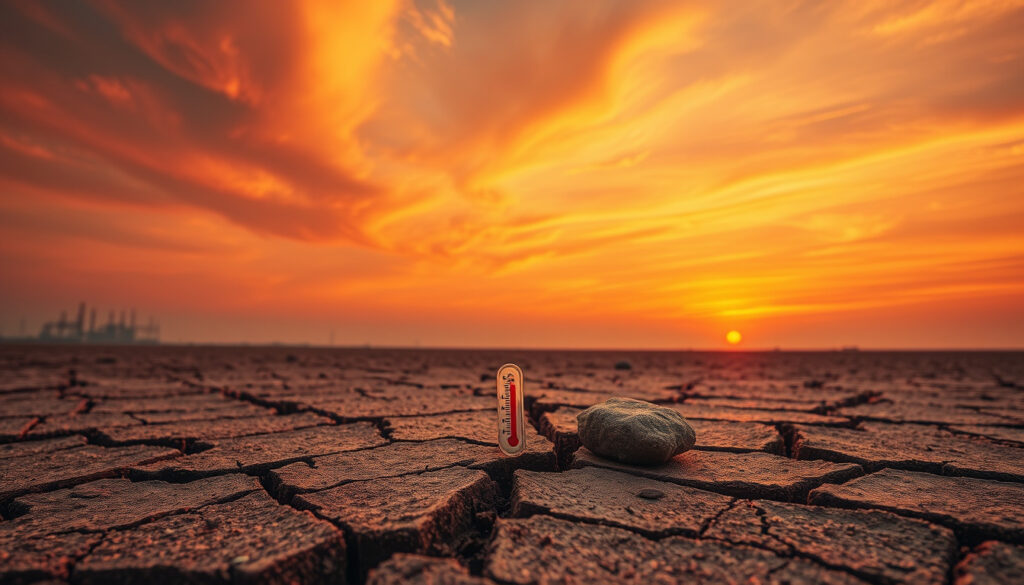
What Is Global Warming? Science, Causes & the 2030 Timeline
Despite being a straightforward physical process, global warming is often misunderstood — and the evidence for it is anything but abstract. This article walks through the definition straight from NASA and the IPCC, separates human-driven causes from natural cycles, and lays out what the next decades actually hold, including what the “2030 deadline” really means for the planet and for us.
Current Temperature Anomaly
+1.1°C vs. pre-industrial (1850–1900)
Atmospheric CO₂ Concentration
424 ppm (2024)
Arctic Sea Ice Loss per Decade
12.2% (September minimum)
Years Left to Breach 1.5°C
~7–10 at current emissions
Current temperature anomaly: +1.1°C vs. pre-industrial (1850–1900) · Atmospheric CO₂ concentration: 424 ppm (2024) · Arctic sea ice loss per decade: 12.2% (September minimum) · Years left at current emissions to breach 1.5°C: ~7–10
| Fact | Value | Source |
|---|---|---|
| Global temperature rise since pre-industrial | +1.1°C | NASA Science |
| Atmospheric CO₂ concentration (2024) | 424 ppm | NASA Science |
| Global sea level rise since 1880 | 8–9 inches (21–24 cm) | NASA Science |
| Arctic sea ice decline per decade | 12.2% (September minimum) | NASA Science |
What is global warming in simple words?
The scientific community, through NASA and the IPCC, is unambiguous about what global warming is. NASA defines it as the long-term heating of Earth’s surface observed since the pre-industrial period, and the term is often used interchangeably with “climate change” — though climate change technically encompasses more than just temperature NASA Climate Change FAQs.
The IPCC refines this further: global warming refers to the increase in global surface temperature relative to a baseline reference period, averaged over a period sufficient to remove interannual variations, such as a decade or more IPCC FAQs. The key word here is “averaged” — global warming isn’t about a hot day or a warm year, it’s about the long-term trend across the entire planet.
Key definitions from the source documents
- Global warming (NASA): Long-term heating of Earth’s surface, distinct from natural weather variability NASA Science.
- Climate change (NASA): A broader term that includes global warming but also refers to changes in precipitation, wind patterns, and other aspects of the Earth system NASA Science.
- Greenhouse effect (NASA): The natural process where certain gases trap heat near Earth’s surface; human activity has intensified it NASA Science.
- Anthropogenic warming (IPCC): Warming attributed to human activities, primarily emissions of greenhouse gases IPCC FAQs.
One of the most common points of confusion is the difference between “global warming” and “climate change.” While global warming specifically tracks the rise in surface temperatures, climate change captures the full range of effects — from shifting rainfall patterns to ocean acidification. NASA notes that human activities are the dominant cause of the warming trend observed since the mid-20th century, a conclusion supported by the physics of the greenhouse effect and multiple independent lines of evidence NASA Science.
Where is global warming?
Global warming is not uniform across the planet. The Arctic is heating up roughly four times faster than the global average, and land areas warm faster than oceans. Cities experience an urban heat island effect that amplifies warming locally. The IPCC notes that human-caused climate change is already affecting every region, but the severity varies.
“Human-caused climate change is already affecting many weather and climate extremes in every region across the globe.” — IPCC Synthesis Report 2023
The warming is most pronounced in the Arctic, where sea ice is declining at 12.2% per decade in September. This feedback loop — less ice means less reflected sunlight, more absorbed heat — accelerates regional warming.
How bad is global warming right now in 2026?
NASA says the effects of human-caused global warming are not a future projection — they’re happening now, at a rate not seen over many recent millennia NASA Science. The warming isn’t happening uniformly; the Arctic is heating up roughly four times faster than the global average, and the oceans are absorbing more than 90% of the excess heat trapped by greenhouse gases.
What the data shows so far
- Atmospheric CO₂: 424 ppm in 2024, up from about 280 ppm pre-industrial — a 50% increase NASA Science.
- Global temperature: +1.1°C above pre-industrial baseline, with the last decade being the warmest on record.
- Arctic sea ice: Declining at 12.2% per decade in September minimum extent.
- Sea level rise: Global average sea level has risen about 8–9 inches since 1880, with the rate accelerating.
- Ocean heat content: More than 90% of the extra heat from global warming has gone into the upper ocean.
The term “global warming” undersells what’s actually happening — it’s not just about temperatures. The entire Earth system is responding, from the acidification of the oceans to the shifting of animal ranges and the increased frequency of extreme weather events. That’s why “climate change” is the more precise term.
The IPCC notes that human-caused climate change is already affecting many weather and climate extremes in every region across the globe. The link between warming and extreme events — hurricanes, heatwaves, and droughts — is not anecdotal; it’s documented in attribution studies that quantify how much more likely a specific heatwave or storm becomes due to human influence.
The takeaway from the observed record is that the window for “avoiding” climate change has passed — the question now is how bad it gets, and how quickly we can slow the momentum. Every tenth of a degree of warming that is avoided translates to measurable reductions in impacts like coral reef loss and extreme heat exposure.
What will happen in 2050 due to global warming?
The trajectory beyond 2030 depends on political will as much as physics. NASA points out that the warming observed since the mid-20th century is attributable to the human expansion of the greenhouse effect, and that means the choices made about energy systems, land use, and technology in the next decade will determine the century’s outcomes.
Projected timeline: What happens as the planet continues to warm
| Year | Projected temperature vs. pre-industrial | Key expected impacts (at current trajectory) |
|---|---|---|
| 2030 | 1.5°C likely crossed | More frequent and intense heatwaves; coral reefs severely degraded |
| 2050 | 2.0–2.5°C | Sea level rise of 0.3–0.6m; reduced crop yields in tropical regions |
| 2100 | 3.0–5.0°C (high emissions) | Mass migration from coastal areas; widespread ecosystem collapse |
| Beyond 2100 | Multi-century commitment | Human survival not globally threatened, but civilization faces major restructuring |
“The current warming trend is proceeding at a rate not seen over many recent millennia.” — NASA Goddard Institute for Space Studies
By 2050, global average temperature is projected to reach 2.0–2.5°C above pre-industrial levels under current emissions pathways. This will accelerate sea level rise, threaten coastal cities like Miami and Jakarta, and severely reduce agricultural output in tropical regions. Small island nations such as the Maldives and Kiribati face existential risk from rising seas. However, human survival is not globally threatened — but regional disruptions will be severe.
Why is 2030 the point of no return?
The year 2030 has become a shorthand for urgency in climate discourse, often labeled a “point of no return.” The reality is a bit more nuanced. The 2030 marker refers to the window in which global emissions must peak and begin declining to have a reasonable chance of limiting warming to 1.5°C above pre-industrial levels, a target defined by the Paris Agreement.
The IPCC states that the concept of a “point of no return” is a misnomer — there is no single moment after which all mitigation becomes futile, but rather a progression of thresholds that become increasingly difficult to avoid IPCC FAQs. However, the carbon budget — the total amount of CO₂ humanity can emit while staying below a given temperature limit — is finite and diminishing rapidly.
What the 2030 milestone actually involves
- Carbon budget exhaustion: At current emission rates, the budget for 1.5°C is likely exhausted in the early 2030s.
- Peak emission requirement: Global emissions must peak by 2025 and decline 43% by 2030 to meet the 1.5°C goal (IPCC scenarios).
- Non-linear tipping points: Some systems — such as the Greenland ice sheet or Amazon rainforest — have thresholds that, once crossed, trigger self-accelerating changes.
2030 isn’t a cliff edge where the world ends — it’s a checkpoint where the options drastically narrow. Missing the 1.5°C target doesn’t mean avoiding it is pointless; it means the world locks in more severe impacts, more displacement, and more ecosystem collapse. It’s a question of damage control, not survival.
There is a common misconception that if the planet exceeds 1.5°C, human survival is at risk. The IPCC clarifies that human survival to 3000 is not under threat from global warming alone — but civilization could face major restructuring, with heavily impacted regions experiencing severe disruption to food systems, water availability, and health.
Will humans survive until 3000?
Long-term climate models show that even after emissions stop, warming persists for centuries due to the longevity of CO₂ in the atmosphere and ocean thermal inertia. The IPCC states that human survival to 3000 is not under threat from global warming alone. However, civilization could face major restructuring, with heavily impacted regions experiencing severe disruption to food systems, water availability, and health.
Adaptation and mitigation can reduce worst-case outcomes. The choices made in the next few decades will determine whether future generations inherit a stable climate or a world of cascading crises. The scientific consensus is clear: the window for action is closing, but it is not yet shut.
“Global average sea level has risen about 8–9 inches since 1880, with about 3 inches of that coming in the last 25 years.” — NOAA Climate.gov
Confirmed Facts and Uncertainties: What We Know vs. What’s Still Open
Distinguishing between what is established science and what remains uncertain is critical for navigating climate discourse. This section separates the confirmed facts — with direct citations — from the legitimate open questions.
Confirmed facts
- Human activities are the dominant cause of the global warming trend since the mid-20th century, primarily through CO₂ and methane emissions NASA Science.
- The current atmospheric CO₂ concentration is higher than at any point in at least 800,000 years NASA Science.
- Effects of global warming are already visible, including rising sea levels, shrinking Arctic ice, and more frequent extreme weather events NASA Science.
- Human influence has warmed the atmosphere, ocean, and land — a conclusion with very high confidence in the IPCC reports IPCC FAQs.
What remains uncertain
- Exact timing of tipping points: When precisely the Greenland ice sheet or Amazon might cross a threshold is not precisely known, as it depends on multiple interacting factors.
- Future policy decisions: The trajectory beyond 2050 depends heavily on whether the world acts aggressively on mitigation, which is not predetermined.
- Regional specifics: While global trends are clear, the local impacts — how much rainfall or drought a specific region will face — have meaningful uncertainties.
The confirmed facts justify urgency; the uncertainties do not justify inaction. In fact, the existence of tipping points — where uncertain thresholds could cause self-reinforcing warming — argues for erring on the side of caution, rather than waiting for perfect predictions.
The implication: Uncertainties about precise timing do not reduce the need for immediate action.
Related reading: NASA defines global warming as the long-term heating of Earth’s surface · IPCC defines warming as an increase in multi-decade global mean surface temperature above pre-industrial levels
science.nasa.gov, science.nasa.gov, science.nasa.gov, science.nasa.gov, earthobservatory.nasa.gov, svs.gsfc.nasa.gov, nasa.gov, science.nasa.gov
Frequently Asked Questions
Is global warming natural or man-made?
Human activities are the dominant cause of the global warming trend observed since the mid-20th century. While natural factors like solar radiation and volcanic eruptions influence the climate, they have been stable enough or have cooling effects, and cannot account for the rapid warming measured. NASA attributes the warming primarily to the human expansion of the greenhouse effect from fossil fuel burning NASA Science.
What is the difference between global warming and climate change?
Global warming refers specifically to the long-term increase in Earth’s surface temperature. Climate change is a broader term that includes global warming but also encompasses shifts in precipitation, wind patterns, ocean currents, and sea level. NASA notes that human activities are causing both, but the full scope of climate change includes more than just temperature NASA Science.
Have scientists really proved that human activity is warming the planet?
Yes, the evidence is robust. Multiple lines of evidence — from direct CO₂ measurements to the analysis of temperature “fingerprints” that only match predictions when human emissions are included — converge on the same conclusion. The IPCC states with very high confidence that human influence has warmed the atmosphere, ocean, and land IPCC FAQs.
Is a 1.5°C temperature rise a hard limit or just a target?
The 1.5°C threshold is an internationally agreed target from the Paris Agreement, not a strict physical cliff. The IPCC notes that it is a “point of no return” misnomer — impacts become more severe with each increment of warming, but there’s no single threshold where all damage occurs IPCC FAQs.
What are the most likely effects if we exceed 2°C of warming?
Beyond 2°C, the IPCC states that severe impacts on food security, water, and human health become increasingly likely, and some systems like coral reefs face near-complete collapse. While human survival is not globally threatened, civilization could face major restructuring, and regional disruptions would be severe IPCC FAQs.
What can individuals do to meaningfully reduce their impact?
While systemic change is the most critical, individual actions still matter. Reducing meat consumption, switching to renewable energy, improving home efficiency, and choosing lower-carbon transport can each cut an individual’s footprint by a substantial percentage. However, these actions must be paired with advocacy and voting to shift policy, since the majority of emissions come from industrial and energy infrastructure, not individual choices NASA Science.
Could solar panels or other technology reverse global warming on their own?
No single technology can reverse global warming in isolation. Renewable energy can help stop adding to the problem, but CO₂ already in the atmosphere remains there for centuries. NASA notes that the only way to stabilize temperatures is to bring net emissions to zero — and even then, some warming is already locked in. Technologies like carbon capture and reforestation are needed to remove existing CO₂ NASA Science.
Related Reading
For readers who want to explore this topic further, the following sources provide authoritative, up-to-date information:
- NASA Science: Global Climate Change — The agency’s central hub for climate data and evidence.
- IPCC Frequently Asked Questions — The IPCC’s own answers to the most common public questions.
The science is clear: human activity is driving global warming, and the next decade will determine the severity of impacts for centuries to come. The choices we make now will shape the future of civilization.
More related posts
 Mount Alvernia Shuttle Bus: Free Timetable & Routes
 Thian Hock Keng Photos: Best Temple Images & Visitor Guide
 Digo Corporation Pte Ltd – Singapore Contractor Profile & Verification
 Select Home Warranty Lawsuit: sh/x/gs/m2/5 Key Cases
 Cross Street Medical Clinic STD Testing Guide
 Great Eastern Supreme Health: Coverage, Premiums & Benefits
 Peach Airlines Singapore to Osaka: Review & Prices
 Rodent Found in Miso Soup: Sukiya Closes 2000 Stores
