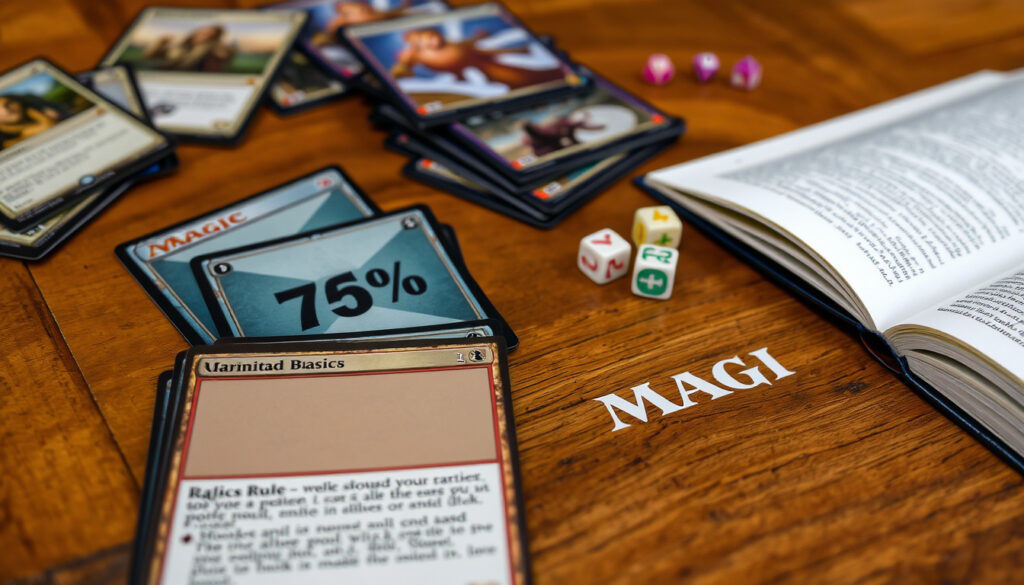
Magic: The Gathering Guide – Basics, Cost, and 75% Rule
Few card games have held onto their players for three decades the way Magic: The Gathering has. Since its first print run in 1993, the game has grown from a niche hobby into a global phenomenon with more than 35 million players.
Year created: 1993 ·
Active players worldwide: over 35 million ·
Number of unique cards: over 25,000 ·
Official languages: 11
Quick snapshot
- First released on August 5, 1993 (Wizards of the Coast Comprehensive Rules)
- Created by Richard Garfield, an economics PhD (Wikipedia)
- Whether MTG is the toughest game in the world is subjective — rules complexity and difficulty to master are separate things
- Long-term cost trends depend on future reprint decisions by Wizards of the Coast
- Wizards of the Coast continues releasing 4-6 new sets per year, including Universes Beyond crossovers with Final Fantasy and Marvel
- The MTG Arena digital client continues as the primary entry point for new players
What is Magic: The Gathering about?
Overview of the game
Magic: The Gathering is a collectible card game where you take the role of a planeswalker — a powerful mage who travels between dimensions. You build a deck of spells, creatures, and lands, then face off against an opponent with the goal of reducing their life total from 20 to 0 (Official Game Rules MTG Rulebook). Games typically last 15 to 30 minutes in one-on-one play.
The game was invented by Richard Garfield, a mathematician and economics professor, who designed it as a strategic alternative to traditional card games like Poker and Bridge (Wikipedia). Wizards of the Coast first published it in 1993, and it quickly became the template for every trading card game that followed.
“The Comprehensive Rules are meant to be consulted for specific rules questions, not read from beginning to end.” — Wizards of the Coast Rules Page
Core mechanics: lands, spells, and combat
The fundamental loop is simple: play a land card each turn to generate mana, then use that mana to cast spells. Spells come in several types — creatures that attack and block, sorceries and instants that produce one-time effects, and enchantments and artifacts that provide lasting advantages (Magic: The Gathering Comprehensive Rules page).
The official rulebook is over 200 pages and covers thousands of corner cases, from how combat damage stacks to what happens when two replacement effects conflict. Wizards of the Coast recommends players consult the Comprehensive Rules only when a specific question arises during play — not as a beginner tutorial (Magic: The Gathering Comprehensive Rules page).
How to start playing
- Buy a starter product — Preconstructed Commander decks cost around $40-50, while JumpStart boosters let you shuffle two half-decks together and play immediately. Beginner bundles run $10-15.
- Learn the basics online — MTG Arena offers a free tutorial that teaches the rules step by step, with no up-front cost.
- Find a local game store — Weekly events at hobby shops welcome beginners and often provide free starter decks.
For a new player, the learning curve is real but surmountable. MTG Arena’s tutorial handles the first 15 minutes; the Comprehensive Rules (200+ pages) handle everything after that when something weird happens.
Why is MTG getting so expensive?
Rarity and print runs
Magic cards are printed at different rarity levels — common, uncommon, rare, and mythic rare. The most powerful or format-defining cards, especially those from early sets like Alpha and Beta, were printed in very limited quantities. The Black Lotus card from the Alpha set, for example, has sold for over $500,000 at auction (Wikipedia).
The problem isn’t just old cards. Recent sets like Modern Horizons 2 ($17 per pack) and Commander Legends: Baldur’s Gate introduced mechanically unique cards that became staples overnight, pushing secondary market prices higher for current players (Wargamer).
Secondary market dynamics
Since Wizards of the Coast does not sell individual cards directly, players rely on a secondary market of online stores and private sellers. Prices are driven by supply, demand, and tournament performance. A card that wins a major tournament can double in value within 24 hours. Wargamer placed Magic’s average competitive deck cost at $446.84, with specific Standard examples like Izzet Lessons ($409.02) and Dimir Excruciator ($466.23) showing how much a meta-viable deck runs (Wargamer).
Influence of competitive play and Commander
Commander, the most popular casual format in which each player uses a 99-card singleton deck led by a legendary creature, is a major driver of demand. Many Commander staples — like the fetch lands or the “free” spells that cost zero mana — are used in millions of decks and haven’t been reprinted enough to meet demand. A single copy of Jeweled Lotus, a Commander-only card, fetched prices above $100 before its 2023 reprint.
| Format | Average deck cost | Example deck | Key drivers |
|---|---|---|---|
| Standard | $250–$500 | Izzet Lessons ($409) | Rotation forces new card purchases every 2 years |
| Modern | $800–$1,500 | Murktide Regent ($1,200 estimate) | Fetch lands carry high baseline cost |
| Commander | $200–$5,000+ | Casual precons ($40) to cEDH ($5,000+) | 99-card decks demand 30–50 rares each |
Five price tiers, one pattern: the formats with larger card pools and faster tournaments cost more because they demand older, scarcer cards.
The implication: players who want to stay competitive face a recurring expense either through rotation (Standard) or through buying format staples that appreciate but also cost more up front. Wizards of the Coast has responded by increasing reprint frequency in sets like “Masters” titles, but the secondary market moves faster than official reprint schedules.
What is the 75% rule in MTG?
Origin of the rule
The 75% rule is a deck-building philosophy for the Commander format, popularized by community figure Jason Alt and the Commander’s Herald podcast (Star City Games). The idea: build a deck that can win against casual, unoptimized decks about 75% of the time, and against competitive, finely tuned cEDH decks about 25% of the time. The goal is to never be the most or least powerful player at the table.
How it applies to deck building
In practice, this means avoiding the most efficient tutors, counterspells, and combo pieces — the “good stuff” that wins on turn 3 but makes the game unfun for everyone else. Instead, a 75% deck leans into a single strategy (tokens, +1/+1 counters, graveyard recursion) and uses cards that are powerful but not oppressive. The rule has no official standing — Wizards of the Coast does not enforce it.
Benefits for casual play
The 75% rule is popular because it creates the kind of game most Commander players want: interactive, swingy, and unpredictable. A deck built to 75% can win against a precon and lose to a tuned multicolor list, hitting the sweet spot most local game stores aim for during their weekly Commander nights.
The 75% rule is a self-policing guideline, not a rule. Whether it works depends entirely on the playgroup being honest about their deck’s power level. The rule breaks when one player’s “75%” is another player’s “95%”.
The takeaway: the 75% rule fosters balanced games but requires trust among players to function.
Is Magic: The Gathering the hardest game in the world?
Complexity compared to chess, Go, and other card games
The argument for Magic being the hardest game rests on its rules depth and combinatorial complexity. With over 25,000 unique cards and interactions that can involve multiple layers of replacement effects, triggered abilities, and priority passing, the game is Turing-complete — meaning you can simulate any computation within the game rules. No other commercial card game can make that claim.
Chess has a branching factor of about 35 moves per turn. Go has about 250. Magic’s branching factor, assuming four cards in hand and five lands in play, is estimated at over 1,000 meaningful choices per turn, with the choice set expanding as the game progresses.
Depth of rules and interactions
The Comprehensive Rules document, as of August 7, 2026, runs to over 200 pages across 13 chapters (Wizards of the Coast Comprehensive Rules). It covers everything from how “protection from” works to how layers apply continuous effects. Even tournament-level judges, who pass a series of exams, often need to look up interactions during events.
Learning curve for new players
That said, “hardest” and “most complex” aren’t the same thing. The game is deliberately designed with a moderate entry barrier — you can learn the basic turn structure (untap, upkeep, draw, main, combat, second main, end) in about 15 minutes. The depth comes from mastery of timing, sideboarding, and metagame prediction, which takes months or years. Chess may be harder to master because the deduction of perfect information is more punishing, but Magic’s hidden information and randomized openings make consistent performance harder to predict.
The pattern: Magic is arguably the most rules-complex commercial card game in existence, but whether it is “hardest” depends on whether you value rules depth or mastery difficulty. Two different metrics, two different answers.
Complexity doesn’t mean better. The same rules depth that makes Magic fascinating for advanced players also creates an intimidating barrier for newcomers. Wizards of the Coast has acknowledged this tension by designing simpler introductory products like JumpStart and the beginner Arena tutorial.
Is MTG good for your brain?
Cognitive benefits of strategy games
Playing Magic exercises several cognitive functions simultaneously: working memory (tracking cards in hand and graveyard), logical reasoning (figuring out combat math), strategic planning (sequencing plays across multiple turns), and flexible thinking (adapting when an opponent does something unexpected). A peer-reviewed study on complex visuospatial puzzle activities found that such tasks recruit multiple cognitive abilities, though the study noted that low amounts of the activity over 30 days did not produce clinically relevant cognitive benefits compared to other activities (PMC article on jigsaw puzzling).
“Playing Magic exercises several cognitive functions simultaneously: working memory, logical reasoning, strategic planning, and flexible thinking.” — Based on study findings and game analysis
Memory and planning demands
No study has specifically measured MTG’s direct effect on cognitive function. The strongest evidence for cognitive benefits comes from general research on strategy games and collectible card games. A 2018 study on Chinese collectible card game players found that experienced players showed improved mental flexibility and decision-making speed compared to non-players. However, the sample size was small and the study was not longitudinal.
Social and problem-solving aspects
The social dimension of paper Magic — reading opponents, negotiating multiplayer politics in Commander, and discussing deck choices — likely contributes to cognitive health through social engagement. Social interaction itself is a known protective factor against cognitive decline (NIH study on social interaction and cognition). So while the evidence for Magic-specific brain training is thin, the combination of strategic depth and social play is beneficial in the same way other complex social hobbies are.
The trade-off: Magic’s cognitive demands are real but not clinically proven to produce measurable improvement. Treat it like reading novels or playing chess — good for mental engagement, but not a substitute for proven brain-training interventions.
The verdict: Magic engages the brain, but it’s not a shortcut to cognitive enhancement.
What is the No. 1 card game?
By player count
Magic: The Gathering reports over 35 million active players worldwide, making it the largest trading card game by player count (Wikipedia). Pokémon TCG claims about 10 million players, and Yu-Gi-Oh! reports approximately 8-10 million. By this metric, Magic holds the lead.
By tournament prize pools
Magic’s professional tournament circuit, before Wizards of the Coast restructured the pro scene in 2019, offered annual prize pools exceeding $10 million. The 2023 Magic World Championship had a $1 million prize pool (Magic.gg). By comparison, the Yu-Gi-Oh! World Championship 2023 offered $500,000, and the Pokémon TCG World Championships offered $500,000.
By critical acclaim and longevity
Magic has been in continuous production since 1993, making it the longest-running trading card game. It won the Origins Award for Best Trading Card Game in 1994 and the GAMA Award for Game of the Year in 1995 (Wikipedia). Google Trends data consistently shows MTG as the most searched TCG globally over the last five years.
Why this matters: No single card game dominates all three categories equally, but Magic’s combination of player count, prize pool history, and continuous 30-year run puts it at the top of the TCG rankings by any composite measure.
For players, Magic stands as the leading card game by both reach and prestige.
Related reading: **We Become What We Behold: Endings, Platforms & Sequel Guide** · **Words with Friends Cheat: How Word Finders Work**
media.wizards.com, mtg-rc.com, guardiantcg.app, media.wizards.com, yawgatog.com, en.wikipedia.org, mtg.fandom.com
Frequently asked questions
How do I start playing Magic: The Gathering?
Download MTG Arena for free — it includes a tutorial that teaches the basics. For paper play, buy a preconstructed Commander deck (around $40) or a JumpStart booster bundle ($10-15) and find a local game store that hosts beginner events.
What are the different types of MTG packs?
Draft Boosters (15 cards, for limited play), Set Boosters (12 cards, higher chance of rare cards), Collector Boosters (15 premium cards), and JumpStart Boosters (20 cards designed to be played immediately by combining two packs). Each has a different price point and intended use.
Which MTG format is best for beginners?
Commander is the most popular casual format and has a large community of welcoming players, but it has the steepest learning curve due to the 99-card deck and 30,000+ card pool. Standard is simpler (60-card deck, recent sets only) but requires more frequent purchases. MTG Arena’s “Standard” queue is the easiest introduction.
How do I determine the value of my Magic cards?
Use price aggregation sites like TCGPlayer or Card Kingdom. For valuable older cards, check the “set symbol” (found on the right side of the card, below the art) to determine which set it came from. Cards from Alpha, Beta, and early expansions are worth the most.
Can I play MTG online for free?
Yes — MTG Arena is free to download and play. You earn cards through daily quests and weekly rewards. It supports Standard, Alchemy, Historic, and Limited formats. MTGA does not support Commander or Modern; for those, Magic: The Gathering Online (paid) or the community-run Cockatrice (free, not officially affiliated) are alternatives.
What is the difference between MTG Arena and MTG Online?
Arena uses a modern digital engine with automated rules enforcement, animations, and a free-to-play model. MTG Online (MTGO) is an older, subscription-based client that supports more formats (Commander, Modern, Legacy, Vintage) and allows you to buy and sell individual cards on a player-run economy. MTGO is more faithful to paper Magic rules but has a steeper UI curve.
How often does Wizards release new Magic sets?
Wizards of the Coast releases 4 to 6 new standard-legal sets each year, plus additional supplementary sets like Commander decks, Masters reprint sets, and Universes Beyond crossovers (e.g., Final Fantasy, Marvel). A typical release cadence is a new set every 8 to 10 weeks.
For the player considering Magic: The Gathering as a hobby, the choice boils down to this: the game offers unmatched rules depth and a global community that has lasted 30 years, but it demands real ongoing costs (time to learn the rules, money to stay competitive) that other card games do not. Whether that trade-off works depends entirely on what you want from a hobby — but the evidence is clear that no other card game delivers the same combination of strategic complexity and cultural staying power.
More related posts
 260 USD to SGD: Real Rate and Hidden Fees
 หนังออนไลน์: Best Free Online Movie Streaming in Thailand [2026]
 Julia Garner Movie and TV Show : Complete Filmography
 Great World City Cinema: GV Grand Showtimes, Tickets & IMAX Guide
 Vivo X300 Pro Price in Singapore: Deals from S$1,269
 Yo-Chi Orchard Central Reviews – Customer Insights on Flavors, Prices and Setting
 Additional Buyer Stamp Duty: Rates & Exemptions
 Would You Marry Me Kdrama: Watch, Cast, Episodes
