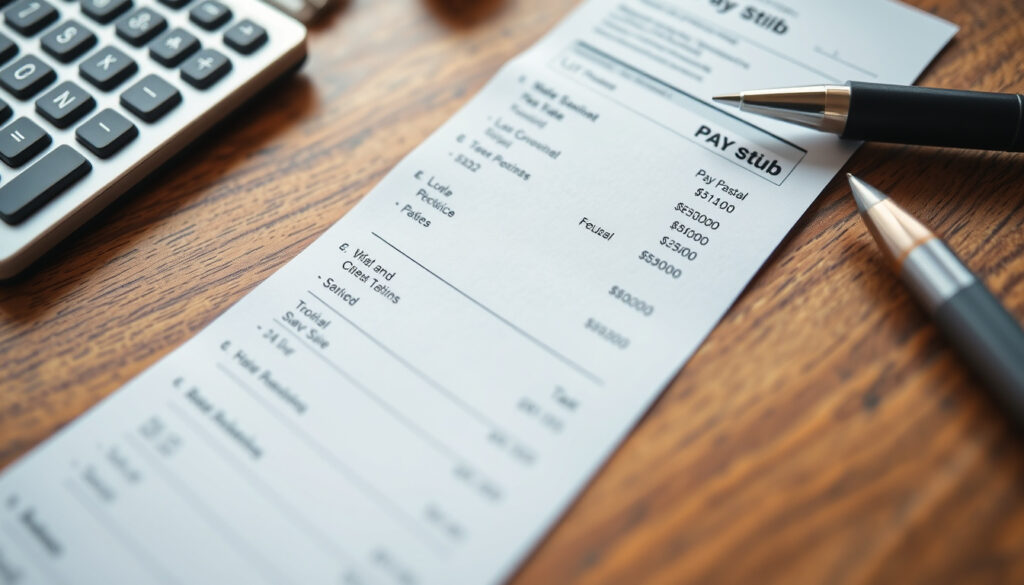
How to Read a Pay Stub: Step-by-Step Guide
There’s a moment that almost everyone recognizes: staring at a pay stub and wondering what all those numbers and abbreviations actually mean. It may be a routine piece of paper, but it holds the story of your earnings, taxes, and benefits — and getting it right matters for your budget and peace of mind.
Most common pay frequency: bi-weekly ·
Typical number of deductions on a pay stub: 4–6 ·
Average percentage of gross pay withheld for taxes: 20–30% ·
Number of pay periods in a bi-weekly year: 26–27 ·
Standard components of a pay stub: gross pay, deductions, net pay, year-to-date totals
Quick snapshot
- 2026 has 27 bi-weekly pay periods for many organizations (U.S. Office of Personnel Management (federal pay administration))
- Gross pay is before deductions; net pay is after (Consumer Financial Protection Bureau (U.S. financial regulator))
- FICA tax rate is 7.65% for employees (Social Security Administration (U.S. government))
- Exact pay stub codes vary by employer and payroll provider (Revenue Commissioners (Irish tax authority))
- Whether a specific employer uses weekly, bi-weekly, semi-monthly, or monthly payroll (Citizens Information (Irish government advisory))
- How pension contributions are itemized can differ between payroll systems (Citizens Information (Irish government advisory))
- 2026 calendar year: bi-weekly payroll cycles produce 27 pay dates for many employees, affecting withholding and budgeting (Paychex (payroll service provider))
- Check your 2026 pay calendar early to adjust withholding and budget for the extra paycheck (IRS (U.S. tax authority))
- Irish employees should verify PAYE, PRSI, and USC deductions against Revenue’s records (Revenue Commissioners (Irish tax authority))
- Employers should update payroll software for 2026 tax bands and USC rates (Revenue Commissioners (Irish tax authority))
Reading a pay stub isn’t just a curiosity — it’s how you catch errors in withholding, benefit deductions, and even tax credits. One misapplied code can cost you hundreds of dollars a year, whether you’re in the U.S. or Ireland.
| Label | Value |
|---|---|
| Gross Pay | Total earnings before taxes and other deductions (CFPB (U.S. financial regulator)) |
| Standard Tax Deductions (U.S.) | FICA (Social Security + Medicare) = 7.65% of gross; federal income tax varies by bracket (Social Security Administration (U.S. government)) |
| Year-to-Date (YTD) | Running total of gross pay, taxes, and net pay from Jan 1 to current pay period (CFPB (U.S. financial regulator)) |
| Number of Pay Periods (Bi-Weekly) | Typically 26; 27 in years like 2026 (Paychex (payroll service provider)) |
| Net Pay | Amount received after all deductions, also called take-home pay (CFPB (U.S. financial regulator)) |
| Irish Statutory Deductions | PAYE (income tax), PRSI (social insurance), USC (universal social charge) (Revenue Commissioners (Irish tax authority)) |
| Gross Pay (Ireland) | Total before deductions; includes salary, overtime, allowances (Revenue Commissioners (Irish tax authority)) |
| Employer Pension Contributions | May appear as a separate deduction line; can affect taxable pay (Citizens Information (Irish government advisory)) |
The table pattern: every pay stub answers four questions — what you earned, what was taken out, what you actually receive, and where you stand for the year.
How do you read your pay stub?
Step 1: Locate gross pay
- Gross pay is the total amount earned before any deductions — it includes your base salary, wages, bonuses, and overtime (Consumer Financial Protection Bureau (U.S. financial regulator)).
- It is often labeled “Gross”, “Gross Pay”, or “Earnings” on U.S. stubs, and “Gross” or “Gross Pay” on Irish payslips.
Step 2: Identify deductions
- Common U.S. deductions: federal income tax (FIT), state income tax (SIT), Social Security, Medicare (combined as FICA at 7.65%), health insurance premiums, and retirement contributions (Social Security Administration (U.S. government)).
- Irish deductions: PAYE (income tax), PRSI (Pay Related Social Insurance), USC (Universal Social Charge) — all mandatory (Revenue Commissioners (Irish tax authority)).
- Optional deductions: union dues, charitable contributions, wage garnishments.
Deductions are the most common source of errors. If you see a deduction you don’t recognize, check your employee handbook or contact payroll. In Ireland, mismatches often happen after a job change or when tax credits aren’t updated (Revenue Commissioners (Irish tax authority)).
Step 3: Find net pay
- Net pay is the amount left after all deductions — this is what goes into your bank account or is paid by check (Consumer Financial Protection Bureau (U.S. financial regulator)).
- It is often labeled “Net Pay”, “Take-Home Pay”, or “Net”.
Step 4: Check year-to-date totals
- YTD (year-to-date) totals show cumulative gross pay, deductions, and net pay since January 1 (Consumer Financial Protection Bureau (U.S. financial regulator)).
- These numbers help you verify that withholding matches your expected tax liability and that you’re on track for retirement contribution limits.
The pattern: each pay stub answers four questions — what you earned, what was taken out, what you actually receive, and where you stand for the year. The YTD line is the most important for long-term planning because it catches cumulative errors that a single period might hide.
What are the codes on my paystub?
Common payroll codes: YTD, FICA, FIT, SIT, SSN
- YTD — Year-to-date: cumulative totals for the calendar year (Consumer Financial Protection Bureau (U.S. financial regulator)).
- FICA — Federal Insurance Contributions Act: the combined Social Security (6.2%) and Medicare (1.45%) tax (Social Security Administration (U.S. government)).
- FIT — Federal Income Tax withholding.
- SIT — State Income Tax (in states that levy one).
- SSN — Social Security Number, sometimes used as an employee identifier.
Understanding deduction abbreviations
- Other abbreviations you may see: MED (Medicare), SOC SEC (Social Security), 401k (retirement), HSA (health savings account), DENT (dental), VISION (vision).
- Irish payslips use: PAYE (income tax), PRSI (social insurance), USC (universal social charge), LPT (local property tax if deducted), and pension contribution codes like “Pension” or “AVC” (Revenue Commissioners (Irish tax authority)).
How to find a code legend
- Many employers provide a legend on the back of the pay stub or in the employee handbook. For ADP and other payroll platforms, you can often hover over a code for a tooltip explanation.
- The Revenue Commissioners (Irish tax authority) also publishes sample payslips with code definitions.
The implication: codes are shorthand for complex tax and benefit systems. Once you know that FICA = 7.65% and PAYE = income tax, the alphabet soup becomes readable.
How to read payslip in Ireland?
Key elements of an Irish payslip
- An Irish payslip must show pay, tax, and deductions in paper or electronic form (Citizens Information (Irish government advisory)).
- It includes gross pay, statutory deductions (PAYE, PRSI, USC), net pay, and often an employer reference number.
Irish tax codes: PAYE, PRSI, USC
- PAYE (Pay As You Earn) — the system for collecting income tax through payroll (Revenue Commissioners (Irish tax authority)).
- PRSI (Pay Related Social Insurance) — linked to social welfare benefits; rates vary by earnings and class (Citizens Information (Irish government advisory)).
- USC (Universal Social Charge) — a flat-rate charge applied to gross pay above a certain threshold (Revenue Commissioners (Irish tax authority)).
Gross pay vs net pay in Ireland
- Gross pay is total earnings before deductions; net pay is the amount after PAYE, PRSI, USC, and other deductions (Revenue Commissioners (Irish tax authority)).
- A salary of €45,000 is close to the Irish average but its after-tax value depends on location and industry.
The pattern: Irish payslips are heavily regulated and transparent — if you see a code you don’t recognize, Revenue’s sample payslip is the best reference. The cumulative nature of the PAYE system means year-to-date checks are essential (Revenue Commissioners (Irish tax authority)).
Is 2026 a 27 paycheck year?
Why 27 paychecks occur
- Bi-weekly payroll has 26 pay periods in most years, but when the calendar aligns such that the first pay date is a Friday, there can be 27 pay dates (Paychex (payroll service provider)).
2026 calendar analysis for bi-weekly pay
- 2026 is confirmed as a 27-paycheck year for many bi-weekly schedules, because January 1 falls on a Thursday, which can create an extra pay period later in the year.
Budgeting implications
- An extra paycheck can increase your annual gross income by 1/26th (about 3.8%). That may push you into a higher tax bracket or affect benefit eligibility.
- Some employees adjust their withholding or retirement contributions to smooth the extra income.
If you’re paid bi-weekly in 2026, check your pay calendar early. The extra paycheck typically occurs in the month with three pay dates. Plan your budget accordingly — and remember that your employer’s payroll software may not automatically adjust withholding.
The trade-off: an extra paycheck sounds great, but it can cause under-withholding of taxes if you don’t adjust. Use the IRS withholding calculator or Irish Revenue’s Tax Credit estimator to stay on track.
What are the 4 types of payroll systems?
Weekly payroll
- 52 pay periods per year; employees receive 52 or 53 paychecks.
Bi-weekly payroll
- 26 or 27 pay periods; most common in the U.S. for salaried and hourly workers.
Semi-monthly payroll
- 24 pay periods per year; often used for salaried employees; pay dates are typically the 15th and last day of the month.
Monthly payroll
- 12 pay periods; common in Ireland and Europe; the full month’s salary is paid once a month.
The implication: the frequency of your pay schedule directly affects your cash flow and per-check withholding. Monthly pay requires tighter budgeting, while bi-weekly can lead to the 27-paycheck quirk.
Timeline: 2026 and the 27-paycheck year
For many employees on a bi-weekly payroll cycle, 2026 will include 27 pay dates. This extra paycheck can cause confusion about withholding and budgeting (Paychex (payroll service provider)).
The pattern: when a year has 27 pay periods, the extra paycheck often occurs in a month with three Fridays. Employees who rely on fixed monthly budgets should adjust early.
Clarity: what we know and what’s uncertain
Confirmed facts
- 2026 has 27 bi-weekly pay periods for many organizations (Paychex)
- Gross pay is before deductions; net pay is after (CFPB)
- FICA tax rate is 7.65% for employees (Social Security Administration)
- Irish payslips must show PAYE, PRSI, and USC (Revenue Commissioners)
What’s unclear
- Exact pay stub codes vary by employer and payroll provider (Revenue Commissioners)
- Whether a specific employer uses weekly, bi-weekly, semi-monthly, or monthly payroll (Citizens Information)
- How pension contributions are itemized can differ between payroll systems (Citizens Information)
Expert perspectives on pay stub reading
Gross income: total pay before taxes and other deductions are taken out.
Consumer Financial Protection Bureau (U.S. financial regulator)
Items marked with an asterisk are taxable and imputed as income.
University of Arizona Payroll Office (public university payroll administration)
For U.S. workers, the CFPB’s definition is the gold standard. For Irish employees, the University of Arizona’s note reminds us that asterisks often signal taxable benefits — a detail many miss.
Summary: what this means for your paycheck
Understanding your pay stub is not just about satisfying curiosity — it’s a practical tool for catching errors, optimizing taxes, and planning your financial year. Whether you’re paid weekly in the U.S. or monthly in Ireland, the core structure is the same: gross pay minus deductions equals net pay. The codes may differ, but the logic is universal. For anyone earning a wage in 2026, the 27-paycheck year adds a twist that demands a proactive look at withholding. For Irish employees, the Revenue’s cumulative system makes YTD checks non-negotiable. Workers who learn the lines of their pay stub now reduce the risk of leaving money on the table.
deel.com, irisglobal.com, youtube.com, thepaystubs.com, finance.cornell.edu, uft.org, nyc.gov
If your employer uses an online payroll system, learning how to read a pay stub becomes much easier once you’ve logged into the employee portal for pay stubs to view your earnings breakdown.
Frequently asked questions
Is €45,000 a good salary in Ireland?
€45,000 is close to the national average salary in Ireland, but affordability depends on your location (Dublin vs. rural) and industry. After PAYE, PRSI, and USC, take-home pay would be roughly €34,000–€36,000 per year, depending on tax credits.
How do I get a pay stub example PDF?
The Consumer Financial Protection Bureau offers a free PDF handout that includes a sample pay stub with callouts (CFPB sample pay stub).
What does a pay stub look like on ADP?
ADP pay stubs typically display earnings, deductions, and year-to-date totals in a clear table format, with a legend for codes. You can view a sample on ADP’s support site.
How to read a pay stub template online?
Many payroll providers offer interactive tutorials. The CFPB’s handout is a free, print-friendly template that walks through each line.
What is the difference between gross and net pay?
Gross pay is total earnings before deductions; net pay is the amount after taxes, insurance, and retirement contributions are taken out (CFPB).
What are common payroll codes in the US?
Common codes include FICA (Social Security + Medicare at 7.65%), FIT (federal income tax), SIT (state income tax), YTD (year-to-date), and 401k (retirement). Some platforms also use MED, SOC SEC, or SS.
How does a 27-paycheck year affect taxes?
An extra paycheck increases your annual gross income, which may push you into a higher tax bracket or reduce eligibility for certain credits. It can also cause under-withholding if your employer’s system doesn’t adjust for the extra pay period.
Related reading
More related posts
 SG Car Plate Check: How to Verify Owner, Road Tax & More
 Kang So-ra: Age, Dramas, Husband & Kids, Latest News
 Yamaha MT-15: Price, Specs, Mileage & Beginner Review
 How to Use Slow Motion CapCut Template Free in 2025
 Channel 8 News Singapore: Live, Schedule & Streams
 260 USD to SGD: Real Rate and Hidden Fees
 Singapore Casino Visits Decline: Data & Policies for 2024
 The Regency at Tiong Bahru: Freehold Condo in D3 Guide
