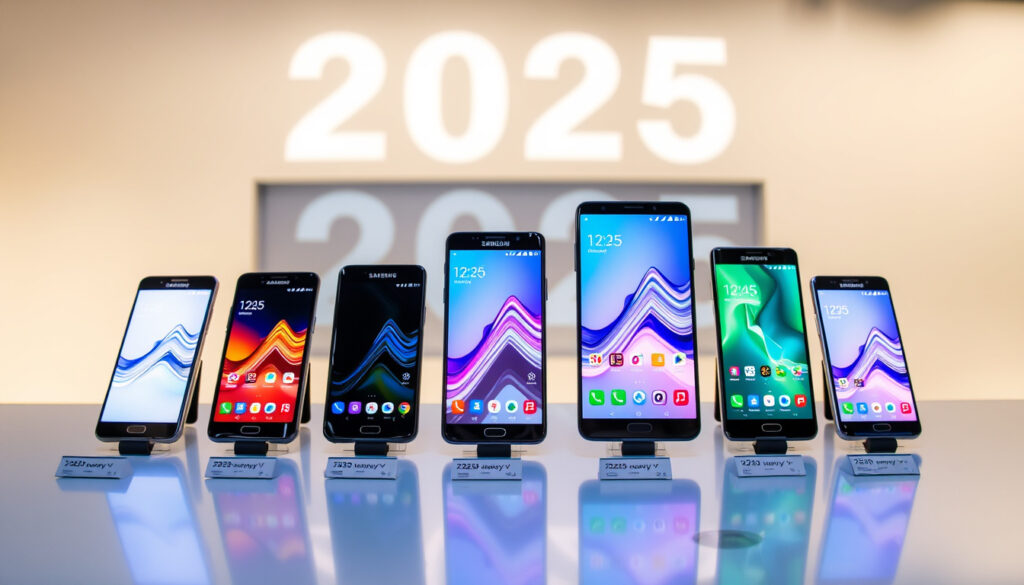
Samsung Galaxy J Series to Buy: Best Models & Prices 2025
Cheap phones get a bad rap, and the Samsung Galaxy J series is a useful case study in why that judgment is only half right. The line started in 2015 as Samsung’s entry-level family and was later folded into the Galaxy A and M ranges in 2019, according to Samsung Electronics’s own buying guide. This guide looks at which J models are still worth buying, what refurbished prices look like, and where the trade-offs really bite.
Discontinued: 2019 ·
Number of models: ~15 ·
Most popular model: Galaxy J7 ·
Refurbished price range: $50–$200
Quick snapshot
- The Galaxy J line launched in 2015 (iFixit’s independent repair documentation for Galaxy J devices).
- Samsung merged the J series into the Galaxy A and Galaxy M families in 2019 (Samsung Electronics’s official phone-range buying guide).
- The early Galaxy J7 shipped with a 5.5-inch display and a 3,000 mAh battery (Italian Wikipedia’s community encyclopedia summary of J-series specs).
- Sources give different exact end dates for the series: one encyclopedia entry says April 2019, while another says 10 April 2019 (English Wikipedia’s community encyclopedia overview of the Galaxy J series).
- The exact number of J models varies by regional release and database (GSMArena’s mobile-spec database for Galaxy J devices).
- Software update status for every old J model is not clearly documented (Samsung Electronics’s official phone-range buying guide).
- 2015: Samsung released the first Galaxy J model, the J1 (iFixit’s independent repair documentation for Galaxy J devices).
- July 2018: J4, J6 and J8 launched on the same day (iFixit’s independent repair documentation for Galaxy J devices).
- 2019: Samsung folded the J name into the A and M ranges (Samsung Electronics’s official phone-range buying guide).
- New J-series buyers today are really shopping for a discontinued product, so the practical move is to compare it with the current Galaxy A line (Samsung Electronics’s official phone-range buying guide).
- Refurbished J7 and J6 units are still indexed by major phone databases, which makes condition-checking easier (GSMArena’s mobile-spec database for Galaxy J devices).
- Price comparison starts with aggregator listings, not Samsung’s current storefront (Smartprix’s price-aggregator database for Galaxy J prices).
Nine facts, one pattern: Samsung built the J series around price, then folded it into A/M when the market moved on.
| Fact | Value |
|---|---|
| Series status | Discontinued; merged into Galaxy A and M in 2019 (Samsung Electronics’s phone-range guide) |
| First model | Galaxy J1, launched 2015 (iFixit’s Galaxy J device page) |
| High-volume launch | J4, J6 and J8 released the same day in July 2018 (iFixit’s Galaxy J device page) |
| Early J7 screen | 5.5-inch display (Italian Wikipedia’s J-series spec summary) |
| Early J7 battery | 3,000 mAh (Italian Wikipedia’s J-series spec summary) |
| J6 storage and RAM | 32/64 GB storage and 3/4 GB RAM (Italian Wikipedia’s J-series spec summary) |
| J3 (2016) display | 5-inch display, up to 2 GB RAM (Italian Wikipedia’s J-series spec summary) |
| Later entries | Galaxy J7 (2018) and Galaxy J2 Core appear in current phone databases (GSMArena’s Galaxy J device database) |
| Current Samsung focus | Galaxy A and Galaxy M series (Samsung Electronics’s phone-range guide) |
Which Samsung J series is the best?
The best Galaxy J to buy in 2025 is not the one with the biggest number; it is the one with the healthiest battery, the cleanest IMEI history and the lowest price for what it actually does. Within the J lineup, that usually means a J7 or a J6.
What to look for when choosing a J series phone
- Battery health: J7 (2015) and J6 (2018) both have 3,000 mAh cells, but a 2018 unit may hold a charge better than a 2015 unit (Italian Wikipedia’s community encyclopedia summary of J-series specs).
- Repairability: Samsung does not service these as current products, so independent replacement parts matter; iFixit’s device documentation is the useful reference (iFixit’s independent repair documentation for Galaxy J devices).
- Price discipline: the J series only makes sense if the price is low; once a refurbished unit costs close to an A-series phone, the J-series value case disappears.
Best Galaxy J7 variants
- Galaxy J7 (2015): the early model with a 5.5-inch display, 13 MP rear camera, 16 GB storage and 1.5 GB RAM (Italian Wikipedia’s community encyclopedia summary of J-series specs).
- Galaxy J7 (2018): the later regional version that still appears in price databases, with a listed launch price of ₹12,990 in some markets (Smartprix’s price-aggregator database for Galaxy J prices).
- Galaxy J6 (2018): the better-spec J-series option for anyone who wants more RAM and storage, with 3/4 GB RAM and 32/64 GB storage (Italian Wikipedia’s community encyclopedia summary of J-series specs).
Is the Samsung J7 a good phone?
- For calls, messaging, maps and light apps, yes: the J7’s 2015-generation hardware is enough for basic daily use (Italian Wikipedia’s community encyclopedia summary of J-series specs).
- For modern banking apps, heavy multitasking and long-term security, no: this is a phone from an older Android era, and Samsung’s current support focus is the A and M families (Samsung Electronics’s official phone-range buying guide).
- The practical verdict: a J7 is a backup phone, a first phone for a child, or a stopgap — not a daily driver for someone who depends on their phone all day.
The pattern: the best J-series phone is the one that still holds a charge and costs less than its A-series cousin.
Is the Galaxy J series discontinued?
When was the J series discontinued?
- Samsung discontinued the Galaxy J series in April 2019, according to iFixit’s device documentation (iFixit’s independent repair documentation for Galaxy J devices).
- Samsung’s own Saudi Arabia phone-range guide says the J series was merged with the Galaxy A and Galaxy M series in 2019 (Samsung Electronics’s official phone-range buying guide).
- The exact date is inconsistent across references: English Wikipedia’s overview says 4 April 2019, while Spanish Wikipedia’s J-series entry agrees with a 2019 end but does not pin the same day (English Wikipedia’s community encyclopedia overview of the Galaxy J series and Spanish Wikipedia’s community encyclopedia entry for the Galaxy J series).
Why did Samsung stop making the J series?
- Samsung’s stated reason is lineup simplification: the J family was reorganized into the A and M families rather than continued as a separate budget brand (Samsung Electronics’s official phone-range buying guide).
- The J series itself had already absorbed several earlier entry-level names, including Galaxy Core, Grand, E, Trend, Ace and Young, so making J into A/M was a consolidation move (Wikipedia’s community encyclopedia overview of the Galaxy J series).
Anyone buying a J-series phone in 2025 is buying a product whose parent company has already moved on. The J line ran on older Android software, and Samsung’s update promises today are about the A and M families, not the retired J models (Samsung Electronics’s official phone-range buying guide).
The pattern: Samsung did not need a J-series successor; it needed fewer support lines to manage across global markets.
Which is better, Samsung A or J?
Key differences: specs, price, updates
- The J series was a discontinued entry-level family; the A series is Samsung’s active current range alongside M (Samsung Electronics’s official phone-range buying guide).
- J-series phones are older, which means lower second-hand prices but also older Android versions and weaker long-term app compatibility.
- A-series phones cost more, but they are the products Samsung actually supports with current software and updates today (Samsung Electronics’s official phone-range buying guide).
A series advantages over J series
- The A series continues Samsung’s present lineup, so buyers can expect a normal retail warranty and current Android support (Samsung Electronics’s official phone-range buying guide).
- Newer A-series models comfortably outperform the J-series hardware generation represented by the J7’s 1.5 GB RAM and 16 GB storage (Italian Wikipedia’s community encyclopedia summary of J-series specs).
- For navigation, video calls and multitasking, A-series RAM and processors are less likely to hit a wall.
When to choose J series over A series
- Choose J if the budget is very tight and the phone is for basic calls, messaging and light apps.
- Choose J if you are comfortable buying a used or refurbished unit from a resale marketplace with buyer protection.
- Choose A if you want Samsung’s current support, a more secure update path and a phone that will still feel usable in three years (Samsung Electronics’s official phone-range buying guide).
The A series fixes the J series’s main weakness—software support—but at a higher price. That is the real trade: save money up front with a J, or buy a longer usable life with an A.
The takeaway: A-series phones are the J-series with the clock turned forward; if software support matters, pay the difference.
What is the latest Samsung Galaxy J series?
Last models released: Galaxy J7 Prime, J5 2016, J3 2017
- The J name appeared across multiple years and regional releases, so “latest” depends on the database you check (GSMArena’s mobile-spec database for Galaxy J devices).
- The last big mainline launch wave included the Galaxy J4, J6 and J8, all released on the same day in July 2018 (iFixit’s independent repair documentation for Galaxy J devices).
- A later Galaxy J2 Core entry also appears in phone databases, though its status as the official final J model is less clearly documented (GSMArena’s mobile-spec database for Galaxy J devices and Logopedia’s community wiki list of unofficial J-series models).
Specs of the latest J series models
- Galaxy J6 (2018): 5.6-inch HD+ display, 13 MP rear camera, 8 MP front camera, 3/4 GB RAM, 32/64 GB storage, 3,000 mAh battery (Italian Wikipedia’s community encyclopedia summary of J-series specs).
- Galaxy J7 (2015): 5.5-inch display, 13 MP rear camera, 5 MP front camera, 1.5 GB RAM, 16 GB storage, 3,000 mAh battery (Italian Wikipedia’s community encyclopedia summary of J-series specs).
- Galaxy J3 (2016): 5-inch display, 8 MP rear camera, 5 MP front camera, up to 2 GB RAM, up to 32 GB storage, 2,600 mAh battery (Italian Wikipedia’s community encyclopedia summary of J-series specs).
If the J-series timeline feels dated, Samsung’s current premium direction shows how far the company has moved — see our Samsung Z Fold7 call transcript for a look at the other end of the catalog.
The catch: the newest J-series phone is still old, and old means unsupported by today’s app expectations.
Where can I buy a Samsung J7?
Best places to buy refurbished J series
- Start with established refurbishers and resale platforms that offer buyer protection; Samsung itself no longer sells J-series phones as new products.
- Use phone databases to confirm the exact model and regional variant before purchasing (GSMArena’s mobile-spec database for Galaxy J devices).
- Check price-aggregator listings to see whether the seller is asking a fair price for the device in its condition (Smartprix’s price-aggregator database for Galaxy J prices).
What to check before buying a used J7
- Confirm the phone is carrier-unlocked and matches the local LTE bands for your region.
- Check battery health and the charging port; these are the first parts to fail on older Samsung phones.
- Ask for the IMEI and verify it is clean before paying.
- Look for a refurbisher warranty or at least a return window.
Price range for Galaxy J7 now
- Refurbished J-series phones generally sell in the $50–$200 range depending on condition, model year and included accessories.
- The Galaxy J7 (2018) had a regional launch price of ₹12,990 according to price database records, so the exact market value today depends on where you buy (Smartprix’s price-aggregator database for Galaxy J prices).
- A fair deal leaves enough headroom over an A-series phone that the trade-off actually makes sense.
If you end up comparing it to newer phones, our Honor Magic V5 Singapore price, specs and review gives a reference point at the other end of the market.
The trade-off: the lowest price often comes with the shortest usable life, so check condition before you chase a bargain.
Three differences, one pattern: the A series takes the J series’s budget role and adds modern software support.
| Category | Galaxy J (last models) | Galaxy A (current entry range) |
|---|---|---|
| Series status | Discontinued; merged into A/M in 2019 (Samsung Electronics’s phone-range guide) | Active today (Samsung Electronics’s phone-range guide) |
| Launch era | 2015–2018 mainline, with later database entries like the J2 Core (iFixit’s Galaxy J device page and GSMArena’s Galaxy J device database) | Ongoing releases (Samsung Electronics’s phone-range guide) |
| Android update outlook | Old Android versions; patch status varies by model (Wikipedia’s Galaxy J series overview) | Current Android with regular updates (Samsung Electronics’s phone-range guide) |
| Buyer profile | Price-first, basic-use buyer | Longer-term owner who needs support |
The pattern: the comparison table shows that the A series is what the J series was, but with a support guarantee.
Six spec points, one pattern: RAM and storage grew while the lineup stayed entry-level; Italian Wikipedia’s community encyclopedia summary of J-series specs lists these figures.
| Spec | Galaxy J3 (2016) | Galaxy J6 (2018) | Galaxy J7 (2015) |
|---|---|---|---|
| Screen | 5.0-inch | 5.6-inch HD+ | 5.5-inch |
| Rear camera | 8 MP | 13 MP | 13 MP |
| Front camera | 5 MP | 8 MP | 5 MP |
| RAM | Up to 2 GB | 3/4 GB | 1.5 GB |
| Storage | Up to 32 GB | 32/64 GB | 16 GB |
| Battery | 2,600 mAh | 3,000 mAh | 3,000 mAh |
The implication: the J6 (2018) is the most balanced model in the family, offering double the RAM of the early J7.
Upsides
- Very cheap on the refurbished market, often between $50 and $200.
- Simple Android experience is enough for calls, messaging and light apps.
- Later J-series models like the J6 pushed storage and RAM up to 64 GB and 4 GB (Italian Wikipedia’s community encyclopedia summary of J-series specs).
- Independent repair documentation exists for the family (iFixit’s independent repair documentation for Galaxy J devices).
Downsides
- Discontinued line with no new models after the A/M merger (Samsung Electronics’s official phone-range buying guide).
- Old Android versions and uncertain security patch coverage.
- 1.5 GB RAM on the early J7 limits modern app performance (Italian Wikipedia’s community encyclopedia summary of J-series specs).
- No first-party warranty from Samsung; buyers depend on third-party refurbisher terms.
Confirmed facts
- The J series launched in 2015 (iFixit’s independent repair documentation for Galaxy J devices).
- The J series was merged into A and M in 2019 (Samsung Electronics’s official phone-range buying guide).
- The early J7 is the highest-spec early model in the family, with a 5.5-inch display, 13 MP camera and 3,000 mAh battery (Italian Wikipedia’s community encyclopedia summary of J-series specs).
What’s unclear
- The exact final model: GSMArena indexes a later J2 Core, but official confirmation of its status is thin (GSMArena’s mobile-spec database for Galaxy J devices and Logopedia’s community wiki list of unofficial J-series models).
- The precise discontinuation date varies by source (English Wikipedia’s community encyclopedia overview of the Galaxy J series).
- Security patch availability for individual J models is not consistently documented (Samsung Electronics’s official phone-range buying guide).
“Samsung merged the Galaxy J series with the Galaxy A and Galaxy M series in 2019, confirming that the J name had run its course.”
Samsung Electronics, official phone-range buying guide
“The Galaxy J series was discontinued in April 2019 and replaced by the Galaxy A series, according to independent repair documentation.”
iFixit, independent device documentation
If you are thinking about a Galaxy J in 2025, you already know the trade-off: money today against usefulness tomorrow. A J7 can still make calls, send messages, play music and run light apps, but the software clock stopped years ago. For a teenager, a driver who just needs maps, or anyone looking for a cheap spare phone, the J series can be a sensible $70 purchase. For anyone who needs banking apps, security patches and enough performance to feel modern, the Galaxy A series is the clear alternative — and the extra money buys the years the J no longer has.
tr.wikipedia.org, alibaba.com, pt.wikipedia.org, en.namu.wiki
Frequently asked questions
How much is the Samsung Galaxy J7 now?
Refurbished J7 prices typically fall between $50 and $200 depending on condition and model year. Price-aggregator records show regional launch prices, so compare current resale listings before paying (Smartprix, price-aggregator database).
What are all the models in the Samsung Galaxy J series?
The complete list varies by market and database, but major entries include the Galaxy J1, J3, J5, J7, J4, J6 and J8, plus later regional entries such as the J2 Core (GSMArena’s mobile-spec database for Galaxy J devices).
Is the Galaxy J7 an old phone?
Yes. The J7 launched in 2015 with 1.5 GB RAM and 16 GB storage, so it is now in the vintage budget-phone category (Italian Wikipedia’s community encyclopedia summary of J-series specs).
Which Samsung series is considered the best?
For current Samsung buyers, the Galaxy S series is the flagship line and the Galaxy A series is the practical mid-range choice. Samsung’s current portfolio centers on Galaxy A, M and S, not the retired J family (Samsung Electronics’s official phone-range buying guide).
What models of Samsung Galaxy J2 are available?
The Galaxy J2 family includes several regional versions from 2016 onward, and a later J2 Core appears in GSMArena’s database. The J2 Core is the most likely “last J-series phone” in official model lists (GSMArena’s mobile-spec database for Galaxy J devices).
Can I buy Galaxy J series online?
Yes, but only as used or refurbished stock. Since Samsung no longer sells the J series as a new lineup, online buyers should use established resale platforms, check IMEI status, and confirm return policies before purchase.
More related posts
 Leeds United vs Liverpool – 0-0 Anfield Draw Report
 Allianz Travel Insurance Singapore: Coverage, Cost & Exclusions
 2000 Yen to SGD: Live Rate for JPY to Singapore Dollar
 Manchester United vs Aston Villa: Head-to-Head Stats & History
 Primary School Ranking 2025 – Top England Schools and Insights
 How to Test Smoke Alarm: Step-by-Step Guide and Troubleshooting
 iPhone 16e Price Singapore (2025): S$868 & Best Deals
 NTUC Packer Part Time Job: Salary, Duties, and How to Apply
