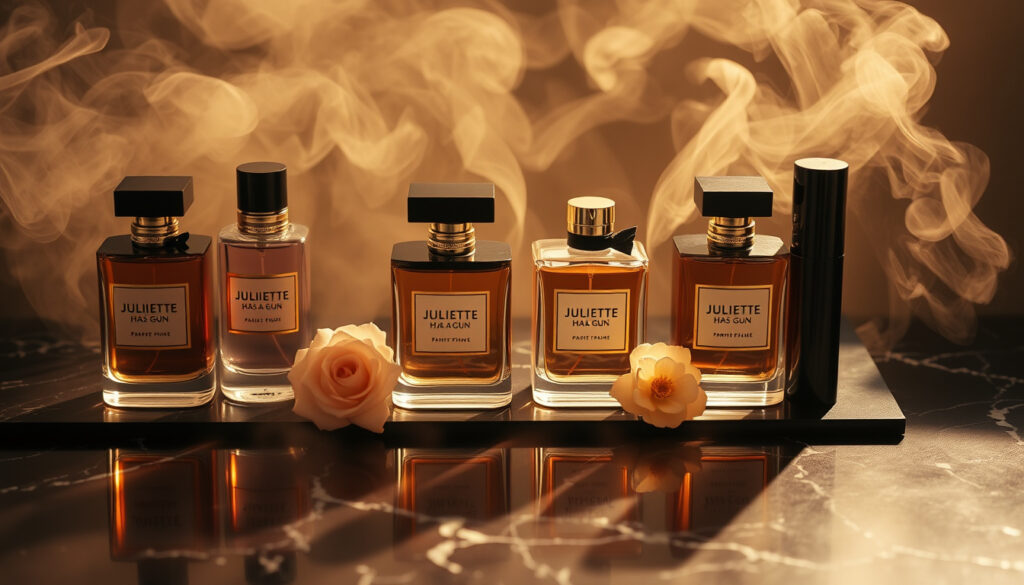
Juliette Has a Gun: Popular Perfumes, Scents & Reviews
There’s something deliciously contradictory about wearing a fragrance that announces it isn’t one. Juliette Has a Gun built its cult following on that exact paradox—and for perfume lovers tired of heavy florals or syrupy orientals, the brand’s minimalist approach feels less like a gimmick and more like a revelation. Founded by Romano Ricci, the great-grandson of Nina Ricci, the brand launched in 2010 with a product literally called Not a Perfume. The idea of building an entire fragrance around a single molecule sounded absurd at the time. It still works.
Founder: Romano Ricci · Signature Product: Not a Perfume · Inspiration: Modern Juliet with gun as seduction weapon · Key Retailers: Space NK, The Perfume Shop
Quick snapshot
- Brand founded in 2005 by Romano Ricci (Beauty Affairs)
- Not a Perfume launched September 2010 (Scent Box)
- Formula built around Cetalox, a single molecule used as base note (Juliette Has a Gun Official US Site)
- Unconfirmed celebrity endorsements reported in gossip columns
- Exact global sales figures or market share data
- Specific Fragrantica star ratings and vote counts (not publicly scraped)
- 2005: Brand launches
- 2006–2009: Early fragrances (Lady Vengeance, Miss Charming, Citizen Queen, Midnight Oud)
- September 2010: Not a Perfume debuts
- 2024: Juliette eponymous fragrance releases
- 2024 Juliette fragrance expands brand universe with Ambroxan-forward profile
- Continued growth through layering-focused discovery sets
- Sustainability positioning with 93.4% biodegradable formula
| Fact | Detail |
|---|---|
| Founder | Romano Ricci, great-grandson of Nina Ricci |
| Concept | Juliet with a gun as seduction metaphor |
| Flagship Product | Not a Perfume Eau de Parfum |
| Key Retailers | Space NK, Flannels, Perfume Shop |
| Fragrantica Page | Juliette Has A Gun Fragrantica |
Why is Juliette Has A Gun popular?
The brand caught attention not through celebrity endorsements or massive ad campaigns, but through a provocative concept: take Shakespeare’s doomed Juliet, give her a gun, and turn that empowered heroine into a fragrance philosophy. Romano Ricci, who created the brand in 2005, reportedly chose the name because “Juliette” refers to the titular character in Shakespeare’s Romeo & Juliet. The gun, Ricci explained, is a metaphor for seduction—not aggression.
That conceptual framework gave the brand an identity that stood apart from heritage houses leaning on floral bouquets or niche brands drowning inoud. From the start, rose played a key role, but the brand expanded rapidly into fresh, clean, earthy, musky, and spicy categories. According to Lore Perfumery, early releases like Lady Vengeance (2006) and Miss Charming (2006) established the rose-forward identity before the brand pivoted toward bolder experimentation.
Brand backstory
Romano Ricci grew up in perfumery—he’s the great-grandson of Nina Ricci, the French fashion designer whose name still carries weight in beauty circles. Rather than simply trading on that legacy, Ricci used it as a launching pad for something deliberately provocative. The brand’s DNA combines fashion-house polish with niche-fragrance audacity.
Unique fragrance approach
Most fragrances layer dozens of ingredients to create complexity. Juliette Has a Gun inverts that logic, often stripping things down to provocative minimalism. The brand’s most famous example remains Not a Perfume, which does exactly what its name promises—it builds an entire fragrance around a single molecule.
Why is Juliette Has a Gun’s Not A Perfume so popular?
Not a Perfume didn’t just launch a product—it launched a conversation. When the fragrance debuted in September 2010, the idea of an Eau de Parfum built entirely around a single note seemed almost absurd. Perfumers typically use single-molecule ingredients as supporting cast—base notes that anchor a blended composition. Not a Perfume puts that molecule front and center.
The key ingredient is Cetalox, a synthetic substitute for ambergris developed in the 1950s by Swiss fragrance house Firmenich. According to Scent Box, Ambroxan—the alternate name for Cetalox—typically appears deep in a fragrance’s development cycle, adding warmth and longevity. Here, Cetalox serves as the top note, heart note, and base note simultaneously. The official brand site confirms that the perfume family classifies as Woody, Musky, Ambery.
Scent profile
The official description calls the scent transparent, musky, amber, animalic, soft, clean, and slightly sweet. User reviews add nuance: YouTube reviewers describe it as having a clean, almost medicinal quality upon first spray, settling into something subdued yet surprisingly long-lasting. Into The Gloss, a beauty publication, noted that upon drying, it smells like “nothing”—and that that “nothing” is precisely the point.
The sillage (projection) sits at medium volume, but longevity proves surprisingly strong. One reviewer noted the scent remained detectable hours after application despite its initial subtlety. This combination—low projection but lasting presence—makes Not a Perfume ideal for close encounters rather than room-filling statements.
Marketing paradox
The name “Not a Perfume” sounds like a disclaimer, but the product inside is a fully concentrated Eau de Parfum. Scent Box describes it as “non-perfume but fragrant Ambrox in a flacon.” The paradox is intentional. The brand leans into contradictions as a brand principle, stating the fragrance is provocative and doesn’t follow the rules of modern perfumery.
Not a Perfume markets itself as anti-perfume while commanding premium pricing. That contradiction—the most “nothing” fragrance at the highest complexity—is precisely what drives collector interest and gift-giving appeal.
What does Juliette Has a Gun smell like?
The honest answer depends on which fragrance you’re sampling. The brand’s portfolio spans widely different olfactory territories, from rose-forward orientals to aquatic fresh scents. Not a Perfume represents the minimal extreme; other releases explore bold florals, spices, and ouds. For buyers at retailers like Space NK and The Perfume Shop, the question “what does it smell like?” requires specifying which product.
Not a Perfume’s Cetalox-forward profile translates differently on each wearer. The official site describes it as suitable for any gender due to its fresh notes—a “my skin but better” fragrance. This skin scent quality means the fragrance interacts with individual body chemistry, sometimes producing subtle variations. According to YouTube reviewers, that variability is part of the appeal: you never quite smell exactly like someone else.
Signature scents
Beyond Not a Perfume, several fragrances have built strong followings. Vanilla Vibes leans into bold vanilla with a modern, slightly sweet edge. Pear offers a fresh, fruity counterpoint to the brand’s warmer signatures. These fragrances occupy different spaces in the wardrobe—Vanilla Vibes for evening or cooler weather, Pear for daytime freshness.
Popular variants like Vanilla Vibes
Vanilla Vibes has become iconic at retailers like Space NK, where it frequently appears in gift sets and recommendation lists. The note profile combines vanilla’s comfort with unexpected modern twists—something that works for the “modern woman” the brand often invokes in its marketing. For buyers seeking something between designer vanilla bombs and niche complexity, Vanilla Vibes hits a specific sweet spot.
The brand’s scent diversity means there’s rarely a single answer to “what does Juliette Has a Gun smell like?” Buyers shopping Not a Perfume should know they’re getting minimalism; those browsing Vanilla Vibes get bold warmth. Discovery sets exist precisely because the portfolio doesn’t smell uniform.
Why does Juliette Has a Gun say it’s Not a Perfume?
The name isn’t marketing spin—it’s a philosophical declaration. Traditional perfumery builds complexity by blending dozens of ingredients across top, heart, and base notes. Not a Perfume rejects that convention entirely. The fragrance contains no allergens and uses only molecules, making it hypoallergenic according to Scent Box’s product listing. The formula features 74% alcohol denat. along with parfum and water.
The sustainability credentials back up the minimalist positioning. The official US site lists 25% upcycled ingredients, 93.4% biodegradability, and 90% natural origin. These numbers matter to consumers increasingly scrutinizing ingredient lists—not just for skin sensitivity but for environmental impact.
Brand philosophy
Juliette Has a Gun’s philosophy centers on empowerment through reduction. Where mainstream perfumery often equates value with complexity (more notes, more sillage, more lasting power), the brand argues that restraint can be bolder than excess. The gun metaphor extends beyond the name: it’s about taking control, whether of your scent identity or your sensory experience.
Romano Ricci reportedly described the brand concept as the evolution of a woman—Juliette—and the gun as a seduction tool. This framing positions the wearer not as passive recipient of a fragrance but as active chooser of an olfactory statement. Not a Perfume, in this reading, is the most radical choice: nothing but yourself, enhanced.
Product details
The official application guidance recommends spraying directly on pulse points—neck, wrists, elbows—and allowing the fragrance to air dry without rubbing. This technique optimizes for the subtle sillage Not a Perfume delivers. The brand’s discovery sets position the fragrance as ideal for layering, allowing wearers to add a transparent base note under more complex compositions.
Which Juliette Has a Gun perfume gets the most compliments?
Compliment frequency varies by fragrance, skin chemistry, and wear context, but certain patterns emerge in user discussions and retailer recommendations. Not a Perfume generates notable conversation precisely because of its subtlety—people notice something different about you without being able to name it. Vanilla Vibes, with its bold vanilla warmth, garners compliments through different mechanics: it announces itself clearly and leaves a memorable impression.
Fragrantica users frequently rank Not a Perfume among the brand’s most-discussed offerings, though compliment density doesn’t always correlate with rating scores. A fragrance can receive mixed reviews while generating consistent word-of-mouth. Not a Perfume’s polarizing nature—some find it undetectable, others describe it as transformative—means compliments often come from people who notice a shift rather than a shout.
Top complimented scents
Based on retailer placement and user review patterns, Not a Perfume and Vanilla Vibes consistently appear in gift sets and “customer favorites” selections at Space NK and The Perfume Shop. These placements reflect repeat purchase behavior and gift-giving patterns—both strong signals of compliment-driven buying. Mmmm, another fan favorite, follows a sweeter profile that appeals to different preference clusters.
User favorites
Discovery sets selling well at retailers suggest buyers often start with Not a Perfume before exploring other fragrances. The entry-point logic makes sense: a minimalist fragrance offers low risk (subtle projection) with the option to layer into stronger signatures. Once a buyer experiences Cetalox on their skin, they often return for variants that amplify or complement that base.
The fragrances generating the most compliments—Not a Perfume and Vanilla Vibes—require different approaches. Not a Perfume rewards patience and subtlety; wearing it means accepting that most people won’t smell it unless they’re close. Vanilla Vibes works for those who want their presence noticed. There’s no universal winner.
The pattern: compliment density depends on matching fragrance intensity to social context. Close-quarter wearers gravitate toward Not a Perfume; those seeking projection choose Vanilla Vibes. Love Bonito stores face similar segmentation—some customers want statement pieces, others prefer subtle elegance.
| Specification | Detail |
|---|---|
| Brand founded | 2005 |
| Flagship launched | September 2010 |
| Key note | Cetalox (Ambroxan) |
| Fragrance family | Woody, Musky, Ambery |
| Alcohol content | 74% VOL |
| Upcycled ingredients | 25% |
| Biodegradable | 93.4% |
| Natural origin | 90% |
| Hypoallergenic | Yes, no allergens |
| Ambroxan development | 1950s by Firmenich |
Upsides
- Single-molecule simplicity appeals to fragrance-sensitive wearers
- 93.4% biodegradable formula addresses sustainability concerns
- Hypoallergenic formula removes common irritation triggers
- Layering versatility through transparent base note
- Unisex appeal with “my skin but better” positioning
- Distinctive brand identity with Shakespearean roots
Downsides
- Low projection means limited “room-filling” impact
- Polarizing scent may not appeal to conventional fragrance preferences
- Premium pricing for minimal ingredients
- Limited longevity on some skin chemistries
- Not a Perfume name requires explanation to unfamiliar buyers
- Discovery sets may be needed to find ideal fragrance in portfolio
Romano Ricci reportedly stated that “Juliette” refers to the titular character in Shakespeare’s Romeo & Juliet, framing the brand name as deliberate literary reference rather than mere provocation.
Into The Gloss, a beauty publication, described the Not a Perfume experience as “Now it’s time to smell like nothing”—capturing the fragrance’s central paradox in five words.
Juliette Has a Gun occupies a peculiar position in the fragrance landscape: simultaneously mainstream enough to stock at Space NK and edgy enough to confuse conventional perfume shoppers. The brand’s success with Not a Perfume proved that a single-molecule fragrance could generate cult devotion—but that very success creates pressure to either repeat the trick or risk becoming a one-note curiosity. The 2024 release of a new Juliette fragrance, built around Ambroxan while adding cherry and jasmine facets, suggests the brand aims for the former. For buyers seeking olfactory statements that subvert expectations, the portfolio offers genuine alternatives to conventional complexity. Those who prefer their fragrance loud and proud might find Not a Perfume frustratingly quiet—but that restraint is precisely the point.
Related reading: Human Made T-Shirts · Love Bonito stores
Related coverage: iconic perfumes guide fördjupar bilden av Juliette Has a Gun: Iconic Perfumes and Scents Guide.
Frequently asked questions
Who created Juliette Has a Gun?
Romano Ricci, the great-grandson of Nina Ricci, founded the brand in 2005. He deliberately built the brand’s identity around provocative concepts, using Shakespeare’s Juliet as inspiration and positioning the “gun” as a seduction metaphor rather than an aggression symbol.
Is Juliette Has a Gun suitable for men?
The brand positions most fragrances as unisex. Not a Perfume, for example, is described on the official site as suitable for any gender due to its fresh, neutral notes. The “my skin but better” quality appeals broadly rather than targeting specific gender demographics.
What are Juliette Has a Gun perfume notes?
Notes vary by fragrance. Not a Perfume contains only Cetalox (Ambroxan) as its sole aromatic ingredient. Other fragrances in the portfolio feature diverse profiles—Vanilla Vibes offers bold vanilla, Pear delivers fresh fruity notes, and Midnight Oud explores dark, woody territory.
Where can I buy Juliette Has a Gun online?
Key retailers include Space NK, The Perfume Shop, Flannels, and the official Juliette Has a Gun website. Discovery sets and gift sets are commonly available, making them ideal for buyers new to the brand wanting to explore multiple fragrances before committing to a full bottle.
How long does Juliette Has a Gun last?
Longevity varies by fragrance and skin chemistry. Not a Perfume offers surprisingly strong staying power despite its low projection—user reviews report detectable presence hours after application. The Cetalox base note contributes to this longevity even as it minimizes initial sillage.
What makes Not a Perfume unique?
Not a Perfume is built entirely around Cetalox, a single molecule typically used as a base note in perfumery. Here it serves as top note, heart note, and base note simultaneously. The formula is hypoallergenic with no allergens, 93.4% biodegradable, and contains 25% upcycled ingredients.
More related posts
 UOB Live Gold Price: Today’s Rates, Charts & Fees in Singapore
 Singapore GE2025 Election Issues: Key Topics & Analysis
 67 Pall Mall Singapore: Membership, Cost & Ownership Guide
 Holland Road Shopping Centre: Shops, Map, Hours & Parking
 Local Server Digital Signage: Best Free Self-Hosted Guide
 S&P 500 (.INX) Returns: Buffett’s Index Fund Guide
 Singapore to Taipei Flight Time: Duration & Airlines
 UOB Singtel Credit Card: Cashback, Fees & Eligibility
